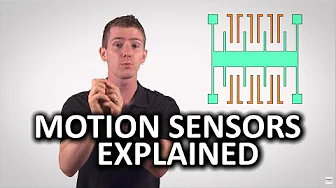
Motion Sensors as Fast As Possible
0 up · 0 down · 0 ratings
Channels and socials
Motion sensors have changed pretty significantly in the last 20 years. We even have sensors that detect their own motion! Wait... how does that work?... Audible message: Thanks to Audible for supporting our channel. Get a free audiobook of your choice at audible.com Twitter: twitter.com Facebook: @linustech Join our community forum: linustechtips.com
Motion sensors have evolved from simple motion-activated lighting to miniature, self-contained devices that can sense their own movement and even track absolute position. The video introduces MEMS, or microelectromechanical systems, with accelerometers and gyroscopes as prime examples. Accelerometers detect changes in velocity through a suspended mass whose position alters capacitance, which a device reads as movement. Gyroscopes, while similar in concept, are more attuned to rotation because they are affected by gravity, making them useful for measuring orientation. The host explains how these sensors complement each other, with gyroscopes providing rotational data and accelerometers filling in for speed and direction, while noting their limitations in free fall or relative position tracking. The discussion then expands to absolute-position sensing methods, including infrared light and camera-based trackers used in gaming systems such as the Wii, and more advanced setups like HTC Vive with lighthouse base stations. The video argues that modern systems combine MEMS, laser position sensing, and external reference frames to achieve precise tracking, enabling applications beyond gaming, including medical rehabilitation, fitness, and augmented reality. Throughout, the presenter highlights the benefits of higher frame rates and reduced lag, which translate to more natural motion control and immersive experiences. The segment closes by linking these sensing technologies to everyday devices and promising future possibilities, while also plugging Audible as a sponsor and encouraging ongoing viewer engagement.
Topics · technology · engineering · motion-sensing · gaming
Questions answered
- What are MEMS and which sensors fall under this category?
- MEMS stands for microelectromechanical systems, and it includes sensors like accelerometers and gyroscopes that are used to detect movement and rotation in compact devices.
- Why do gyroscopes help in motion sensing beyond what accelerometers provide?
- Gyroscopes measure rotation and are less affected by linear acceleration, offering orientation data that complements accelerometers, which primarily track changes in velocity and position.
- How do light-based tracking systems differ from MEMS-based sensors?
- Light-based systems use infrared emitters and cameras to determine exact positions, while MEMS sensors rely on internal mass and capacitance changes to infer motion, with lighthouse-based setups enabling precise room-scale tracking for VR.