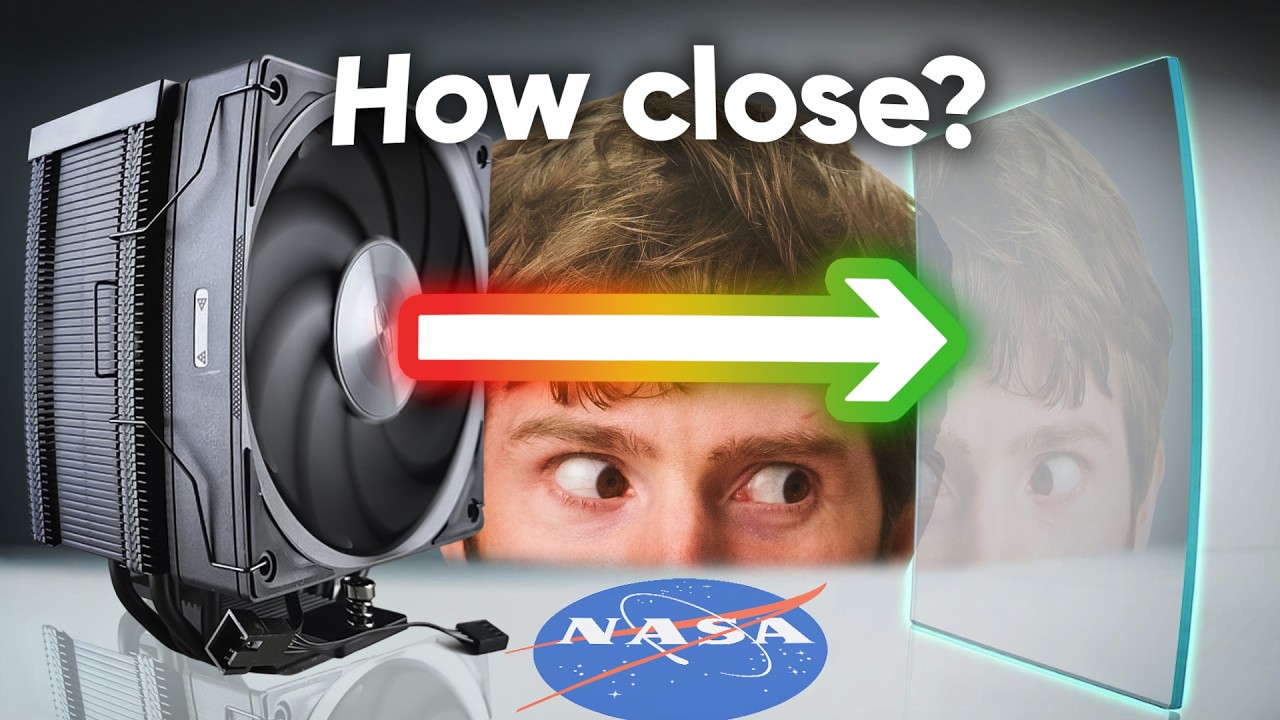
We Went to NASA To Solve a Computer Mystery - How Close is Too Close for Cooling?
0 up · 0 down · 0 ratings
Description
Thanks to UGREEN for sponsoring this video!
Check out their AI NAS lineup below! UGREEN AI NAS iDX Series bit.ly
Check Out More about UGREEN NAS nas.us.ugreen.com Link to Labs Article: lttlabs.com We went down to NASA to learn about how air works! Just how much distance does your fan really need before you've ruined it's performance? Turns out it's pretty complicated. Discuss on the forum: linustechtips.com
Channels and socials
Check out our Channel Partners: Secretlab - Grab a TITAN Evo ergonomic gaming chair: lmg.gg PIA - Get the VPN of our choice: piavpn.com dbrand - Buy a "Circuit" series skin for your device: dbrand.com ► SHOP LTT PRODUCTS: lttstore.com ► GET EXCLUSIVE CONTENT ON FLOATPLANE: lmg.gg ► DIVE DEEPER ON THE LTT LABS WEBSITE: lmg.gg ► SPONSORS, AFFILIATES, AND PARTNERS: lmg.gg Purchases made through some store links may provide some compensation to Linus Media Group. Affiliate links powered in part by affilimate.com Linus Sebastian is an investor in Framework Computer, Inc and HexOS by Eshtek. CHAPTERS ---------------------------------------------------
The video begins by identifying a widespread problem in PC case design: intake fans often starve for air due to obstructions and tight layouts. The hosts explain that even with airflow focused cases, real-world conditions like being pressed against a wall or carpet can drastically impair cooling performance. They describe a plan to quantify “how close is too close” by testing a simple fan setup with a panel distance ranging from several centimeters down to very close contact. The NASA Langley Research Center becomes the testing ground for a more rigorous aerodynamic investigation, underscoring how air behavior around a fan affects cooling. The segment blends practical PC building curiosity with high-end scientific methods to illuminate what happens to airflow when clearance is limited. The team emphasizes that the goal is to understand the airflow itself rather than relying solely on generic fan performance data, setting the stage for deeper experiments with advanced measurement techniques.
Topics · science · aerospace · aerodynamics · education
Questions answered
- What is the primary factor that limits fan cooling when a case panel is too close to the fan?
- The primary factor is the reduction in effective air intake and the development of a stalled flow region, which creates a dead zone and can cause reverse flow or highly unsteady airflow, severely reducing cooling performance.
- What measurement technique did NASA researchers use to visualize airflow around the fan?
- They used tufting to visualize flow patterns and particle image velocimetry (PIV) to quantify air velocity fields in a thin light sheet, allowing them to map how air moves away from the fan blades.
- How close can a fan be to a surface before cooling performance degrades significantly, according to the tests?
- The tests suggest that a clearance of about 15 millimeters (roughly 0.6 inches) can still provide reasonable performance, but closer than that markedly reduces cooling effectiveness and increases noise.
- Why did the team include a radiator in the later tests?
- Introducing a radiator increases back pressure and changes the flow dynamics, helping to study how a heat exchanger interacts with a restricted fan and to understand how clearance and obstruction affect real-world cooling in a more complete system.