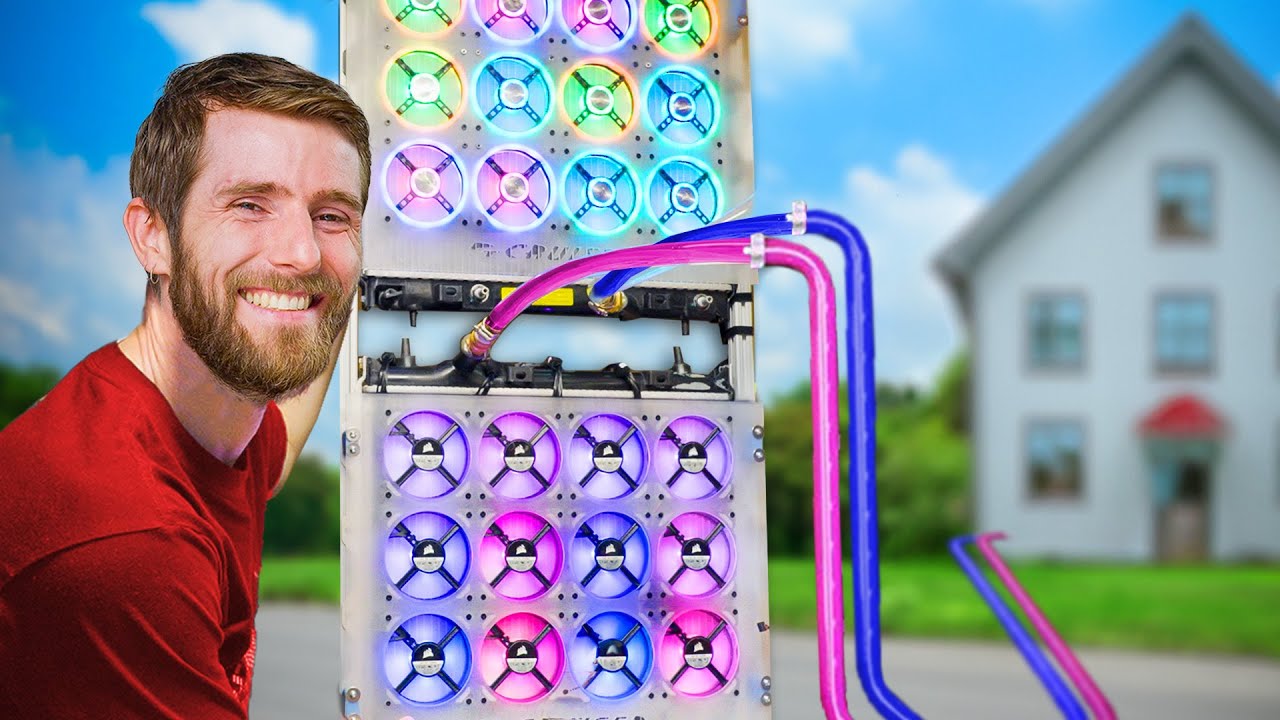
I leveled up my house water cooling! - Whole Server Room Pool Watercooling Part 5
0 up · 0 down · 0 ratings
Promos
Your business deserves a website! Create one for free at odoo.com Using the pool to cool Linus' computers is working great... for the computers. For the humans though it is too dang hot. Discuss on the forum: linustechtips.com ► GET MERCH: lttstore.com ► GET EXCLUSIVE CONTENT ON FLOATPLANE: lmg.gg ► SPONSORS, AFFILIATES, AND PARTNERS: lmg.gg ► EQUIPMENT WE USE TO FILM LTT: lmg.gg ► OUR WAN PODCAST GEAR: lmg.gg FOLLOW US --------------------------------------------------- Twitter: twitter.com Facebook: @LinusTech Instagram: @linustech TikTok: @linustech Twitch: twitch.tv MUSIC CREDIT --------------------------------------------------- Intro: Laszlo - Supernova Video Link: youtube.com iTunes Download Link: itunes.apple.com Artist Link: soundcloud.com Outro: Approaching Nirvana - Sugar High Video Link: youtube.com Listen on Spotify: spoti.fi Artist Link: youtube.com Intro animation by MBarek Abdelwassaa @mbarek_abdel Monitor And Keyboard by vadimmihalkevich / CC BY 4.0 geni.us Mechanical RGB Keyboard by BigBrotherECE / CC BY 4.0 geni.us Mouse Gamer free Model By Oscar Creativo / CC BY 4.0 geni.us CHAPTERS --------------------------------------------------- 0:00 - Intro 1:16 - Odoo! 1:27 - Thermal Camera Investigation 3:26 - The Plan 6:05 - Is it heating the pool? 6:54 - PT Cruiser rad mounting 11:49 - The RGB is glorious, final plumbing 14:01 - Turning it on 15:55 - Power adapter cooling 17:18 - Did it work? 19:29 - Odoo! 20:19 - Outro
The video documents a major upgrade to Linus Tech Tips’ house water cooling project, focusing on cooling the entire server room with a pool-based loop. The opening segment reviews the current system’s performance after a FurMark stress test, noting that the pool loop cools water to around 30 C while the heat exchanger raises the warm water to about 34 C, leaving an eight degree delta overall. The hosts explain that cooling the room itself remains a challenge because the hot side water returns around 40 C, which is uncomfortable for humans and some equipment, so they pivot to a mixed strategy that also cools the room while keeping the machines themselves chilly. They plan to add two PT Cruiser radiators fed by pool water to improve room conditions, while also preserving the computer cooling benefits. The narrative emphasizes the tension between achieving optimal cooling for hardware and maintaining a breathable, quiet working environment, leading to considerations about noise, door placement, and thermal management. The segment also includes a thoughtful aside about sponsorship and a reminder that more improvements and experiments are coming, setting a tone of iterative engineering and community engagement.
Topics · science & technology · home improvement · computer hardware · cooling systems
Questions answered
- What is the main cooling strategy being tested in this video?
- The main strategy is to use pool water to cool a set of PT Cruiser radiators that in turn cools the server room water, with the goal of reducing the room temperature while keeping the computer loop adequately cooled.
- Why is it important to consider the order of components in the cooling loop?
- Because the temperature delta between the hottest and coldest points in this setup can be several degrees, unlike a standard PC loop where the delta is small, so the arrangement of flow paths affects overall cooling efficiency.
- Did the pool cooling approach lower the room temperature significantly?
- Yes, the team reported a drop of about five degrees in the room temperature after implementing the second cold loop and radiator changes, making the space more habitable.
- What safety concerns are raised by the viewers?
- Viewers point out potential overloading of cables and power adapters, suggesting caution with Molex to SATA connections and advising robust power handling for multiple RGB controllers and fans.
- What future improvements are hinted at in the video?
- Possible improvements include refining plumbing, better mounting solutions, more robust cable management, and potentially more efficient long-term heat dissipation strategies for the room.