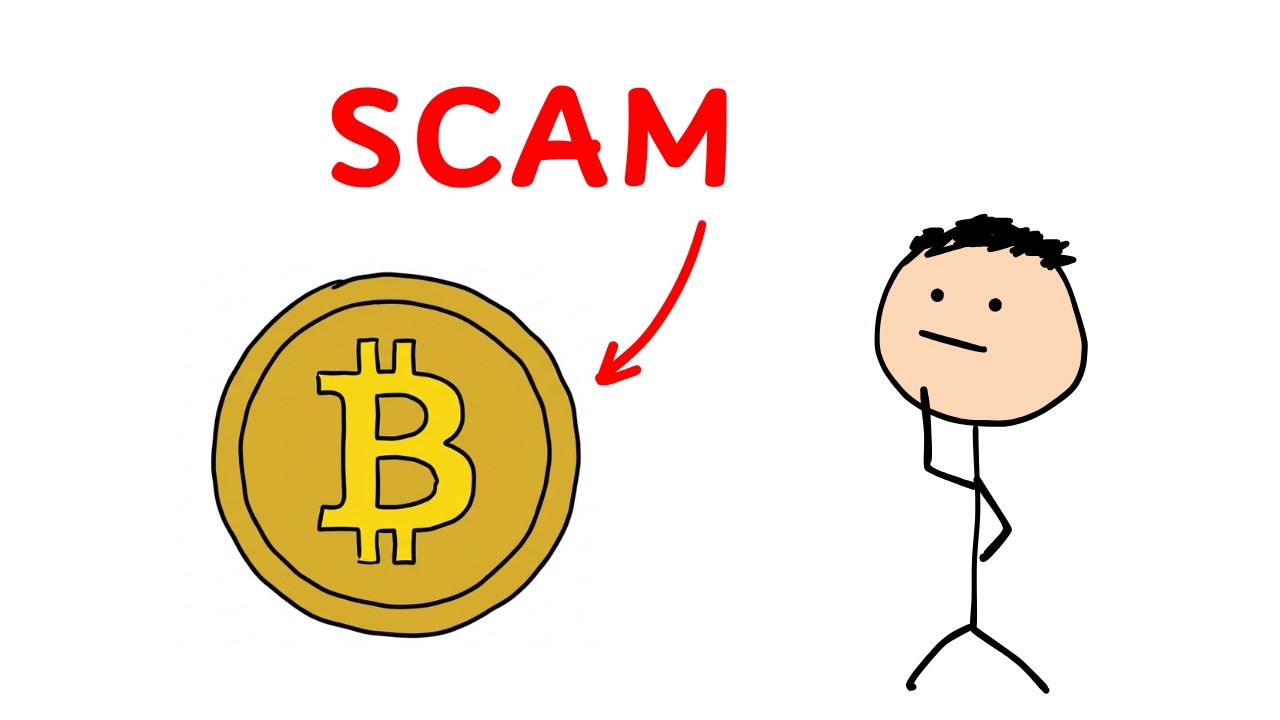
Bitcoin Is a Brilliant Scam and I Can Prove It (Again)
0 up · 0 down · 0 ratings
Channels and socials
Everyone thinks they understand Bitcoin... but they don't. Because if Bitcoin is the future of money, why does it fail the most basic tests? In this video, I'll break down: • Why Bitcoin fails the currency test • The real reason Bitcoin hasn't been adopted as a global currency • What the El Salvador experiment actually revealed • The hidden risks behind Bitcoin's ownership • How the Greater Fool Theory drives Bitcoin's price Complex topics, simple breakdowns. Join my free weekly newsletter to stay ahead of what's actually happening in markets: casualmarkets.co (All illustrations, visuals, and animations in this video are original and hand-drawn by a freelance artist) Disclaimer: The information provided in this video and on this channel (collectively, the “Content”) is for informational, educational, and entertainment purposes only and does not constitute investment, financial, legal, or tax advice, nor a recommendation to buy, sell, or hold any security or investment strategy. Investing involves risk and you must do your own research. Nothing in the Content should be interpreted as creating a fiduciary relationship, financial advisory relationship, or client relationship of any kind. The host, the channel, and all affiliated entities expressly disclaim any and all liability for any direct or consequential loss or damage arising directly or indirectly from the use of, reliance upon, or interpretation of the Content. By viewing or interacting with the Content, you acknowledge and agree to these terms and release the host and all related parties from any and all claims related to your reliance on the information provided. #cryptocurrency #crypto #finance #investing #bitcoin
The host returns with a renewed critique of Bitcoin and frames it as part of a broader pattern of fragile crypto narratives. He recalls earlier videos criticizing MicroStrategy as a leveraged bet on Bitcoin, saying MicroStrategy has since lost nearly $100 billion in market cap and that its stock is down more than 50%. He then argues that earlier concerns about the crypto industry also proved out, describing a large global market value decline after his previous critiques. From there, he positions Bitcoin as the “foundation” of the industry and claims its price is driven by repeated narratives such as “digital gold,” “future of money,” and “hedge against inflation and corruption.” He says the way to evaluate Bitcoin is to test what it is supposed to do rather than rely on changing technology promises. He argues that Bitcoin fails the basic economic tests for money by claiming it does not meet the requirements for medium of exchange, store of value, and unit of account. For medium of exchange, he says Bitcoin is slow and expensive, citing about half a million transactions per day versus Visa at roughly 65,000 transactions per second, and he adds a carbon and electricity comparison for a single transaction. For store of value, he claims Bitcoin is historically highly volatile, giving an example volatility level of about 20% in a single month, and he also argues ownership is concentrated, claiming roughly 2% of addresses control 95% of the supply. For unit of account, he says businesses that accept Bitcoin still price in dollars and only convert to Bitcoin at payment time, so Bitcoin does not function as a stable pricing standard. He then points to the El Salvador experiment as a real world test, describing the Chivo wallet, a $30 incentive, and legal tender adoption, and he claims that Bitcoin accounted for less than 2% of remittances, while most remittances continued through traditional systems, with additional claims that many users downloaded Chivo mainly for the incentive. He concludes that Bitcoin’s value, once stripped of narratives, is explained through greater fool theory, where price rises because buyers expect later buyers to pay more, and he argues the cycle continues only while new buyers keep entering.
Viewers largely praise the video as a well thought out, entertaining breakdown and many treat the critique as “comedy” or “peak comedy,” especially when crypto ads appear right after the upload. A recurring sentiment is skepticism toward Bitcoin, with comments emphasizing laughs about timing, “bottom signal” humor, or jokes about FOMO buyers and coming “told you so” moments. Some viewers agree strongly with the argument structure and thank the creator for supporting their skepticism. Several commenters push back by mentioning Bitcoin Lightning as a missing counterpoint and dispute comparisons like carbon footprint and volatility versus gold. Other recurring themes include requests for further topics such as MSTR short ideas, derivative markets, and deeper discussion of miners and electricity costs, plus a few comments about real world utility for people facing sanctions.
Topics · education · finance · markets · economics · business · stock market
Questions answered
- Why does the host argue Bitcoin fails the medium of exchange test?
- The host argues Bitcoin is slow and inefficient for payments, citing transaction throughput and comparing Bitcoin’s transaction volume and cost to Visa, and he adds energy and carbon related costs per transaction.
- What three criteria does the host say economists use to evaluate whether something functions as money?
- The host uses three criteria, medium of exchange, store of value, and unit of account, and he evaluates Bitcoin against each.
- What does the host claim is the main reason Bitcoin has not been widely adopted as a global currency?
- The host claims it has not been adopted because it does not perform well as a medium of exchange, does not reliably preserve purchasing power due to volatility, and does not serve as a stable unit of account for pricing.
- What does the host claim the El Salvador experiment revealed about Bitcoin adoption?
- The host claims Bitcoin remained a very small share of remittances, with most remittances still sent through traditional systems, and he argues many Chivo downloads were driven by the incentive rather than continued usage.
- How does the host explain Bitcoin’s price using greater fool theory?
- The host explains price as driven less by cash flows or utility and more by belief that a later buyer will pay a higher price, which creates demand and a feedback loop as long as new buyers keep entering.