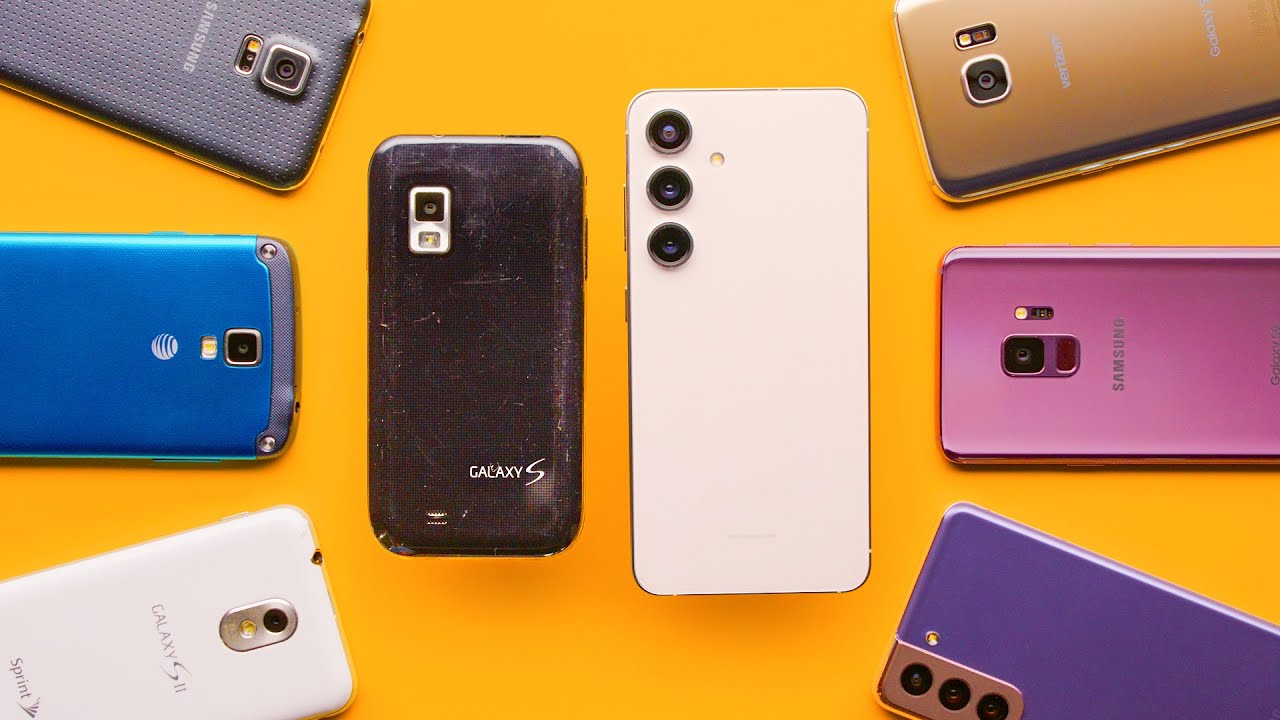
Reviewing EVERY Samsung Galaxy S Ever!
0 up · 0 down · 0 ratings
Promos
There have been countless Galaxy S phones in 14 years. Let's take a look at every single one of them! Get a dbrand grip case for your Galaxy S 24 at dbrand.com 0:00 Intro 3:13 Galaxy S 1 6:20 Galaxy S 2 7:35 Galaxy S3 9:45 Galaxy S4 12:40 Galaxy S5 14:47 Galaxy S6/Edge 19:24 Galaxy S7 21:22 Galaxy S8 25:40 Galaxy S9 27:77 Galaxy S10/S10e 30:35 Galaxy S20/FE 33:40 Galaxy S21 34:57 Galaxy S22 36:24 Galaxy S23 37:59 Galaxy S24 39:46 The Graphs! MKBHD Merch: shop.mkbhd.com Tech I'm using right now: amazon.com Intro Track: youtube.com Playlist of MKBHD Intro music: goo.gl ~ twitter.com @MKBHD @MKBHD
This video presents a comprehensive, retroactive tour through every Samsung Galaxy S model released to date, anchored by the host’s personal ownership history and hands-on impressions. It begins with context about the Galaxy S line, explaining the naming origins and how Samsung expanded the lineup with many variants across carriers, price tiers, and feature sets. The host frames the S series as Samsung’s flagship project evolving from simple, pocketable devices to high-end supercomputers in the palm of the user’s hand, emphasizing the dramatic shifts in design, materials, display technology, and battery life over time. Across the first segment, the video revisits the original Galaxy S from 2010, highlighting its 4-inch AMOLED display, removable back and battery, microSD expansion, and early camera capabilities, while noting how carrier-tuned variants began a long era of model fragmentation. The narration then moves through the Galaxy S2 and S3, focusing on meaningful upgrades such as faster CPUs, larger screens, improved cameras, and the onset of premium materials like metal and glass that defined later generations. The host paints a clear arc from the S1 era to the S4 and S5, calling attention to the introduction of features like NFC, fingerprint sensors, higher-capacity batteries, and early water resistance, which gradually reframed consumer expectations about durability and capability. The mid-range and edge-oriented experiments start to dominate around S6 through S8, where Samsung experimented with glass backs, wireless charging, edge displays, and even a failed bifurcation with Exynos versus Snapdragon chip variants, underscoring the company’s willingness to risk new ideas for potential rewards. The S9-S10 era is described as a peak of bold experimentation and design language, with dual aperture cameras, the reintroduction of microSD storage, and a push toward a nearly bezel-free front, culminating in the S10’s 2019 design language that solidified modern Samsung aesthetics. The analysis then covers the S20 series and the S21/S22/S23 generations, noting the shift toward a more uniform design language, the emergence of the Ultra subline, the removal and reintroduction of features like headphone jacks, and the move to higher refresh rates and 5G capabilities, followed by the more refined but still aggressively feature-laden S24. Throughout, the host contrasts each generation against contemporaries and highlights how price, battery, camera systems, and software skins (notably TouchWiz and later One UI variants) influenced user perception and real-world usability. The narrative frequently returns to the central theme that Samsung balanced audacious experimentation with practical compromises, such as removing microSD on base models, adopting unified chip choices in newer generations, and continually refining screen technology to maximize screen-to-body ratio while maintaining durability. The video concludes with a nod to the current design language, where the S24 and related flagships emphasize AI features, general performance, and a mature ecosystem, while also referencing ongoing debates about the value of bold experimentation versus consistent refinement. Across the full journey, the host uses clear, concrete examples, timelines, and personal anecdotes to illustrate how far Samsung has come from the original Galaxy S to the present day, and how those shifts have shaped consumer expectations for flagship Android devices. The closing graphs section offers a visual recap of key dimensions like battery, cameras, and displays, reinforcing the overall narrative of evolution from simple hardware to sophisticated, AI-assisted smartphones. The video ends by acknowledging that, despite periods of controversy or mixed reactions to certain features, Samsung’s willingness to push boundaries has continually redefined what a Galaxy S can be, shaping the broader Android landscape.
Topics · technology · mobile devices · consumer electronics · history · smartphones
Questions answered
- Welke Galaxy S-modellen worden genoemd als de hoogtepunten van Samsung's ontwerpevolutie?
- Hoogtepunten genoemd in de video zijn onder meer de Galaxy S8 en S10 vanwege hun design, edge-schermen, en introductie vanFramebuffer- en camera-innovaties.
- Wat is een belangrijke trade-off die Samsung maakte tussen S-Generaties en chipkeuzes?
- Een belangrijke trade-off was de afwisseling tussen Exynos- en Snapdragon-chips per regio, wat resulteerde in verschillende prestaties en energieverbruik afhankelijk van waar het toestel werd verkocht.
- Welke/vector/selectie van features werd op de S5 geïntroduceerd die later werd aangepast?
- De S5 introduceerde waterbestendige features en een dubbele micro-USB/USB-C-technologie met speciale kabel, met later controverse en afgedwongen aanpassingen.
- Welke positie innam de S10 ten opzichte van de mate van scherm-naar-lichaam verhouding?
- De S10 markeerde een hoogtepunt in scherm-naar-lichaam verhouding met near-bezels en de camera in de uitsparing aan de bovenkant.