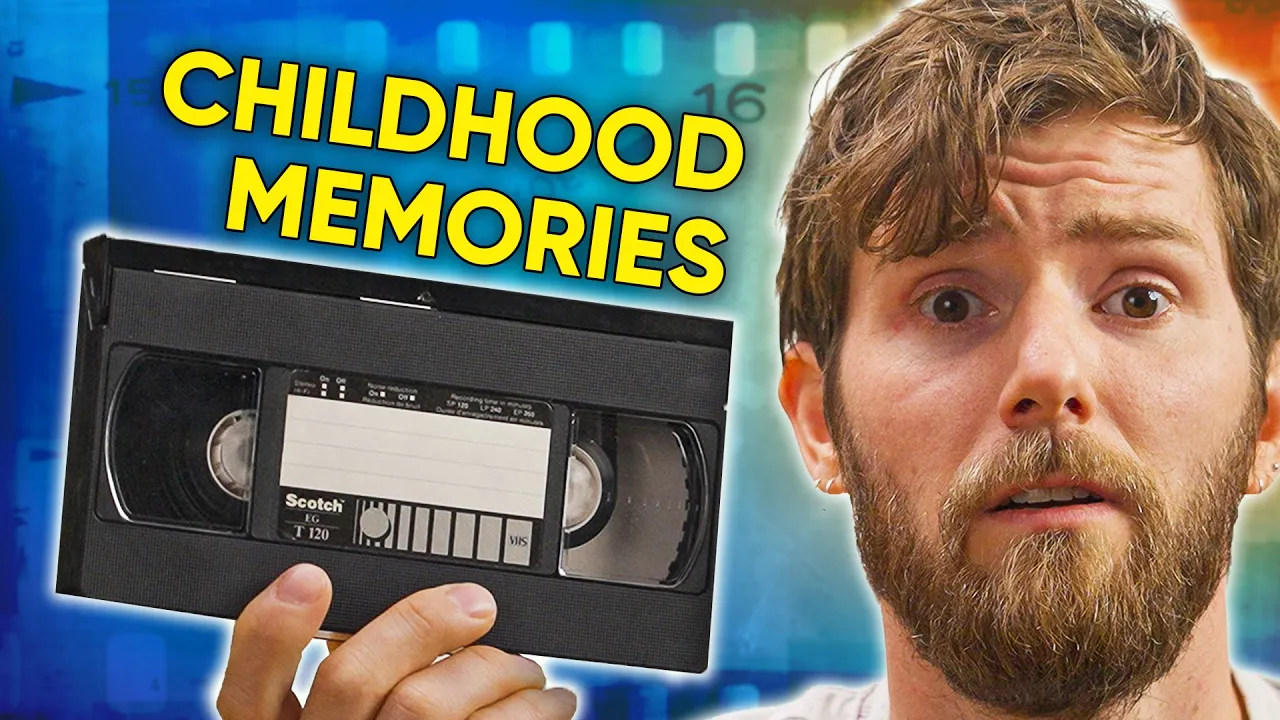
I Thought My Childhood was LOST
0 up · 0 down · 0 ratings
Promos
Get $25 off all pairs of Vessi Footwear with offer code LinusTechTips at vessi.com
Check out Crucial's gaming products at crucial.gg Linus tries to backup some embarrassing VHS tapes from his childhood with the help of Mark's VCR. Discuss on the forum: linustechtips.com ► GET MERCH: lttstore.com ► SUPPORT US ON FLOATPLANE: floatplane.com ► AFFILIATES, SPONSORS & REFERRALS: lmg.gg ► PODCAST GEAR: lmg.gg FOLLOW US --------------------------------------------------- Twitter: twitter.com Facebook: @LinusTech Instagram: @linustech TikTok: @linustech Twitch: twitch.tv MUSIC CREDIT --------------------------------------------------- Intro: Laszlo - Supernova Video Link: youtube.com iTunes Download Link: itunes.apple.com Artist Link: soundcloud.com Outro: Approaching Nirvana - Sugar High Video Link: youtube.com Listen on Spotify: spoti.fi Artist Link: youtube.com Intro animation by MBarek Abdelwassaa @mbarek_abdel Monitor And Keyboard by vadimmihalkevich / CC BY 4.0 geni.us Mechanical RGB Keyboard by BigBrotherECE / CC BY 4.0 geni.us Mouse Gamer free Model By Oscar Creativo / CC BY 4.0 geni.us CHAPTERS --------------------------------------------------- 0:00 Intro 1:18 Will this work? 3:40 What makes a GOOD VCR? 6:49 What else you'll need 9:44 WATCHING THE TAPES 13:04 The capture setup 13:34 TEENAGE LINUS 19:01 Linus tries French 19:39 Improving the quality 21:15 Bad Backup strategies 23:15 Outro
I thought My Childhood was LOST is a Linus Tech Tips episode that takes viewers on a hands-on archival journey, showing how to salvage and digitize old VHS tapes from a personal stash. The video opens with a clear goal: determine whether the aged tapes still contain usable footage and then capture that footage with the best possible quality. Linus teams up with Mark, a VHS digitization expert, to assess the physical condition of the tapes, explain common failure modes, and discuss practical gear for a clean transfer. Early on, Mark outlines the dual challenge of preserving content while mitigating the degradation introduced by storage, heat, and humidity, especially for tapes stored in attic spaces. The conversation then shifts to the hardware chain required for a high-quality capture, highlighting the importance of four-head VCRs, proper anti-ghosting features, and the role of time base correction in stabilizing analog video. This segment also touches on the realities of finding reliable gear today, including the scarcity of functioning VCRs and the cost of professional-grade machines, setting the stage for a deeper dive into a DIY pipeline that balances quality and cost. The team then demonstrates the capture process, showing the exact steps from loading a tape to selecting capture settings, using OBS, and choosing 525i as a baseline resolution to preserve original data fidelity. The narrative evolves into hands-on experimentation with various interfaces, from SDI devices to external converters, and compares capture paths with legacy analog outputs and modern upscaling approaches. A parallel thread in the video is Linus’ playful dive into teenage francophone footage, which doubles as an entertaining demonstration of how archives can reveal personal history and language development across decades. The duo discusses the ethical and practical aspects of preserving memories, emphasizing the nontrivial nature of long-term archival reliability and the need to maintain master copies and safe backups. Finally, the video culminates in a live viewing of a Friends intro, a Quebec camp performance, and a humorous reveal of the era’s VHS-typical ad breaks, all of which underscore how digitization can uncover surprising context while also exposing the fragility of home archives. The closing sections connect this technical journey to broader themes of data preservation, arguing that owning physical media does not guarantee accessibility years later and inviting viewers to consider robust, scalable backup strategies beyond cloud storage alone. The sponsor segment then rounds out the content with a practical plug, bridging the technical exploration with consumer products that support the channel, before the team reflects on the value of archival work for future generations and teases potential follow-up on more tapes. In sum, the video is both a practical guide to preserving VHS memories and a thoughtful meditation on the resilience and limits of analog media in a digital age, offering concrete steps, cautionary tales, and a sense of shared curiosity about our collective media past.
Topics · technology · archival · video preservation · retro tech · how-to · vintage media · digital transformation
Questions answered
- What is the first key factor when attempting to salvage a VHS tape for digital transfer?
- Assess the tape condition and read quality, since degraded tapes require careful capture to maximize data retrieval and future upscaling potential.
- Why is a four-head VCR recommended for preserving VHS content?
- Four-head VCRs read more accurately, providing better deinterlacing and overall picture quality during playback, which improves the fidelity of the captured video.
- What is the role of a time base corrector in analog video capture?
- A TBC helps stabilize timing and reduce artifacts, resulting in cleaner captures and easier downstream processing.
- What capture workflow does the video illustrate for VHS to digital?
- Use OBS for capture at a faithful baseline resolution (like 525i), then potentially deinterlace and upscale with tools such as Topaz Gigapixel AI for best results.
- What is a practical archival takeaway from the video?
- Keep masters, back up to multiple formats, and avoid relying solely on cloud storage, since access to old formats and hardware may degrade or disappear over time.