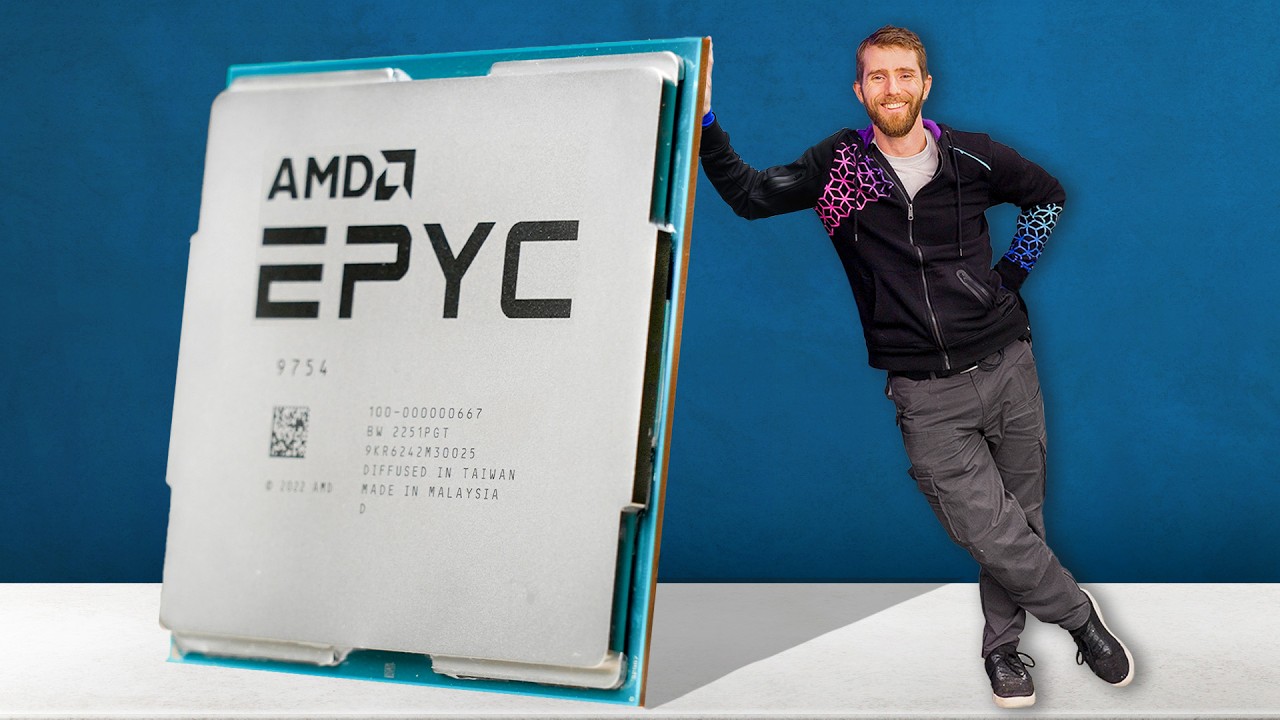
AMD’s 128 Core MONSTER - Epyc Bergamo
0 up · 0 down · 0 ratings
Promos
Your business deserves a website! Create one for free at odoo.com AMD has done it again, cramming 128 cores into their 4th generation EPYC server CPU and calling it ‘Bergamo’. But what exactly is Zen4c, and what’s it supposed to do? Discuss on the forum: linustechtips.com Special thanks to @wolfmanmods1428 Purchases made through some store links may provide some compensation to Linus Media Group. ► GET MERCH: lttstore.com ► GET EXCLUSIVE CONTENT ON FLOATPLANE: lmg.gg ► SPONSORS, AFFILIATES, AND PARTNERS: lmg.gg ► EQUIPMENT WE USE TO FILM LTT: lmg.gg ► OUR WAN PODCAST GEAR: lmg.gg FOLLOW US --------------------------------------------------- Twitter: twitter.com Facebook: @LinusTech Instagram: @linustech TikTok: @linustech Twitch: twitch.tv MUSIC CREDIT --------------------------------------------------- Intro: Laszlo - Supernova Video Link: youtube.com iTunes Download Link: itunes.apple.com Artist Link: soundcloud.com Outro: Approaching Nirvana - Sugar High Video Link: youtube.com Listen on Spotify: spoti.fi Artist Link: youtube.com Intro animation by MBarek Abdelwassaa @mbarek_abdel Monitor And Keyboard by vadimmihalkevich / CC BY 4.0 geni.us Mechanical RGB Keyboard by BigBrotherECE / CC BY 4.0 geni.us Mouse Gamer free Model By Oscar Creativo / CC BY 4.0 geni.us CHAPTERS --------------------------------------------------- 0:00 Intro 1:18 How did they do it? 3:24 Let's Build! 7:17 Picking a lane 9:54 This deserves a case 12:15 Taking it for a little spin 16:00 Not so delicious after all 17:05 Don't try this at home. Or work. Or anywhere. 18:13 It had to happen. 22:28 Outro
AMD’s 128 core monster, Bergamo, is the centerpiece of this detailed exploration into the newest EPYC family. The host walks through how AMD achieved the high core count by using Zen 4C cores arranged in eight 16-core dies within the same IO die used by Genoa, then discusses the trade-offs, including reduced L3 cache and lower clock speeds. The video delves into the hardware platform, starting with the impressive ASRock Genoa 8UD-2T slash X550 motherboard that supports massive PCIe Gen 5 expansion, multiple memory channels, and a large PCIe lane count, highlighting the sheer IO density of Bergamo. The build segment covers intriguing installation steps, from the SP5 socket and memory configuration to the power delivery scheme and the unusual ATX power arrangement, all demonstrated with the host’s characteristic mix of humor and hands-on problem solving. Then the host runs a series of benchmarks to gauge performance, including Cinebench and a threaded workload test, comparing Bergamo to a Threadripper and noting the strong multi-core performance. Finally, real-world considerations such as cooling, thermals, and the limitations of the single-server form factor are discussed, along with takeaways on the market trajectory for EPYC and the broader datacenter ecosystem. In the opening, Bergamo is framed as a “monster CPU” that is still interesting to the average viewer because its architectural choices may trickle down into consumer hardware. The host emphasizes Zen 4C’s tighter core packing and explains that although Bergamo offers 128 cores, it does so with a trade-off in clock speed and L3 cache, which is rationalized by a cloud-native workload model. The video then pivots to the motherboard and IO capabilities, underscoring the platform’s extraordinary PCIe Gen 5 throughput and memory bandwidth, and it explains why the dense socket area and high pin-count are necessary for dependable operation. The assembly sequence illustrates the practical challenges of mounting such a processor, including torque considerations and the importance of proper torque sequencing to ensure all connections are reliable. As the build progresses, the host evaluates memory options, power supply constraints, and the overall layout, painting a picture of Bergamo as a highly capable but specialized datacenter component rather than a consumer-ready chip. The commentary around cloud-native workloads provides context for Bergamo’s architectural decisions, linking core counts, cache behavior, and virtualization-friendly design to real-world use cases like search, social platforms, and cloud infrastructure. The host revisits how Bergamo’s Zen 4C cores deliver performance with a tighter footprint, enabling higher density in datacenter deployments while still preserving essential features and compatibility with PCIe and memory standards. The RAM configuration is examined in detail, noting eight memory channels and the difficulty of leveraging a full terabyte of memory due to form-factor constraints, and the implications of eight-channel operation for throughput and latency. The discussion on PCIe lanes continues with a tour of the IO-rich motherboard layout, including MCIO connectors, breakout cables, and the remaining unutilized lanes, illustrating how Bergamo doubles as a PCIe switch as much as a CPU. The narrative then shifts to performance exploration, including clock behavior across cores, turbo patterns, and how Zen 4C’s core density impacts single-threaded vs multi-threaded workloads. Benchmarking is used to anchor Bergamo’s capabilities in tangible numbers, beginning with Cinebench R23 and moving to Cinebench R24, where Bergamo demonstrates impressive multi-core throughput, even when compared to a powerful Threadripper kit. The clock distribution is described as highly variable, with many cores boosting to around 2.8–3.1 GHz while some cores linger near 2.6 GHz, a consequence of the 360 W default TDP and the Zen 4C design. Thermal performance emerges as a critical factor in day-to-day performance, with the host noting that thermal throttling limited the observed throughput when the cooling solution was not perfectly aligned to the heat load, prompting a lighthearted but practical discussion about improving airflow and heat dissipation. The video closes with reflections on the datacenter market, underscoring Bergamo’s leadership in core counts and IO, the competitive response from Intel, and the likely continued evolution of EPYC CPUs, while acknowledging that consumer gaming and desktop workloads will not directly mirror server-class performance. The overall message is that Bergamo represents a significant step in datacenter hardware, combining high core density with extensive IO and memory capabilities, while also highlighting the challenges of cooling, power delivery, and form-factor constraints. The host frames Bergamo as a catalyst for broader industry trends, suggesting that innovations in server CPUs can filter down into consumer platforms over time, even if Bergamo itself remains primarily a data center workhorse. The video ends with a nod to archival hardware and a tease for related EPYC content, inviting viewers to explore Genoa and other AMD server platforms to understand the full landscape. Viewers are left with a clear sense of Bergamo’s potential impact on cloud-native workloads and the ongoing race between major CPU vendors to deliver ever-higher core counts with robust IO ecosystems.
Topics · technology · computing · hardware · data_center · servers · cloud_computing · benchmarking
Questions answered
- What is Zen 4C and how does Bergamo differ from regular Zen 4 cores?
- Zen 4C cores are a denser packing of cores compared with regular Zen 4, allowing up to 256 cores in a 2P setup, but with reduced cache and clock speeds to fit more cores into the same die area.
- Why does Bergamo have so many PCIe lanes and how does that affect its use in data centers?
- Bergamo uses a highly IO-dense design that packs many PCIe Gen 5 lanes, effectively turning the CPU into a PCIe switch as well as a processor, which benefits dense server and storage configurations typical in data centers.
- What workload characteristics justify Bergamo’s architecture in cloud-native environments?
- Cloud-native workloads often involve contained cores with limited cross-core cache sharing, making higher core counts with Zen 4C cores advantageous for parallelizable tasks and scalable microservices.
- What were the major thermal and power challenges observed in the build and testing?
- The build showed thermal throttling due to imperfect cooling alignment, and the power delivery system was stressed by the 360 W to 400 W rated cooler, illustrating real-world limits of high core-count server CPUs in compact form factors.
- How does Bergamo compare to consumer or desktop CPUs in gaming or single-threaded tasks?
- Bergamo is not optimized for consumer gaming or high single-thread performance; its strengths lie in multi-threaded and cloud workloads, where many cores can be utilized concurrently.