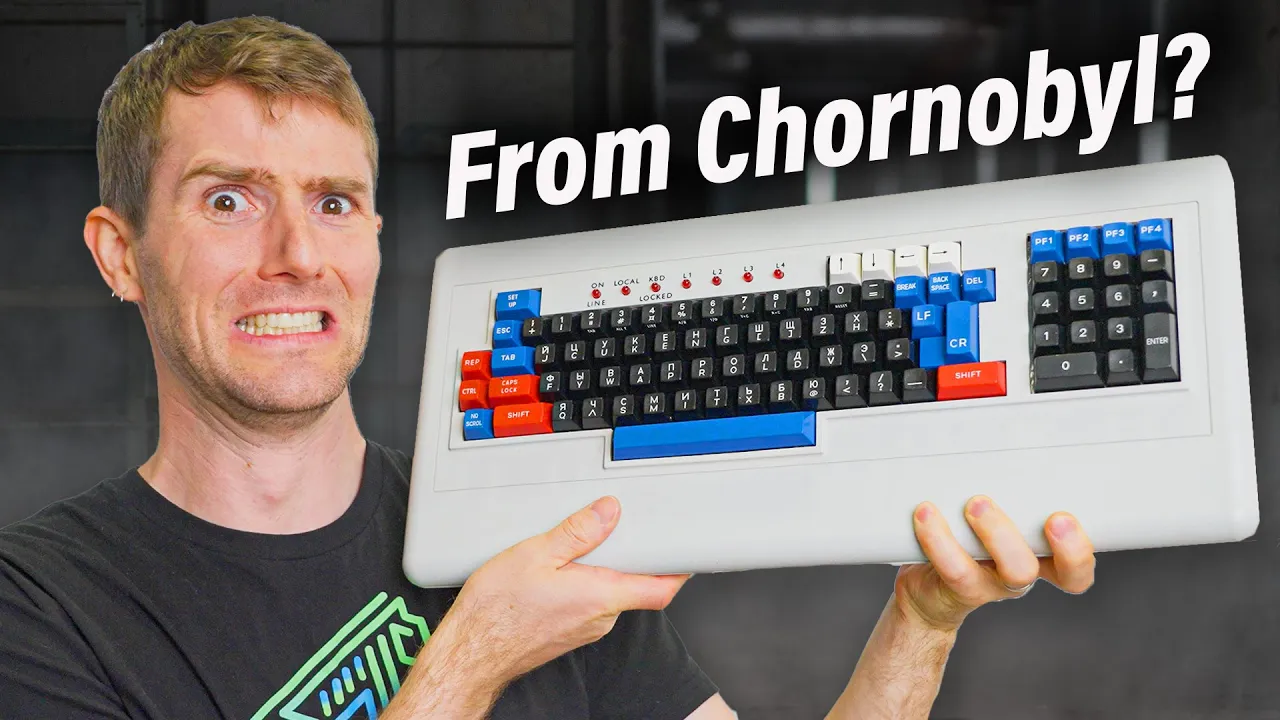
I Tried Gaming on a Soviet Hall-Effect Keyboard
0 up · 0 down · 0 ratings
Promos
Thanks to MANSCAPED for sponsoring today's video. Get 20% Off + Free International Shipping with promo code LINUSTECH or visit manscaped.com Learn more about the HelloCam Pro at: lmg.gg After our ‘success’ with the Soviet mouse, we just HAD to try out this keyboard when we spotted it on eBay! Imagine our surprise when we spotted the same model in the ruins of Chernobyl! Discuss on the forum: linustechtips.com ► GET MERCH: lttstore.com ► GET EXCLUSIVE CONTENT ON FLOATPLANE: lmg.gg ► GET A VPN: piavpn.com ► SPONSORS, AFFILIATES, AND PARTNERS: lmg.gg ► EQUIPMENT WE USE TO FILM LTT: lmg.gg ► OUR WAN PODCAST GEAR: lmg.gg FOLLOW US --------------------------------------------------- Twitter: twitter.com Facebook: @LinusTech Instagram: @linustech TikTok: @linustech Twitch: twitch.tv MUSIC CREDIT --------------------------------------------------- Intro: Laszlo - Supernova Video Link: youtube.com iTunes Download Link: itunes.apple.com Artist Link: soundcloud.com Outro: Approaching Nirvana - Sugar High Video Link: youtube.com Listen on Spotify: spoti.fi Artist Link: youtube.com Intro animation by MBarek Abdelwassaa @mbarek_abdel Monitor And Keyboard by vadimmihalkevich / CC BY 4.0 geni.us Mechanical RGB Keyboard by BigBrotherECE / CC BY 4.0 geni.us Mouse Gamer free Model By Oscar Creativo / CC BY 4.0 geni.us CHAPTERS --------------------------------------------------- 0:00 Intro 1:06 What is it? 2:45 That ain't right 4:15 What's going wrong? 6:44 How do we fix it? 7:24 Tetris 10:01 Doom 11:15 The Best? 13:04 Credits
The video begins by introducing the Consul 262.4, a hall-effect keyboard built in 1989 in the Czechoslovak Socialist Republic, highlighting its Soviet-era production and the fact that it found its way into locations like the Chernobyl nuclear power plant. The host describes the surprising possibility of gaming on this device, framing the keyboard as both impressive and flawed, with the lab’s previous success with an older Soviet mouse setting expectations high. Early on, the troubleshooting mindset is established as they tackle the DA15 style game port and the need to provide specific electrical signals, including a clock pulse, ground, and power rails, to get any usable output. The team uses a Raspberry Pi Pico to generate a 16x clock signal and to read serial data, feeding it through USB as a custom USB-HID device, effectively turning the antique hardware into a modern input peripheral. As the debugging unfolds, the input shows that multiple keys produce the same output due to ROM chips and a keyboard controller translating a nine-bit parallel signal into ASCII, revealing the complexity hidden inside the hardware. The narrative then shifts to a deeper diagnostic, using a Rohde Schwarz ASCII mode to visualize raw data and identify where the output deviates from expected behavior, leading to the realization that one ROM chip is broken and that the keyboard’s design limits repeated key presses. The host explains the importance of schematics and how an open, fault-tolerant path through ROMs and a UART would be needed for faithful key-to-byte translation, and why the project benefits from stepping back to map signals from the connector toward the controller and ROMs. With this groundwork, the video explains the repair strategy: intercept the signals before the broken ROMs by substituting custom lookup tables on a microcontroller and re-emulating the keyboard as a USB device. The presenter humorously references a separate sponsorship and shows how modular upgrades, like a USB interface and a better cable management setup, are used to support the retro gaming experiment. In the peak experimental sections, the team attempts to game using the Soviet keyboard for Tetris and a Doom run, grappling with quirky input behavior such as the lack of true key repeat and unusual key mappings, all while noting the nonstandard behavior of the keyboard matrix and the need to adjust delays to achieve playable response. The final assessment highlights that while the keyboard remains technically imperfect, its actuation feel is surprisingly consistent due to the steel backplane, supporting the assertion that it is among the best keyboards the team has tested despite its age and idiosyncrasies, and it demonstrates that careful modification can unlock its potential for modern gaming. The video closes with a nod to prior Soviet-era peripherals and a call back to the moral of the project: curiosity about old tech is rewarded when you trace signals carefully, even if the path is not perfectly straightforward.
Topics · technology · gaming · retro computing · hardware hacking
Questions answered
- Hvordan fungerer hall-effekt tastaturet og hva gjorde teknikerne for å få det til å virke som et spillinput-enhet?
- De brukte en Raspberry Pi Pico til å generere en klokke på 16 ganger frekvensen og leste seriell data, som ble sendt ut over USB som et USB-HID-enhet. De identifiserte at ROM-brikkene og UART hadde begrensninger, og byttet ut datauttaket med egendefinerte oppslags-tabeller slik at tastetrykk kunne oversettes til meningsfulle bytes.
- Hva var hovedutfordringen som hindret perfekt gamingopplevelse på dette tastaturet?
- Hovedutfordringen var at en av ROM-brikkene var defective og at tastaturet brukte en uvanlig to-nivå dataord og en spesifikk prosessorlogikk som hindret riktig repeat-funksjon og konsistente tastetrykk, noe som krevde intercepjon av signaler før ROM-ene og tilpasning av oppslags-tabeller.