Why the Era of US Dominance is (Mathematically) Over
0 up · 0 down · 0 ratings
Channels and socials
Try Genspark with free credits available upon signup bit.ly #Genspark #WorkwithGenspark Follow Genspark here: @GensparkProduct The US dollar's share of global reserves just hit the lowest level in more than 25 years. And somehow, nobody's freaking out about it. In this video, I'll break down: • How being the global reserve currency saves the US over $200B annually • Why every major crisis since 2008 has chipped away at the dollar • Why the dollar is quietly losing its dominance • Why optionality is the real threat to the dollar • The secret advantages America gets from running the global financial system Complex topics, simple breakdowns. Join my free weekly newsletter to stay ahead of what's actually happening in markets: casualmarkets.co All illustrations, visuals, and animations in this video are original and hand-drawn by a freelance artist. Disclaimer: The information provided in this video and on this channel (collectively, the “Content”) is for informational, educational, and entertainment purposes only and does not constitute investment, financial, legal, or tax advice, nor a recommendation to buy, sell, or hold any security or investment strategy. Investing involves risk and you must do your own research. Nothing in the Content should be interpreted as creating a fiduciary relationship, financial advisory relationship, or client relationship of any kind. The host, the channel, and all affiliated entities expressly disclaim any and all liability for any direct or consequential loss or damage arising directly or indirectly from the use of, reliance upon, or interpretation of the Content. By viewing or interacting with the Content, you acknowledge and agree to these terms and release the host and all related parties from any and all claims related to your reliance on the information provided. #economics #investing #finance #business #stockmarket
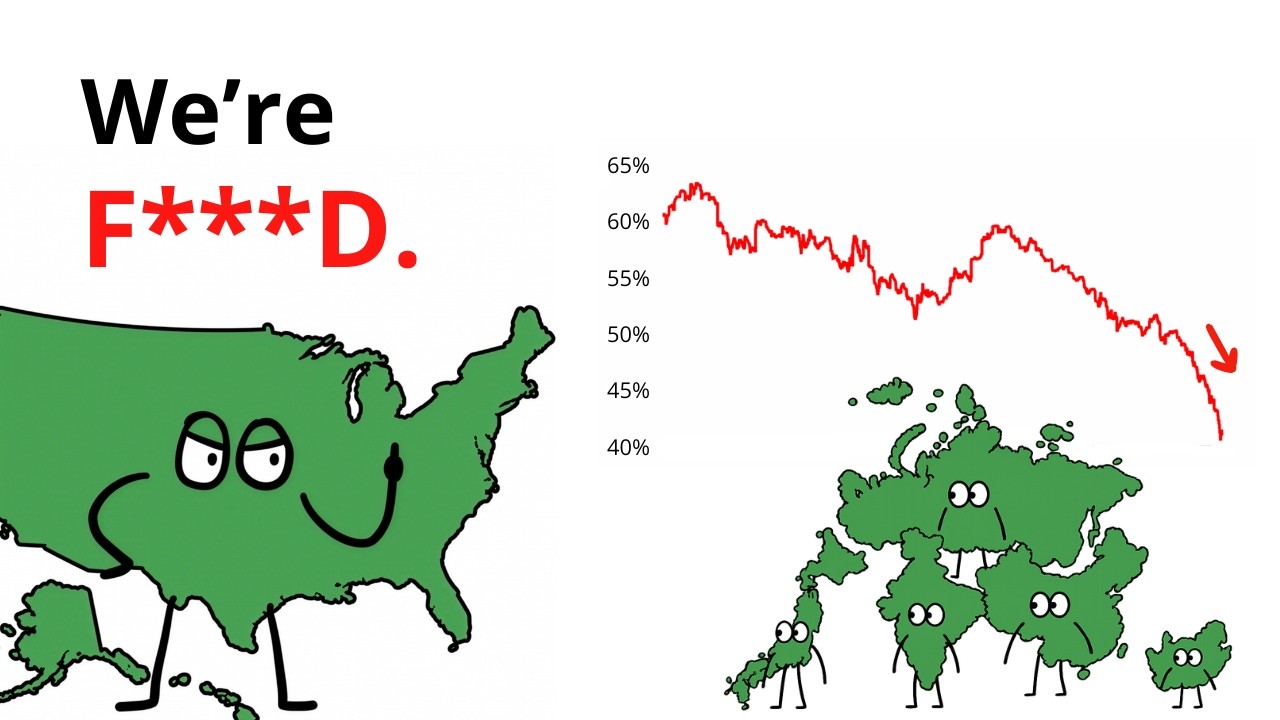
The video starts with the claim that the US dollar’s share of global reserves has hit the lowest level in more than 25 years, yet there is little visible market panic or “breaking news.” The host argues this is happening slowly in the background, while people focus on other topics, and that the key to understanding the stakes is the meaning of reserve currency status. Being the global reserve currency is presented as an “invisible engine” for the US economy: other countries need dollars to settle trade and international debts, which encourages them to hold US bonds and dollars. The video cites an estimate that the US saves more than $200 billion annually from this arrangement, describing it as a post-World War II outcome that became the default for global finance. It then frames the shift in numbers, saying the dollar was 71% of global reserves in 2000, slipped to 66% by 2010, and is now below 58%, with major crises pushing the trend along. To explain why the decline matters, the video links US dollar dominance to the built infrastructure of global finance rather than just currency preference. It walks through how the 2008 financial crisis and subsequent quantitative easing raised questions about over-concentration in dollar assets, and how US sanctions on Russia in 2014 accelerated efforts to build alternatives such as CIPS. The host then points to 2022 as a major signal, saying the US and allies froze roughly $300 billion in Russian sovereign assets and cut Russia off from SWIFT, portrayed as a message that the system can be “switched off” if countries challenge Washington. From there, the video argues that correspondent banking through New York turned the US financial system into the foundation of global payments, and it lists “exorbitant privilege” as three pillars: intelligence through trade-related data flow, investment through persistent Treasury bond demand and lower borrowing costs, and jurisdiction through the ability to regulate or disable key payment pathways. The host emphasizes that other countries cannot replace these advantages overnight, so the focus becomes coordinated infrastructure-building. The second half introduces BRICS as the cooperation mechanism, with an expansion described for 2024 that includes countries such as Saudi Arabia, the United Arab Emirates, Iran, and Egypt. The video highlights “The Unit,” presented as a blockchain-based settlement tool for BRICS countries, designed to let members bypass the dollar with a neutral unit of account backed 40% by physical gold and 60% by a mix of BRICS currencies, moving from concept to an operational pilot in January 2026. It also discusses an additional infrastructure example, “Enbridge,” described as a blockchain-based cross-border payment platform meant to enable direct trade without correspondent banks and without “New York watching over” transactions. Finally, the video argues the deeper threat is optionality: individual steps such as gold buying, bilateral trade settling in non-dollar currencies, or alternative commodity pricing are not immediate full replacements, but they reduce the monopoly created by the absence of alternatives. The conclusion is that when options exist for routing and pricing, the basis for dollar dominance, including data advantages and regulatory choke points, erodes.
Viewers repeatedly praise the video for breaking down complex topics clearly and for focusing on issues that “actually matter.” There is frequent enthusiasm for future or additional coverage, especially requests for a dedicated “petrodollar” video and rabbit-hole follow-ups. A lot of comments use humor or panic framing, comparing the tone to panic-selling scripts, while others respond with reassurance that change can be gradual and that there is no immediate reason to panic. Several commenters debate factual framing and nuance, mentioning Bretton Woods and questioning claims about what was or was not agreed, as well as disagreements about details like control over SWIFT or how assets were frozen. Some comments express skepticism about feasibility and governance of blockchain-based alternatives, asking who controls supply or fiscal stability, while others argue the erosion of US power is inevitable as options expand.
Topics · economics · finance · markets · debt markets · stock market · business · education
Questions answered
- How does reserve currency status let the United States access cheaper capital, according to the video’s explanation?
- The video says other countries need dollars to settle trade and international debts, which pushes them to buy and hold US dollars and US Treasury bonds, increasing demand and allowing the US to borrow at lower interest rates.
- Why does the video say the US dollar’s dominance is being eroded after 2008?
- It argues that crises and policy responses like quantitative easing led central banks to question how concentrated their dollar-denominated holdings are, and later sanctions actions encouraged efforts to build alternatives to dollar-based infrastructure.
- What are the three pillars of “exorbitant privilege” described in the video?
- The video lists intelligence, investment, and jurisdiction: (1) data visibility from trades clearing through New York, (2) Treasury bond demand that lowers borrowing costs, and (3) regulatory leverage and the ability to interrupt access to the system.
- What is BRICS, as described in the video, and why does the host say it matters?
- The video presents BRICS as a group of emerging economies coordinating economic, political, and financial efforts so they can cooperate to operate outside the Western-led financial system rather than trying to challenge US dominance individually.
- What is The Unit, and what does the video claim it is designed to do?
- The video describes The Unit as a blockchain-based settlement tool using a neutral unit of account backed 40% by physical gold and 60% by a mix of BRICS currencies, aiming to replace the dollar role in pricing commodities by providing a different reference point for price discovery.
- What does the video mean by optionality being a threat to the dollar?
- It argues that dominance relies on a lack of alternatives, and once countries and markets can route transactions and pricing through other systems, monopoly power weakens even if no single alternative immediately fully replaces the dollar.