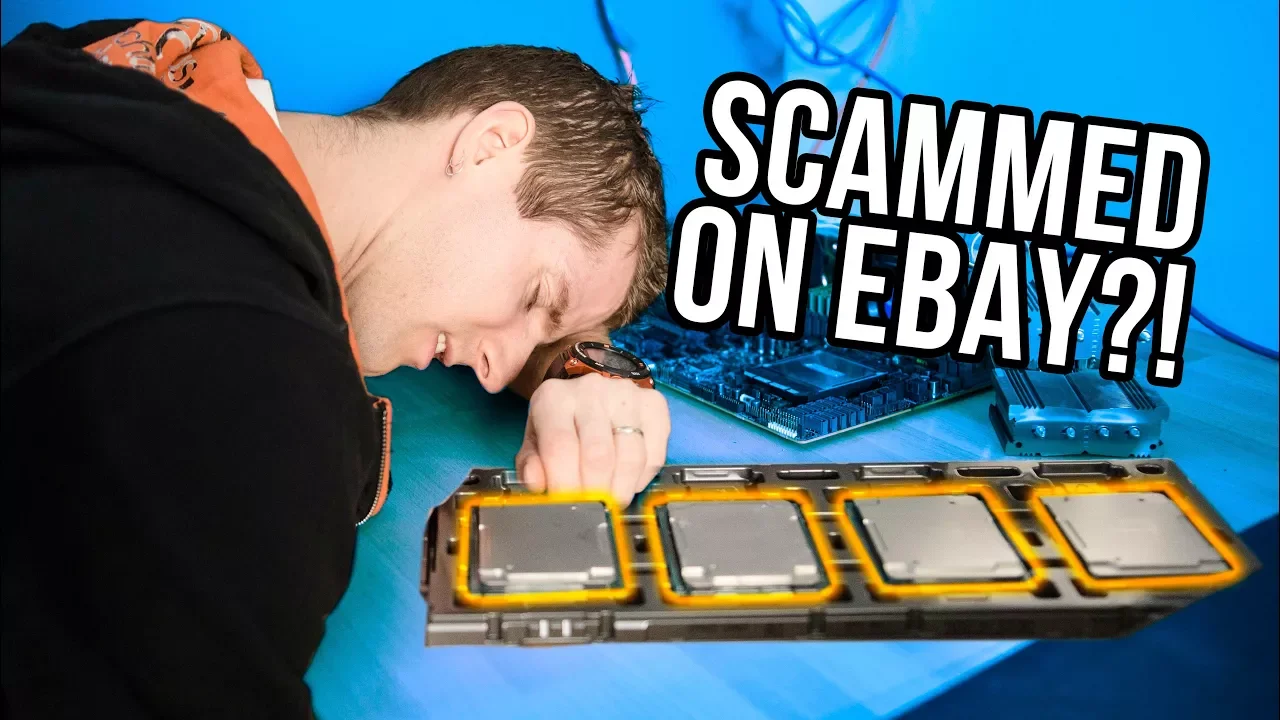
Scammed on ebay... Testing the 56 CORE system!
0 up · 0 down · 0 ratings
Promos
Thanks so much for Audible for sponsoring this video! Get Your FREE 30 Day Audible Trial Today! Head to audible.com or text Linus to 500-500. Enter our competition to win a free 6-month subscription by Tweeting @LinusTech screenshots of your favorite Audio Books! #NewYearNewMe Buy Intel Xeon processors On Amazon (Paid Link): geni.us On Newegg (Paid Link): geni.us Purchases made through some store links may provide some compensation to Linus Media Group. Discuss on the forum: linustechtips.com Our Affiliates, Referral Programs, and Sponsors: linustechtips.com Linus Tech Tips merchandise at designbyhumans.com Linus Tech Tips posters at crowdmade.com Our production gear: geni.us Twitter - twitter.com Facebook - @LinusTech Instagram - @linustech Twitch - twitch.tv Intro Screen Music Credit: Title: Laszlo - Supernova Video Link: youtube.com iTunes Download Link: itunes.apple.com Artist Link: soundcloud.com Outro Screen Music Credit: Approaching Nirvana - Sugar High youtube.com Sound effects provided by freesfx.co.uk
The video begins with Linus and his team unpacking a dual socket motherboard and two claimed 28-core CPUs purchased on eBay. They express excitement at the prospect of testing high-core-count hardware and the enormous RAM modules that accompany the CPUs. The initial problem becomes evident quickly: there is little to no documentation or verification from the seller, and a lack of compatible cooling and mounting hardware makes physical installation a challenge. The team immediately questions the legitimacy of the parts, with attempts to get CPU-Z screenshots and a lack of clear identification for the CPUs. This sets up the core premise of the episode: can they validate that these ebay components are real, functioning 28-core Xeon parts, or are they being scammed? They describe the physical oddities, such as unusual sockets and mounting systems, and begin experimenting with mounting pressure to see if the CPUs would even boot, signaling a mix of skepticism and curiosity about whether any of the components will work as advertised. As the testing unfolds, the crew discovers mounting and compatibility hurdles that complicate the build. They find that the LGA 3647 socket requires specific cooling solutions and that the motherboard support for enterprise Xeon sockets can be unusually finicky. The team experiments with different mounting pressures, memory configurations, and cooling solutions, while pausing to reflect on the risk of damaging expensive hardware. The tone shifts between cautious optimism and mounting anxiety as they realize that even if the CPUs power on, reliability and compatibility are far from guaranteed. A pivotal moment comes when they finally secure a working post and begin to see functional behavior, albeit with lingering questions about RAM compatibility and BIOS support. This section highlights the tension between high expectations and the practical realities of niche hardware. Confronting the main question of the episode, Linus revisits more options: engineering sample Xeons, retail Xeons, and finally the previously unverified ebay chips. With a mix of trial, error, and troubleshooting, they attempt to bootstrap Windows and run basic benchmarks, hoping to confirm that the ebay chips can perform adequately or at least boot reliably. The team documents the process of swapping processors, adjusting RAM speeds, and updating BIOS to crash-free or USB BIOS flash modes. They observe that the retail Xeon 8180s deliver reliable performance, while the ebay 8136 and other 28-core claims remain dubious, underscoring the risk of misrepresented hardware and the importance of verification. The culmination of the testing reveals mixed results: one ebay chip behaves like a scam while another set shows some potential, reinforcing a nuanced takeaway about buying high-end server CPUs on secondary markets. Towards the end, the video pivots to a broader lesson about cautious purchasing and verification, acknowledging that engineering samples can still offer value but can also complicate expectations. Linus highlights the unpredictability of authenticating rare parts, and the crew reflects on how the outcomes might influence future buying decisions. The episode closes with a sponsor plug and an invitation to participate in a new-year themed Audible offer, but the undercurrent remains: when dealing with specialized hardware, thorough validation and reasonable expectations are vital. The overall takeaway is a practical blend of caution, curiosity, and the thrill of pushing hardware to its limits, even when the path is uncertain or occasionally frustrating.
Topics · technology · hardware · computing · consumer_electronics
Questions answered
- What was the main objective of testing the ebay 28-core CPUs?
- The goal was to verify whether the ebay-listed 28-core CPUs were real, working, and compatible with the dual-socket motherboard, and to determine if buying such engineering samples on eBay could ever be reliable.
- Which CPUs finally booted reliably, according to the video?
- Retail Xeon 8180 processors booted reliably and produced usable Cinebench-like results, while the ebay 8136 chips remained dubious in performance and compatibility.
- What was a major challenge encountered during installation?
- A major challenge was mounting pressure and socket compatibility for enterprise Xeon LGA sockets, including the lack of proper cooling solutions and mounting hardware for a nonstandard ILM/socket arrangement.
- What lesson does the video suggest about buying high-end server CPUs on eBay?
- The lesson is that buying engineering sample or nonstandard server CPUs on eBay carries significant risk; verification and compatibility checks are essential, and some listings may not reflect reality.
- How did the team approach troubleshooting when things didn't boot initially?
- They tried different CPUs, tested mounting pressures, swapped RAM speeds and counts, updated BIOS, and attempted various cooling and mounting configurations to identify whether the issue was thermal, mechanical, or firmware related.