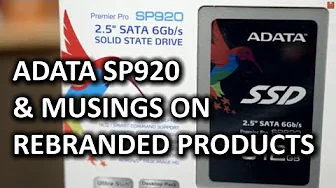
ADATA SP920 SSD & Some Thoughts on Rebranding Products
0 up · 0 down · 0 ratings
Channels and socials
In this overview of the ADATA SP920 SSD I talk about the product itself a little bit, but also about the widely used practice of "rebranding" or "rebadging" in the computer industry. Sponsor link: linustechtips.com Pricing & discussion: linustechtips.com Support us: linustechtips.com Join our community forum: bit.ly twitter.com @LinusTech Intro Screen Music Credit: Adhesive Wombat -
Check out his channel here: youtube.com Outro Screen Music Credit: Approaching Nirvana - Sugar High youtube.com
This video presents a detailed overview of the ADATA SP920 SSD and uses the product as a case study to discuss the broader practice of rebranding or rebadging in the computer hardware industry. The host explains that although the SP920 uses a Marvel 9189 controller with Crucial’s firmware and typically mirrors the interior of Crucial’s M550, it is not the same as a SanForce 3000 series drive. The discussion highlights the included high-density NAND flash, capacitors for power-loss protection, and enterprise-style features like AES 256-bit hardware encryption, TRIM, and active garbage collection, all of which contribute to strong data protection and performance reliability at a competitive price. The host notes that some features are more commonly associated with enterprise drives, such as power-f loss protection, and emphasizes how these elements make the SP920 appealing from a data safety and long-term support perspective. The video then shifts to a broader analysis of why vendors rebrand products, enumerating benefits such as extended warranties, easier evaluation for consumers, increased competition and pricing pressure, and the potential for long-term support backed by larger brands. It is argued that rebranding can be advantageous when it creates perceived value, but it can also cause confusion if differences between capacities or models are not clearly documented, as evidenced by the SP920’s performance variations across capacities. In conclusion, the SP920 is positioned as a solid, price-competitive option with strong data protection features, a robust warranty, and useful kit inclusions like migration software, while not necessarily delivering the highest performance in its class. The overall takeaway is that this SP920 sits well for users prioritizing security, value, and long-term support, even if pure speed benchmarks aren’t the top in its segment.
Topics · technology · hardware · consumer electronics · reviews
Questions answered
- What makes the ADATA SP920 different from the SanDisk/SanForce lineup and why does ADATA use a Crucial-like design?
- The SP920 uses a Marvel 9189 controller with Crucial firmware and high-density NAND, sharing many internal components with Crucial’s M550, which helps keep features and pricing competitive even though it is not a SanForce 3000 series drive.
- What are the practical pros and cons of product rebranding as discussed in the video?
- Pros include potential extended warranties, easier evaluation via comparisons to reviewed similar products, more aggressive pricing through competition, and long-term support from a larger brand. Cons include confusion from capacity-specific performance differences and less transparent documentation of how lower-density versus higher-density flash affects performance.