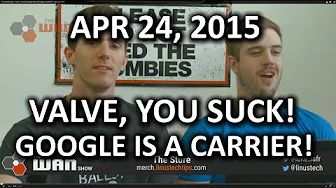
The WAN Show - Valve, You Suck Right Now & Google a Carrier?? - April 24, 2015
0 up · 0 down · 0 ratings
Promos
linustechtips.com Sponsors! Lynda.com Link: lynda.com for a 10 day free trial Squarespace: squarespace.com offer code LINUS to save 10%. Work at Squarespace: nycommit.squarespace.com Freshbooks: Head over to freshbooks.com and don’t forget to enter WAN in the “How Did You Hear About Us” section when signing up for your free trial. Soundcloud Link: soundcloud.com Timestamps courtesy of Ghost (deadfire19), FlighterLuid, cloclo8003 & JJMC89 00:03:40 - Vacation discussion 00:13:37 - Skylake CPUs leaked with specs [RUMOR] 00:16:10 - The First USB Type - C Phones (3 of Them) 00:22:43 - OnePlus One available to buy whenever, OnePlus Two announced and will have invite system, OnePlus Lite announced 00:30:30 - Google Project Fi - Google's Own Network Officially Launched 00:36:53 - DOJ Could stop Comcast-Time Warner Merger for violating anti-trust laws 00:39:45 - Strawpoll: "Aggressive Love" strawpoll.me 00:40:56 - Sponsor - Lynda.com 00:42:33 - Sponsor - Squarespace.com 00:44:29 - Sponsor - Freshbooks.com 00:46:30 - In 2017, Norway will be first country to shut down FM radio 00:52:49 - Google is deprecating old Youtube API 00:54:37 - Valve giving content creators the option to sell mods 01:15:54 - Pre-order crisis looms as 3.4m UK gamers hold off 01:16:14 - Liberland - the new European nation that runs off of Bitcoin 01:17:30 - GTX 980 Metal & 980 Ti 01:19:23 - Low HBM yields may lead to limited supply of the AMD R9 390X 01:20:25 - Steam users now have to spend $5 worth in purchases before they can add friends 01:25:03 - iFixit: Replacing the Apple Watch’s battery is easy, replacing the S1 is hard 01:26:22 - Sony Announces Xperia Z4 01:27:03 - AMD reveals Windows 10 will launch in late July
The WAN Show opens with a lighthearted discussion about television shows and pop culture before diving into technology news for the day. The hosts set a casual, energetic tone, joking about Tom Green and Red Green, then pivot to quick teasers on Skylake CPU leaks and early USB Type-C phone announcements. They promise a broad sweep of topics, including Google Project Fi and the potential regulatory action around the Comcast Time Warner merger, and remind viewers of upcoming sponsors and content segments. The conversation quickly moves into personal travel and vacation stories, giving viewers a sense of Linus and the team as real people with busy, jet lagged schedules. The crew then shifts to hardware topics, describing the ambitious IT infrastructure plans for the new WAN show office and the data consolidation efforts around the storinator and 24-drive RAID configurations. They discuss networking gear, storage throughput, and the performance benchmarks they ran, emphasizing real-time 4K media playback and the need for robust read performance. The dialogue weaves through the practicalities of building out a modern media and testing lab, including rack layouts, security considerations, and the challenges of streaming large files across a local network. A lengthy technical detour covers RAID configurations, with the team explaining RAID 50 and the rationale for using multiple arrays, hot spares, and cold spares to balance capacity, redundancy, and performance for professional workloads. The show transitions to CPU architecture commentary, analyzing Skylake rumors against the prior generation and weighing IPC gains against clock speeds, while contrasting the naming quirks of 6th generation Intel parts with user-friendly expectations. They review the evolving USB Type-C ecosystem, clarifying the difference between USB 3.0 Type-C and USB 3.1 Type-C, and debating the practicality and adoption curve for Android phones and Apple's ecosystem. The OnePlus news cycle is summarized, with speculation about the OnePlus 2 and the return of an invite-based ordering system, and the panel critically examines the rumored specs, such as the Snapdragon 810, 4GB RAM, dual SIM, and microSD support, while also sharing experiences with removable batteries and expandable storage on other flagship devices. The discussion broadens to Google Project Fi, detailing the pay-as-you-go model, data credits, and the interesting tethering and cloud-number features, with the team weighing the benefits and trade-offs of a carrier-like service that emphasizes flexible data usage and international coverage. The DOJ antitrust angle is explored, with a recap of Comcast's bid for Time Warner and the regulatory pushback that could reshape the broadband and pay-TV landscape in the United States, prompting a broader conversation about consumer choice and market competition. Throughout the episode, the hosts pepper in sponsor segments for Lynda, Squarespace, and FreshBooks, integrating promotions with their usual banter and humor, and occasionally riffing with impromptu audience polls and live chat interactions. They also touch on broader tech culture topics, such as the transition away from FM radio in Norway by 2017 and the evolving API landscape at Google, including deprecation news that could impact developers and content creators. The show eventually returns to practical production updates, recapping the team’s plans for new office setups, server racks, and the ongoing workflow improvements that will support more ambitious WAN Show productions and more frequent content. In closing, the hosts reflect on the balance between innovation and practicality, acknowledging the need to keep content accessible while exploring cutting-edge hardware, networking, and software trends. The episode ends with lighthearted sponsor notes and a playful tease about future WAN Show episodes, office tours, and the behind-the-scenes work that makes their content possible, leaving viewers with a sense of momentum and community.
Topics · technology · hardware · media · business · gaming
Questions answered
- What is the purpose of the storinator and the RAID 50 configuration discussed on the WAN Show?
- The storinator and RAID 50 setup are used to achieve high-capacity, high-throughput storage with redundancy for professional workflows, enabling real-time 4K media playback and efficient data sharing across a local network.
- What is the general stance on USB Type-C discussed in the video?
- The hosts explain that USB Type-C offers reversibility and durability advantages over micro-USB, discuss differences between USB 3.0 Type-C and USB 3.1 Type-C, and consider practical adoption timelines for phones and devices.