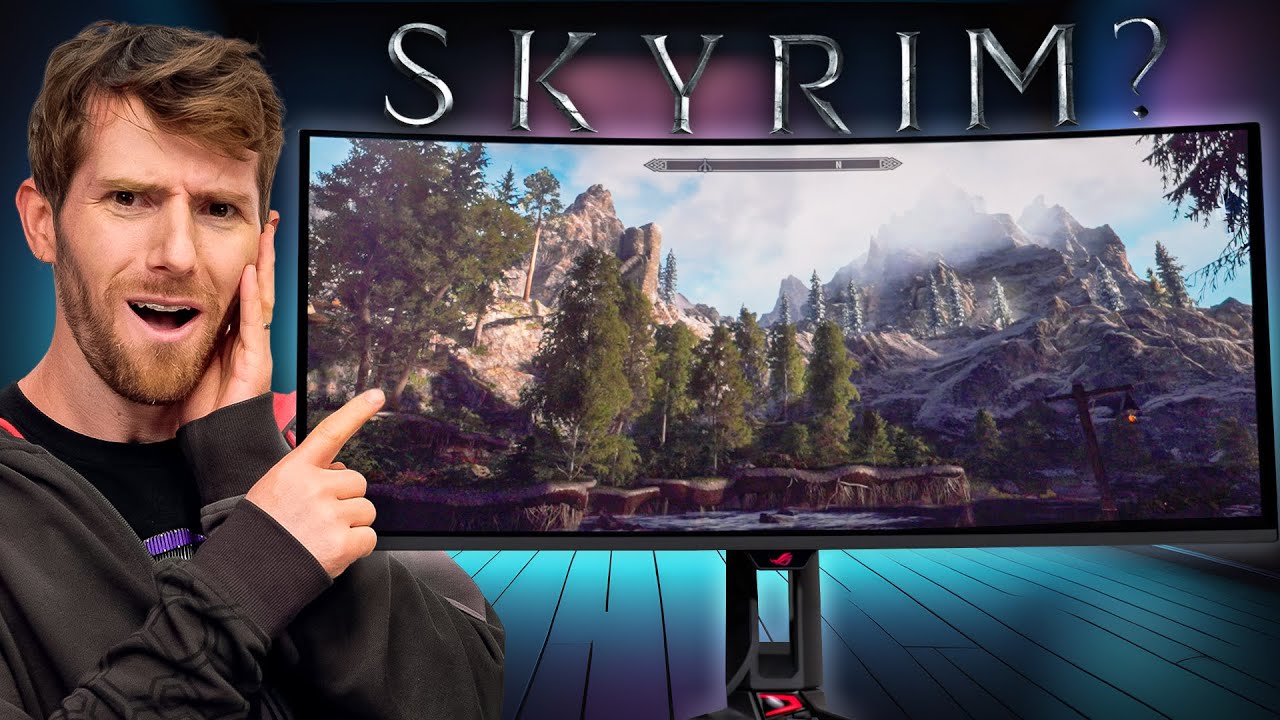
Playing Decade-Old Games at Photorealistic Quality
0 up · 0 down · 0 ratings
Description
Thanks to ASUS ROG for sponsoring this video!
Check out their all new PG34WCDN QD-OLED and the rest of their ROG OLED gaming monitors using our links: ROG OLED Gaming Monitors: rog.gg ROG Swift PG34WCDN Monitor: rog.gg 5th Gen QD-OLED panels are here, and what better way to test them then by playing games that have been heavily modded to look as real as possible. I'm talking Cyberpunk looking true-to-life, Skyrim looking like Skyrim 2, and a secret game requested by Linus. Discuss on the forum: linustechtips.com
Promos
Check out our Channel Partners: Secretlab - Get great chairs and desksts at: lmg.gg PIA - Get the VPN of our choice: piavpn.com dbrand - Buy a "Circuit" series skin for your device: dbrand.com ► GET OUR MERCH: lttstore.com ► GET EXCLUSIVE CONTENT ON FLOATPLANE: lmg.gg ► SPONSORS, AFFILIATES, AND PARTNERS: lmg.gg Purchases made through some store links may provide some compensation to Linus Media Group. Affiliate links powered in part by affilimate.com Linus Sebastian is an investor in Framework Computer, Inc and HexOS by Eshtek. CHAPTERS --------------------------------------------------- 0:00 Intro 2:06 Cyberpunk 9:05 Modding Games is tricky 10:48 Game Number 2 brokey 11:50 Skryim 18:55 Game 4 is a secret 21:47 Is it really worth it? 24:14 A wild Linus appears 28:52 Outro
The video investigates whether decades-old games can be transformed into photorealistic experiences using modern modding, high-end hardware, and OLED displays. It starts with the premise that some players crave visual realism the way modern titles offer it, even if the core gameplay remains unchanged. The host explains that achieving near photo realism requires a combination of ray tracing, path tracing, high resolution texture packs, lighting mods, and asset upgrades, often managed through a complex mod load order. They demonstrate how a premium monitor from ASUS ROG, the PG34WCDN, helps push the visuals with a fifth generation QD-OLED panel, and discuss performance trade-offs such as frame rates at ultrawide resolutions. The segment sets expectations about the effort required, including potential payoffs and the possibility of paid mod packs, while acknowledging the risk of unstable configurations and broken mods. The overall question is whether the payoff in visual fidelity is worth the time, money, and troubleshooting involved. In Cyberpunk 2077, the team showcases a large collection of mods (about 72) focusing on environmental textures, reflections, water, and lighting. They explain that path tracing and DLSS are used to balance quality and performance, achieving about 110 fps in some scenes with a 1440p ultrawide display. They discuss how headlight mods, rain on water, and body camera-style mods contribute to a more immersive atmosphere, while noting that not all mods integrate neatly, requiring careful configuration and sometimes individual mod menus. The hosts highlight that even with strong mods, real-world scenes may not look uniformly perfect across the map, pointing out that viral showcase moments are often selectively chosen to maximize impact. They also emphasize that a game’s engine and texture work influence perceived realism, so the same degree of fidelity can vary by location and weather conditions. The dialogue underscores ongoing trade-offs between absolutely photoreal visuals and playable, enjoyable gameplay. The Skyrim segment delves into a heavily modded setup that reworks environment assets, lighting, water, and distant LOD textures. ENB is used for advanced lighting and post-processing similar to ReShade, while Vortex and other mod managers handle load orders and conflicts. A major theme is load-order management and the difficulty of coordinating hundreds of mods, which may require launching through dedicated launchers and patching to ensure stability. The team explains that even with a strong configuration, some elements like distant ground textures or denser foliage may still lack the fidelity of newer titles, but the overall scene can be dramatically improved. They compare vanilla Skyrim with the modded version to illustrate the leap in atmosphere and detail, especially in water, shadows, and rock textures. The discussion also covers the time investment required, noting that achieving a playable Skyrim experience at photorealistic quality can take significant days of setup and iteration. GTA V or another requested title is shown next, illustrating the fragility of mod ecosystems on newer patches and the risk of mods breaking after game updates. The crew explains that injectors like Script Hook V may need to align with specific game versions, and that some popular mod packs rely on continually updated components that can disrupt a working configuration. The dialogue includes commentary on paid mod packs and the value proposition of prepackaged installations versus DIY customization, encouraging viewers to back up their files and experiment safely. The Crisis segment demonstrates a more faithful 2007 era title with a modernized texture pack and HDR support, showing how even long-standing games can look surprisingly current under careful tuning. The episode ends with a reflection on the practicality of modding as a hobby, emphasizing that for a first-time viewer, running a game cleanly before diving into hundreds of mods is often the smarter route. Across all titles, the hosts repeatedly frame modding as a blend of artistic direction and technical challenge, where a balance must be struck between performance and beauty. They stress the importance of understanding load orders, texture resolutions, and engine limitations, and they provide practical tips such as reducing texture detail for performance, using DLSS or ENB/ReShade tools, and applying high-resolution texture packs where it matters most. They praise the ASUS OLED monitor for its true blacks, color fidelity, and HDR performance, noting that hardware like these displays can dramatically affect perceived realism. The video closes by acknowledging that many viral photorealism clips are cherry-picked and that the real joy comes from pushing old titles toward their limits while maintaining a playable experience. Viewers are invited to explore the modding communities and to try modding themselves, with a reminder to back up data and proceed with curiosity and caution.
Topics · technology · gaming · graphics
Questions answered
- What is the core idea behind achieving photorealism in decade-old games?
- The core idea is to combine ray tracing, path tracing, high resolution textures, lighting and weather mods, and sometimes upscaling techniques to upgrade visuals while managing performance.
- Why is load order important when modding games like Cyberpunk and Skyrim?
- Load order determines how mods interact and which assets or settings override others; incorrect order can cause crashes, missing content, or broken textures, so careful, step-by-step installation is essential.
- What role does hardware play in these experiments?
- Hardware like a high refresh OLED monitor, powerful GPUs, and VRAM capacity enable higher fidelity scenes and smoother performance, but can also reveal performance bottlenecks in photoreal mods.