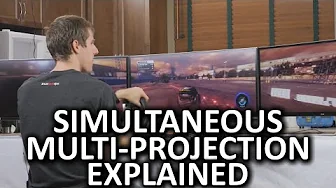
What is Simultaneous Multi-Projection?
0 up · 0 down · 0 ratings
Description
How does NVIDIA's new SMP technology help gamers who are rocking a multi-monitor setup? Massdrop link: dro.ps Follow: twitter.com Join the community: linustechtips.com
Simultaneous Multi-Projection (SMP) is presented as a GPU technology designed to fix distortion that appears when gaming across multiple monitors. The video explains that standard 3D rendering projects a scene onto a 2D screen, which works well for a single monitor but becomes skewed when side displays tilt inward. SMP addresses this by effectively using a separate camera angle for each screen, similar to having multiple projectors behind each monitor. The host compares SMP to lens-based VR rendering, noting that it makes wide or unusual monitor arrangements look correct without requiring a single, space-hungry straight line of displays. The explanation emphasizes that the heaviest parts of rendering, such as geometry and lighting, are done once, while SMP uses lightweight transforms to adapt the rendered image to each screen, preserving frame rates. The technology is highlighted as a feature of Nvidia's GeForce 10 series, currently supported by GTX 1080 and GTX 1070 in certain games, with potential expansion as VR and surround gaming gain popularity. The host also touches on future hardware prospects, such as Nvidia’s Polaris architecture, and encourages viewers to explore related products like LG ultrawide monitors with FreeSync, demonstrating how multiple displays can work together for immersive experiences.
Topics · technology · gaming · graphics · virtual-reality
Questions answered
- What problem does Simultaneous Multi-Projection solve on multi-monitor setups?
- SMP solves image distortion and skew that occur when side monitors are tilted on multi-monitor setups by providing a separate projection angle for each screen, ensuring realistic perspective across all displays.
- Which Nvidia hardware supports SMP in the video, and what is the impact on performance?
- SMP is demonstrated on Nvidia GeForce 10 series GPUs, specifically the GTX 1080 and GTX 1070 in supported games, with most heavy rendering done once and only lightweight transforms applied for each projection, helping maintain frame rates.