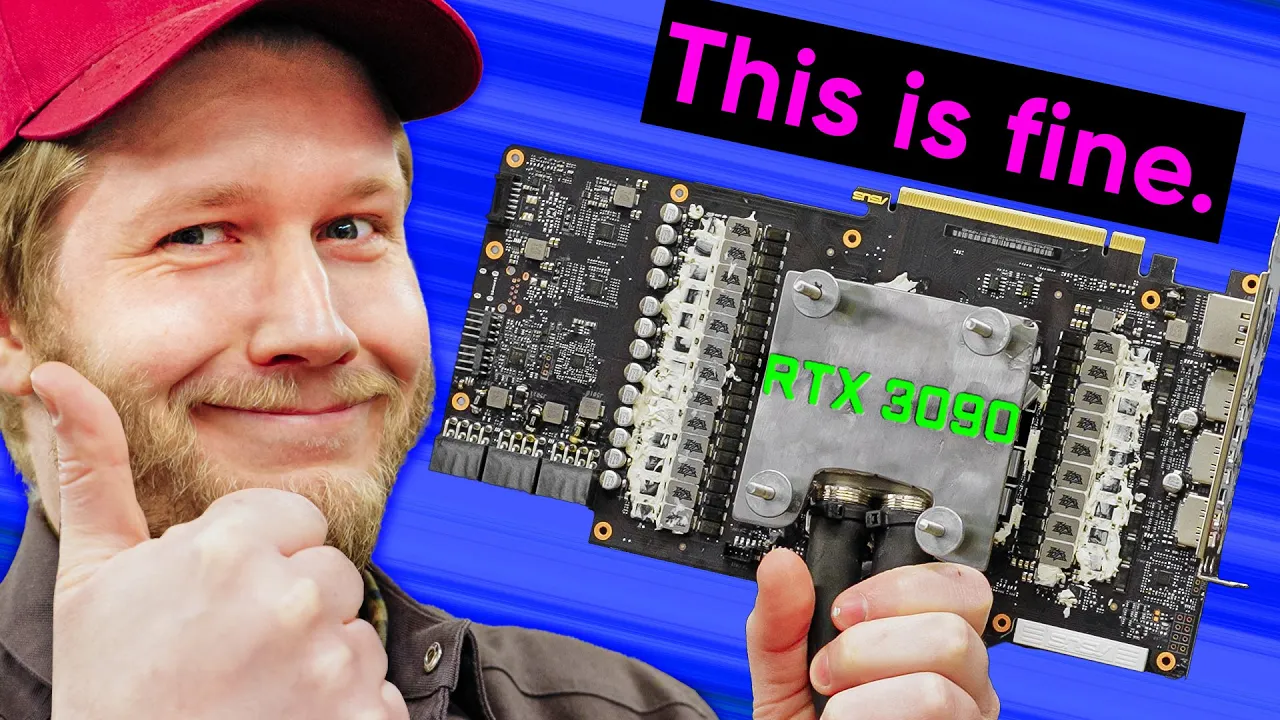
Nvidia Doesn't Want You to Do This - GPU Shunt Mod
0 up · 0 down · 0 ratings
Promos
Thanks to Seasonic for sponsoring this video! Buy Seasonic Prime Platinum 1300W Amazon: geni.us Newegg: geni.us Buy a Seasonic Ultra Titanium PSU Amazon: geni.us Newegg: geni.us Armed with a bag of 5mΩ resistors Alex attempts to make a very fast RTX 3090. Discuss on the forum: linustechtips.com Buy the Elmor Labs EVC2SX: lmg.gg Buy Asus Strix RTX 3090 Amazon: geni.us Best Buy: geni.us Newegg: geni.us Buy Asus Maximus Z690 Extreme Amazon: geni.us Best Buy: geni.us Newegg: geni.us Buy G.Skill Trident Z5 Amazon: geni.us Newegg: geni.us Purchases made through some store links may provide some compensation to Linus Media Group. ► GET MERCH: lttstore.com ► AFFILIATES, SPONSORS & REFERRALS: lmg.gg ► PODCAST GEAR: lmg.gg ► SUPPORT US ON FLOATPLANE: floatplane.com FOLLOW US ELSEWHERE --------------------------------------------------- Twitter: twitter.com Facebook: @LinusTech Instagram: @linustech TikTok: @linustech Twitch: twitch.tv MUSIC CREDIT --------------------------------------------------- Intro: Laszlo - Supernova Video Link: youtube.com iTunes Download Link: itunes.apple.com Artist Link: soundcloud.com Outro: Approaching Nirvana - Sugar High Video Link: youtube.com Listen on Spotify: spoti.fi Artist Link: youtube.com Intro animation by MBarek Abdelwassaa @mbarek_abdel Monitor And Keyboard by vadimmihalkevich / CC BY 4.0 geni.us Mechanical RGB Keyboard by BigBrotherECE / CC BY 4.0 geni.us Mouse Gamer free Model By Oscar Creativo / CC BY 4.0 geni.us CHAPTERS --------------------------------------------------- 0:00 Hardcore Overclocking is Super Easy...? 0:50 The Plan 1:29 Baseline Readings 2:12 K5 Pro: The Sticky Sequel 2:38 How to Make a GPU Faster 3:27 Shunt Mod Explained 4:25 Soldering the Resistors (Legendary Difficulty) 7:34 How to control Voltage 9:45 Resurrecting the Chiller 11:11 Water Cooling a GPU feat. Angle Grinder 12:49 Our Chiller is Terrible 14:13 Will the GPU Work?? 15:36 Hardcore Overclocking (for real) 19:12 Outro
This video dives into hardcore GPU overclocking on an RTX 3090 using a shunt mod to increase current delivery, pushing the limits of stock safety protections. The host explains the fundamental challenge: GPUs have strict current limits for safety, and voltage control has been restricted in recent generations, requiring hacks to extract more performance. The plan is laid out: baseline measurements followed by pushing current with shunt resistance tweaks, and reclaiming voltage control through an Elmer Labs EVC-2SX device to feed the GPU more voltage for higher clocks. Early segments detail the disassembly, the difficulties of soldering tiny resistors, and the decision to avoid liquid metal due to reliability concerns, opting instead for a solder-based approach. The host emphasizes safety and risk, including the possibility of destroying the card, while also highlighting sponsorship from Seasonic and showing the power supply’s performance under stress. The narrative progresses from baseline benchmarking to a multi-stage overclocking sequence, culminating in significant but not limitless improvements and a candid reflection on the janky, high-stakes nature of DIY hardware modification. In the core experimental phase, the team explains shunt mod theory, how measuring voltage drop across a resistor lets the GPU think it is drawing less current, and how adding a parallel resistor reduces the effective shunt value. They install a 5 milliohm resistor on top of existing ones, effectively halving the software-reported current while actually drawing more power. An alternative liquid metal method is mentioned but dismissed due to reliability concerns, reinforcing their choice of a more controllable solder-based modification. They then address voltage control by integrating the Elmer Labs EVC-2SX, which talks directly to the GPU voltage controller via the I2C bus, enabling programmable voltage beyond Nvidia’s stock limits. A series of practical hurdles follows, including the need for better soldering tools, thermal management challenges, and a homegrown chiller that ultimately proves insufficient, prompting redesigns and improvisation. The segment ends with the system finally powering up, the GPU remaining intact, and the team preparing for rigorous testing and real overclocking results. With the GPU running again, the testing phase reveals a careful balance between cooling, current, and voltage. The air-cooled setup falls short, necessitating a robust water cooling strategy, and the team iterates on chiller design, foam insulation, and leak management. They monitor VRM and memory temperatures as they push the core to higher clocks, noting that core voltage increases tend to raise temperatures quickly, which limits stability. The group brings in Buildzoid for expert opinion, contrasting stock voltage behavior with the realities of silicon and thermal limits. The final overclock attempts show a meaningful uplift: roughly a 12 percent performance gain over stock in 3DMark scores, but still short of the global leaderboards, illustrating both the potential and the practical ceiling of such mods. The video closes with reflections on risk, the thrill of experimentation, and a nod to Seasonic for sponsoring the build, underscoring that this is entertainment and exploration rather than a recommended, safe modification path for everyday users.
Topics · technology · hardware · overclocking · DIY · experimental
Questions answered
- What is a shunt mod and why is it used in GPU overclocking?
- A shunt mod is a modification that places a resistor in parallel with the GPU's current sensing path to reduce the effective shunt resistance. This tricks the GPU voltage controller into thinking it is drawing less current than it actually is, enabling higher power draw and performance in experiments.
- What device enables direct voltage control beyond Nvidia’s stock limits in this video?
- The Elmer Labs enhanced voltage controller, or EVC-2SX, connects to the GPU I2C bus to override the normal voltage controller and allow higher voltages during testing.
- Why did the team avoid liquid metal for the shunt mod in this build?
- Liquid metal can provide unreliable readings and is risky because it can leak, damage solder joints, and cause unpredictable behavior, so they chose a solder-based approach for reliability.
- Was the final overclock a world-beating result?
- No, the final overclock achieved around a 12% gain over stock and did not reach the top leaderboards, illustrating both the potential and practical limits of such modifications.