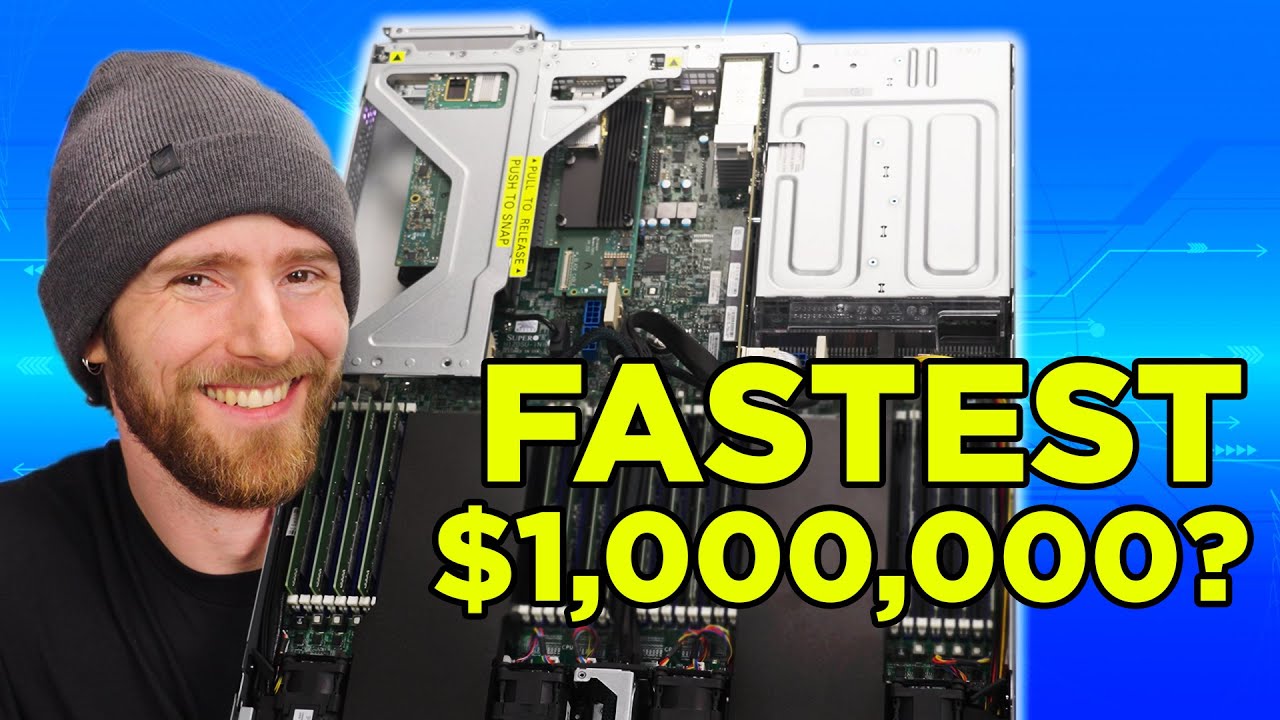
They Told Me NOT to Do This... - Building a Node of the $1,000,000 PC
0 up · 0 down · 0 ratings
Description
Promos
Thanks to MANSCAPED for sponsoring the video! Get 20% OFF + Free Shipping at manscaped.com Use code LINUS and get 25% off GlassWire at lmg.gg We've built a LOT of crazy servers, but when Supermicro asked us to not rebuild one of the storage servers for the Petabyte of flash project, well, we had to do just the opposite! Discuss on the forum: linustechtips.com
Check out the NVIDIA ConnectX-6 200GbE Cards: lmg.gg Buy some Infinite Cables Fibre Cables: lmg.gg Buy some Infinite Cables Custom Cables: lmg.gg Buy some FS.com 100GbE Transceivers: bit.ly Purchases made through some store links may provide some compensation to Linus Media Group. ► GET MERCH: lttstore.com ► AFFILIATES, SPONSORS & REFERRALS: lmg.gg ► PODCAST GEAR: lmg.gg ► SUPPORT US ON FLOATPLANE: floatplane.com FOLLOW US ELSEWHERE --------------------------------------------------- Twitter: twitter.com Facebook: @LinusTech Instagram: @linustech TikTok: @linustech Twitch: twitch.tv MUSIC CREDIT --------------------------------------------------- Intro: Laszlo - Supernova Video Link: youtube.com iTunes Download Link: itunes.apple.com Artist Link: soundcloud.com Outro: Approaching Nirvana - Sugar High Video Link: youtube.com Listen on Spotify: spoti.fi Artist Link: youtube.com Intro animation by MBarek Abdelwassaa @mbarek_abdel Monitor And Keyboard by vadimmihalkevich / CC BY 4.0 geni.us Mechanical RGB Keyboard by BigBrotherECE / CC BY 4.0 geni.us Mouse Gamer free Model By Oscar Creativo / CC BY 4.0 geni.us CHAPTERS --------------------------------------------------- 0:00 – Intro 2:03 – The Supermicro A+ Server 1124US 3:47 – Opening it up 9:38 – Installing the AMD EPYC 7543 11:06 – Installing the RAM 12:04 – Installing the Boot Drive and Storage 16:13 – Powering it up and Configuration 19:43 – Testing 21:45 – Conclusion
The video documents Linus Tech Tips' hands-on exploration of a high density 1U storage server built around the Supermicro 1124US chassis, driven by AMD EPYC processors and a large amount of NVMe storage. The team defies initial expectations from Supermicro by choosing to assemble and test the server themselves rather than accepting a pre-built unit. The discussion centers on the design philosophy of dense compute with maximum drive capacity in a compact form factor, highlighting how CPU, memory, and PCIe topology must balance to avoid bottlenecks in a petabyte-scale flash project. From the outset, they emphasize how enterprise servers are purpose-built and not as flexible as off-the-shelf desktops, setting the stage for deeper technical demonstrations. The segment introduces the key components and their roles, including the dual 10Gbps networking, NVMe backplanes, and the front-to-back air flow strategy that enables high density without overheating. In the mid section, the team disassembles and inspects a bare-bones storage server to understand its inner workings, including the power supplies, PCIe backplanes, and three power supplies with a hidden fourth unit. They explain the importance of channel filling in EPYC CPUs to maximize memory bandwidth, noting that each CPU should have all memory channels populated to avoid latency and bandwidth penalties. The host discusses ZFS versus later WekaFS deployment, acknowledging that ZFS will be used initially for testing while WekaFS could be cost-prohibitive for full production, which frames the practical constraints of the build. The narration also covers the memory configuration: 256 GB ECC memory per server, Samsung DIMMs rated for 3200 MT/s, and the rationale for filling all channels to maintain performance in a storage-focused workload. The crew highlights the substantial physical complexity of the chassis, including the thick motherboard, dense PCIe topology, and air management features designed to push air over multiple CPUs and NVMe drives. The installation phase documents the actual build: installing 12 drives per 1U layer across six servers, wiring the NVMe backplanes, and seating AMD EPYC 7543 processors with a robust thermal solution. They describe the motherboard’s remarkable PCIe topology, featuring multiple 16x and 32x PCIe slots, and the potential for GPU or accelerator cards in addition to NVMe storage. The dialogue around thermal paste application and the physical act of mounting CPUs underscores the hands-on, trial-and-error nature of high-end server assembly. They also discuss RAM qualification by Supermicro for stability in this specific chassis, tying memory reliability directly to data integrity in a petabyte-scale deployment. In combination, these steps illustrate why the team prioritizes density and compute balance to enable true NVMe over fabrics performance rather than simple storage capacity alone. As the system comes together, they configure the ZFS pool with 12 drives per server and plan a two-vdev RAIDZ configuration to withstand two drive failures, then combine these into a single pool for the petabyte flash objective. They experiment with a one-megabyte block size to reflect workloads that involve large video files, and adjust ARC settings to optimize metadata performance for large backend storage. The testing phase assesses random and sequential I/O using a mix of NVMe drives, revealing CPU-bound behavior and the importance of parallelism across multiple servers to achieve higher aggregate throughput. They report impressive sustained throughput numbers that approach the network’s capabilities, reinforcing the theme that the value of such a system lies in architecture as much as raw drive count. The segment closes by acknowledging the real-world trade-offs between cost, performance, and the intended application, and reiterates that the project is a demonstrator for what dense, purpose-built storage hardware can achieve. A brief sponsor segment interrupts the technical run to promote Manscaped and GlassWire, but the main takeaway remains the project's aim: to push the limits of a 1U storage node as part of a larger six-node NVMe over fabrics fabric. The hosts reflect on lessons learned, including the importance of proper tool-less sleds for rapid deployment, the value of validated memory, and the role of network fabric in achieving expected performance. They tease a follow-up video that will dive deeper into the head controller and the full six-node stack, inviting viewers to compare this approach with other enterprise configurations. Overall, the video blends hands-on hardware exploration with practical performance testing to illustrate how density, topology, and software choices converge to enable scalable, high-speed storage solutions for very large datasets.
Topics · technology · data center · hardware · storage · servers · performance testing