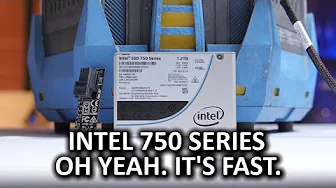
Intel 750 Series 2.5" SSD - Is NVMe the final answer?
0 up · 0 down · 0 ratings
Channels and socials
We know that Intel's new 750 Series SSDs are amazing... but just how far ahead of "traditional" consumer storage drives are they? Corsair link: linustechtips.com Pricing & discussion: linustechtips.com Support us: linustechtips.com Join our community forum: bit.ly twitter.com @LinusTech Intro Screen Music Credit: Title: Laszlo - Supernova Video Link: youtube.com iTunes Download Link: itunes.apple.com Artist Link: soundcloud.com Outro Screen Music Credit: Approaching Nirvana - Sugar High youtube.com
The video introduces Intel’s 750 Series 2.5 inch SSD and makes the case that NVMe can deliver a substantial leap over traditional SATA solid state drives. The host emphasizes the claim that this is the fastest consumer SSD on the market, repeatedly underscoring the performance advantages unlocked by NVMe and the PCIe interface, which bypasses the legacy AHCI architecture designed for spinning disks. The discussion explains how NVMe is built for nonvolatile memory and parallelism, enabling more efficient command handling and better CPU-to-drive communication. The physical drive is described in detail, including its 15 mm thickness, a large heatsink, and the dual-connectivity that supports both standard SATA power and a mini SAS HD link via a hyperkit module. The host then benchmarks the 750 Series against a top SATA contender, the Samsung 850 Pro, using CrystalDiskMark and Blackmagic Disk Speed tests, showing dramatic performance differences with sequential reads and writes, and 4K performance that is several times faster. The video notes that these results are synthetic and can deviate in real-world scenarios due to other bottlenecks, but concludes that the Intel 750 is presently the fastest consumer-grade SSD. Finally, the presenter acknowledges the trade-offs, including NVMe’s relative novelty for consumers and the hardware prerequisites needed to utilize the full speed, such as PCIe lanes and compatible motherboards or the HyperKit solution for certain form factors. The closing section invites viewer opinions and directs them to forums for discussion while mentioning sponsorship and affiliate links in the description. Overall, the video argues that NVMe represents a major step forward for consumer storage speed, while also highlighting practical considerations for adoption and integration in different PC builds.
Topics · technology · hardware · storage
Questions answered
- What drives the Intel 750 Series to achieve such high speeds compared to SATA SSDs?
- The 750 Series uses PCIe lanes with an NVMe controller designed for nonvolatile memory, providing a streamlined command set and better parallelism, which reduces bottlenecks and enables much higher sequential and 4K performance than AHCI-based SATA SSDs.
- Are there practical drawbacks to adopting NVMe for most users?
- Yes, NVMe requires PCIe lanes and compatible motherboards, and some form factors may need adapters like HyperKit for full performance. Real-world gains can be limited by other system bottlenecks, so the speed benefit is most pronounced in well-balanced systems with capable CPUs and sufficient PCIe bandwidth.