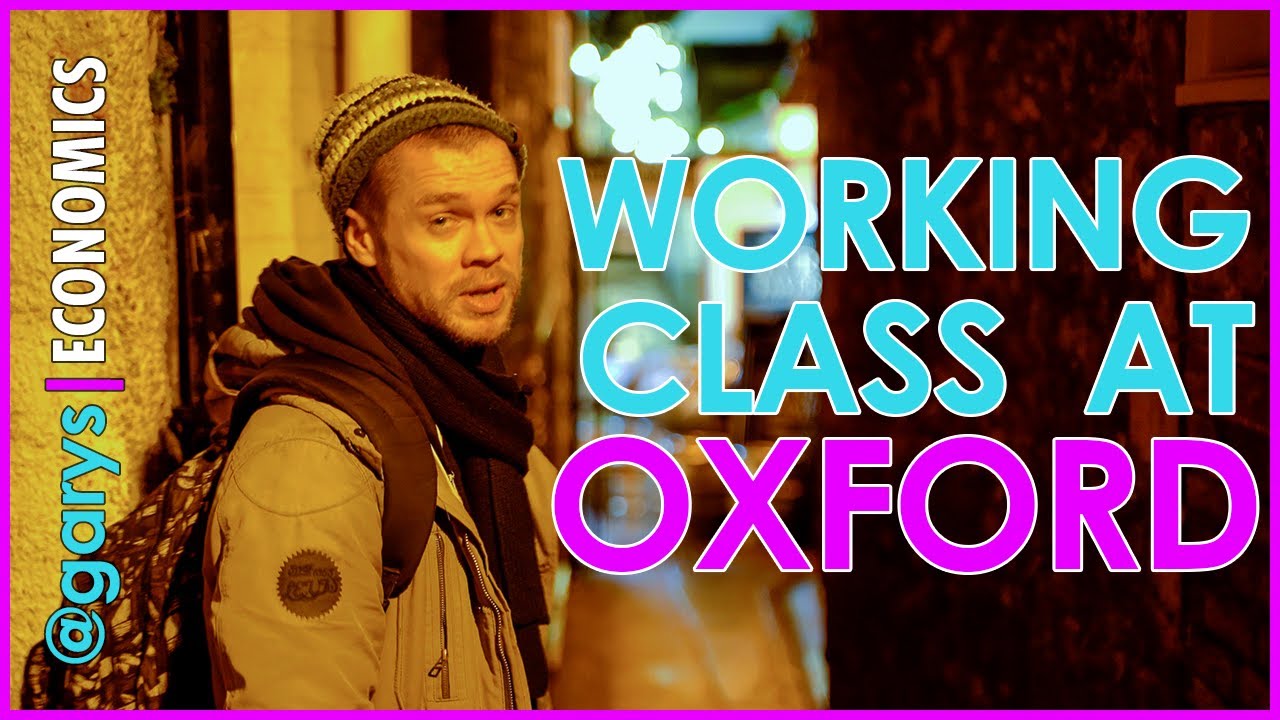
What it's like being working class at Oxford University
0 up · 0 down · 0 ratings
Channels and socials
Gary goes of in search of his favourite pubs as a student and talks about being working class at the elite Oxford University when he gets there. "I'm a nobody right, like I'm a short guy from a poor background in Ilford. I'm not handsome like a model, I don't have no connections you know, I mean I'm not excellent at football; the only thing I've got is I can make good predictions and because I understand the economy better than anyone else that is enough to get to the top in the city, but it gets you nowhere in academia I would have to spend years working the game and making connections and doing all of this stupid academic maths on whiteboards while at the same time the world's getting worse and worse & at the end of it there's no guarantee that I'm going to fix anything" Economists Mentioned (Country Of Birth) Gabriel Zucman (France) Thomas Piketty (France) Amir Sufi (USA) Atif Mian (Pakistan) Ludwig Straub (Germany) Ha-Joon Chang (South Korea) SUBSCRIBE, SHARE & START A CONVERSATION SOCIAL MEDIA: WEBSITE - wealtheconomics.org TWITTER - @garyseconomics FACEBOOK - @garyseconomics INSTAGRAM - @garyseconomics Performed by Gary Stevenson GARYSECONOMICS Produced by Simran Mohan MOHAN MEDIA
The video follows Gary Stevenson as he navigates life as a working-class student at Oxford University, sharing candid reflections on class, privilege, and the emotional landscape of academia. He contrasts the reality of ordinary people’s concerns with the abstract world of advanced economics, where many students are insulated from the hardships facing working-class families. The narrative threads through personal anecdotes from pubs and campus spaces, highlighting moments of nostalgia for Oxford’s historic streets, while underscoring the frustration of confronting academic culture that often overlooks lived experience. He explains how his successful career in the city initially made him think he could contribute from within economics, only to find that the discipline at Oxford can feel disconnected from the people it studies. The dialogue touches on the scarcity of working-class representation in postgraduate spaces, the dominance of “playing the game” to advance, and the sense that change in economics requires engaging with those most affected by policy. Throughout, the viewer is invited to weigh the tension between intellectual rigor and social relevance, and to consider whether elite institutions can ever fully address broader economic inequality. The piece culminates in a hopeful but sober recognition that while mathematics and models have their beauty, real progress may demand deeper empathy and structural change within academia.
Topics · economics · education · inequality · society · higher-education · class · policy · research
Questions answered
- What does the speaker identify as the core barrier for working-class students in Oxford’s economics programs?
- The speaker argues that the core barrier is the culture of academia and the emphasis on mathematical, technical, and networked 'game playing' that excludes those who lack elite connections and backgrounds.
- How does the speaker describe the impact of inequality on academic discussions of economics?
- He explains that while economics can discuss issues affecting working-class families, the discussions often remain disconnected from emotional and real-world consequences, which can lead to frustration for students from non-privileged backgrounds.
- What examples from campus life are mentioned to illustrate class differences?
- Examples include pubs near the university, matriculation rituals, and the general sense that many peers come from comfortable backgrounds, contrasted with the speaker’s own modest upbringing and lack of connections.