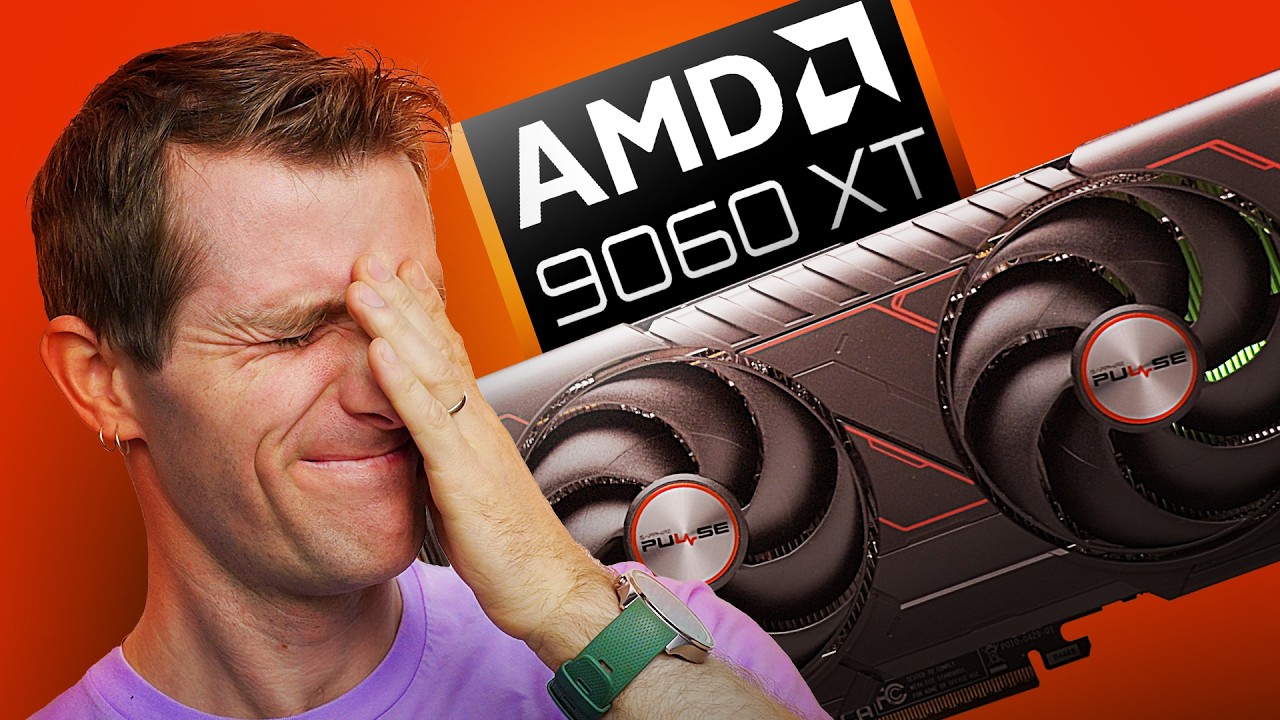
This Was Supposed to be a Happy Day - AMD Radeon 9060XT Review
0 up · 0 down · 0 ratings
Promos
Visit squarespace.com and use offer code LTT for 10% off Try Rocket Money for free: rocketmoney.com (US Residents Only) This is might be the last GPU review we'll do this year. After Nvidia, and AMD - and Intel, releasing disappointment after disappointment. Maybe the 9060 XT will be great? Discuss on the forum: linustechtips.com Buy an AMD 9060XT GPU geni.us ► GET OUR MERCH: lttstore.com ► GET EXCLUSIVE CONTENT ON FLOATPLANE: lmg.gg ► GET A VPN: piavpn.com ► SPONSORS, AFFILIATES, AND PARTNERS: lmg.gg Purchases made through some store links may provide some compensation to Linus Media Group. CHAPTERS --------------------------------------------------- 0:00 Intro 1:36 1080 Results 3:16 Architecture 5:04 Power and Thermals 5:55 1440p Gaming 6:46 Raytracing 7:26 Productivity 8:18 Our Take and Frustrations
This video provides a deep dive into AMD's RDNA4 based 9060 XT graphics card, with a focus on how it stacks up against Nvidia’s competing GPUs at multiple resolution targets and in different workloads. The host starts by outlining the context that launched the 9060 XT, including the existence of several variants such as an 8 GB model and a higher-clocked 16 GB SKU, and notes that the review is part of a broader push to evaluate value in a market hungry for alternatives to Nvidia. The discussion then pivots to architecture level details, explaining enhancements in ray tracing and AI workloads that come with the new RDNA4 family, while acknowledging that the 9060 XT still remains a mid-range option with half the compute units of the larger sibling. The host emphasizes the importance of memory bandwidth and IO, noting the card’s 16 PCIe Gen 5 lanes and a reduced number of display outputs, which influences both compatibility with older systems and perceived value at a given price point. Across the analysis, power efficiency and thermal behavior are spotlighted, with measurements showing a higher than expected draw in some titles but generally manageable cooling and noise under load. The narrative then examines gaming performance at 1440p, revealing that while the 9060 XT can outperform older generations and hold ground against certain 8 GB Nvidia cards, it often trails the RTX 5060 Ti 8 GB in most titles, raising questions about the value proposition at its price. In ray tracing, the reviewer laments that AMD’s RDNA4 RT gains still don’t eclipse Nvidia’s offerings, turning the focus to software support and AI workloads where AMD shows growth yet remains uneven against competition. The productivity segment highlights the 16 GB VRAM advantage as a meaningful benefit for AI workloads and certain content creation tasks like DaVinci Resolve, even though Nvidia still leads in more popular benchmarks such as Premiere Pro. Ultimately, the host expresses a sense of frustration about the product’s overall value, citing three core themes: ambiguous naming and confusing SKU differentiation related to memory, uncertain MSRP and availability, and a performance envelope that feels closer to the 5060 Ti than to the ideal $300 market sweet spot. The verdict is that the 9060 XT is not a clear slam dunk for PC gamers on a tight budget, prompting a cautious recommendation to consider the 960 XT or other alternatives depending on whether one prioritizes memory capacity, power efficiency, or ray tracing and AI features. The video wraps with a sponsorship segment and a nudge toward additional reviews in the same family, inviting viewers to compare the 9070 and 9070 XT for a broader architectural picture.
Topics · hardware-review · graphics · gpu · technology · software-tools · ai
Questions answered
- What variants does the AMD 9060 XT come in and how do their specs differ?
- The 9060 XT is available in multiple variants, including an 8 GB version, a base 16 GB model, and an OC Sapphire variant. All variants share the same Navi 44 GPU and RDNA4 architecture, with the 16 GB models offering more memory bandwidth and headroom for modern workloads, while the 8 GB version targets lower budgets and may limit future-proofing.
- How does the 9060 XT perform in 1440p gaming compared to the RTX 5060 Ti 8 GB?
- In 1440p gaming, the 9060 XT generally trails the RTX 5060 Ti 8 GB in raster performance across most titles tested, though it can win in a few like certain levels of Alan Wake 2 and Last of Us Part One. The card does not consistently outperform the 5060 Ti and sits closer to it in many games, raising questions about value at its price point.
- What are the power and cooling characteristics of the 9060 XT under load?
- The 9060 XT shows an average power draw around 174 watts with peaks near 225 watts in some titles, which is higher than the 5060 Ti 8 GB but still manageable with a modest power supply. The reviewer notes that the card remains cool and reasonably quiet under load, implying that a beefier than 450 W PSU is advisable for sustained gaming bursts.