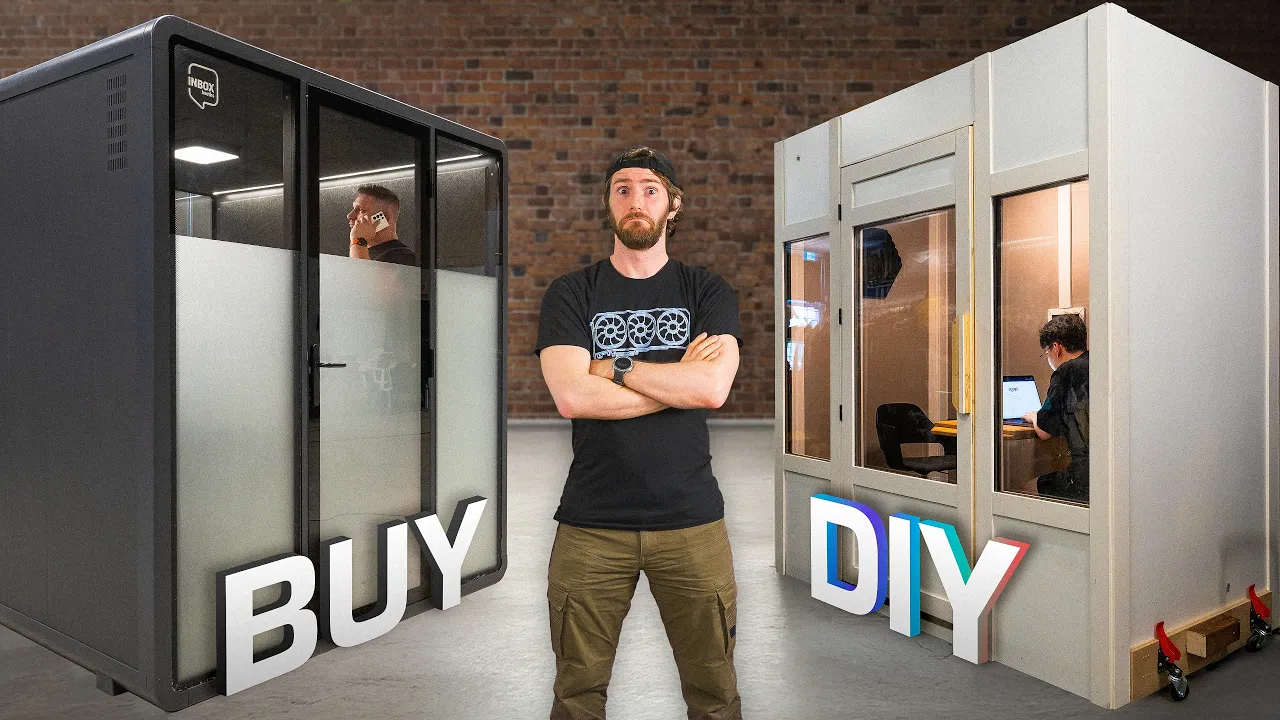
Meeting pods are a ripoff, so I built my own. Buy or DIY?
0 up · 0 down · 0 ratings
Promos
Visit squarespace.com and use offer code LTT for 10% off With open-plan workspaces, shared offices, and only a handful of meeting rooms, it can be a real challenge to find a quiet space to take a call or just work without distractions. Call pods are a solution, but the prices seem so high! Couldn’t we just make our own? Discuss on the forum: linustechtips.com
Channels and socials
Check out our Channel Partners: Secretlab - Grab a TITAN Evo ergonomic gaming chair: lmg.gg PIA - Get the VPN of our choice: piavpn.com dbrand - Buy a "Circuit" series skin for your device: dbrand.com ► SHOP LTT PRODUCTS: lttstore.com ► GET EXCLUSIVE CONTENT ON FLOATPLANE: lmg.gg ► DIVE DEEPER ON THE LTT LABS WEBSITE: lmg.gg ► SPONSORS, AFFILIATES, AND PARTNERS: lmg.gg Purchases made through some store links may provide some compensation to Linus Media Group. Affiliate links powered in part by affilimate.com Linus Sebastian is an investor in Framework Computer, Inc and HexOS by Eshtek. CHAPTERS --------------------------------------------------- 0:00 Intro 1:43 What are we up against? 2:06 Plan A 5:38 A little wiggly 9:00 Oops 10:12 Pivot! 11:04 Plan B 12:40 Everything is better with Windows 13:45 Day 9? 16:25 Day 11 17:00 Judgement Day 23:46 Credits
Linus Tech Tips explores the practical challenge of quiet meeting spaces in open offices by attempting a Buy or DIY for a two-person call pod. The video starts by framing the problem: commercial call pods are expensive and space is at a premium, so the hosts set out to build a cheaper, DIY alternative that preserves privacy and sound isolation. They introduce Plan A, referencing a Bureau Tuesday Plus pod priced around $14,000 plus installation, and outline the goal of constructing something significantly cheaper while keeping roughly the same footprint. Early on, the team sketches a rough plan, selecting dimensions, framing methods, and materials like plywood, 1x4s, hardboard, and fabric, with an understanding that the process may require iterations. The hosts emphasize that this is a learning process, with time and budget as key metrics to determine whether DIY makes economic sense. They also sponsor the episode with Squarespace, positioning it as a platform for building a professional online presence to accompany their project. The narrative then pivots to Day 2 and Day 4 where they encounter structural challenges, such as dovetail fitment, wall framing choices, and the need to switch from a high-complexity joinery approach to a simpler North American stick framing. The team documents mistakes and incremental improvements, including tool choices like a Milwaukee multi-tool and a Ryoba pull saw, as they refine their method and adjust the design to improve rigidity and sound isolation. As they progress, they add components for acoustics, including double-layer Sonopan panels and acrylic windows to boost sound dampening, and experiment with fabric covering and insulation to balance absorption and reflections. By Day six or seven, they assemble windows, a bench, a tabulated desk area, and a door, while integrating electronics such as a USB-C powered screen for sharing, power outlets, and basic lighting. The final analysis compares the DIY pod to the commercial option on cost and time, noting that labor hours were substantial and that the DIY route saved some money but required a significant time investment, making the economics favorable only under specific conditions. The video concludes with a verdict that the DIY approach can work and will likely be deployed in the future, while acknowledging the tradeoffs in time, complexity, and ultimate cost, and they reiterate sponsor messaging and offer to explore more Buy or DIY projects in the future.
Topics · technology · maker · design · procurement · business
Questions answered
- What was the initial cost comparison between Plan A and the DIY pod?
- Plan A cited a Bureau Tuesday Plus pod at about $14,000 US plus installation, while the DIY approach ended up costing roughly $4,400 CAD in materials and about 176 hours of labor at $30 US per hour, leading to substantial time investment but lower material costs.
- What design changes did the builders implement to improve rigidity and acoustics?
- They shifted from a complex dovetail wall construction to a more traditional 2x2 stick framing, added double-layer Sonopan within the walls, used acrylic windows with an air gap, and applied fabric coverings with sound-damping materials to balance absorption and reflection.
- Did the DIY pod end up being a viable replacement for commercial options?
- Economically it saved money on materials and generally reduced cost versus installation, but the time commitment was high and the final product required further finishing and iteration, making the DIY path viable mainly for teams with time, space, and labor willing to invest.