Siri vs Google Voice Search!
0 up · 0 down · 0 ratings
Promos
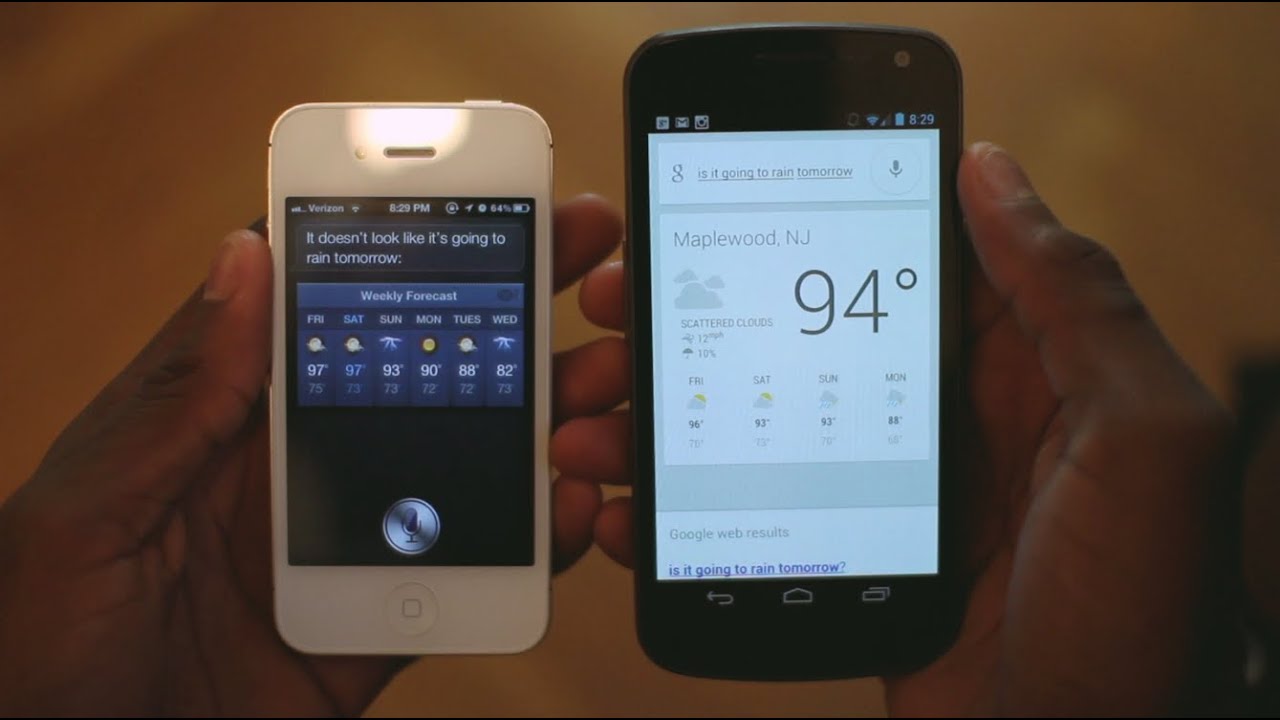
Siri vs Google Voice Search on Android 4.1 Jellybean! Thumbs up! Clearly Google's voice search is ridiculously fast. Some like Siri's beauty & others like Google's simplicity. Which side are you on? Note: The Galaxy Nexus was running Android 4.1 Jellybean and the iPhone 4S was running iOS5. Both were on the same Wifi network. Full list of questions asked: Round 1 [Easy]: Is it going to rain tomorrow? How hot is it in topeka? What's the weather in Belgium? Convert 1 pound to ounces. What is the capital of Florida? Who is the president of Egypt? How big is Japan? How long is the Golden Gate Bridge? How tall is the Sears/Willis Tower? How tall is Yao Ming? When is Tiger Woods' Birthday? Round 2 [Difficult]: Did the Yankees win? What movies has Brad Pitt been in? Where are nearby theaters? Where can I get sushi nearby? What is the area code for Beverly Hills? Remind me to go to the gym tomorrow at 9AM. Set a timer for 2 minutes. Note to self: Get more cereal! ~ twitter.com gplus.to @MarquesBrownlee @MKBHD
The video presents a side-by-side comparison between Siri on iOS and Google Voice Search on Android 4.1 Jelly Bean to evaluate how each assistant handles a range of questions. In the early portion, the host demonstrates basic factual queries such as weather, temperatures, and simple data like currency conversion and famous landmarks. Google Now demonstrates quick, direct responses for straightforward questions like weather in Topeka or the height of the Sears Tower, while Siri provides results that often include additional context or cards, sometimes sourced from Wolfram Alpha, and occasionally requires extra steps or confirmations. The presenter notes that Google Now and Google Voice Search excel at factual information and direct answers, whereas Siri shines in conversational capabilities, jokes, and interactive prompts, though it sometimes relies on richer information cards that come from third-party sources. The summary of the test concludes that factual reliability leans toward Google, while Siri offers a more playful and conversational experience, with each assistant showing strengths and weaknesses depending on the type of query. The video closes with reflections on the different design goals of the two assistants and an invitation for viewers to comment with their preferences and experiences, while an annotation encourages exploration of Android 4.1 Jelly Bean features. In the concluding segment, the host recaps that Google Now and Google Voice Search deliver faster and more accurate factual responses, particularly for weather, distances, and measurements, backed by Google’s algorithms. Siri is described as more conversational and capable of jokes and advice, but it sometimes returns results that are read aloud from Wolfra m Alpha cards or requires reading off additional contextual information. The presenter also notes the visibility of the information sources in the cards produced by the Google ecosystem, something not always mirrored in Siri's responses. The overall takeaway is that Google’s approach is highly effective for data-driven questions, while Siri offers a more human-like assistant experience despite occasional limitations in pulling direct facts. Viewers are encouraged to weigh the trade-offs between speed, accuracy, and conversational capability when choosing which assistant to rely on for different tasks.
Topics · Science & Technology · Mobile Technology · Artificial Intelligence · Voice Assistants
Questions answered
- Which assistant handles weather and simple fact questions more efficiently?
- Google Now and Google Voice Search tend to provide faster and more direct factual responses for questions like weather, distances, and measurements.
- What can Siri offer beyond direct facts?
- Siri offers a more conversational experience, can tell jokes, and provide advice, which is a different kind of interaction than Google's straightforward results.
- What happens when the assistant cannot answer a question?
- If the assistant cannot answer, it typically defaults to a Google web search to try to retrieve relevant information.