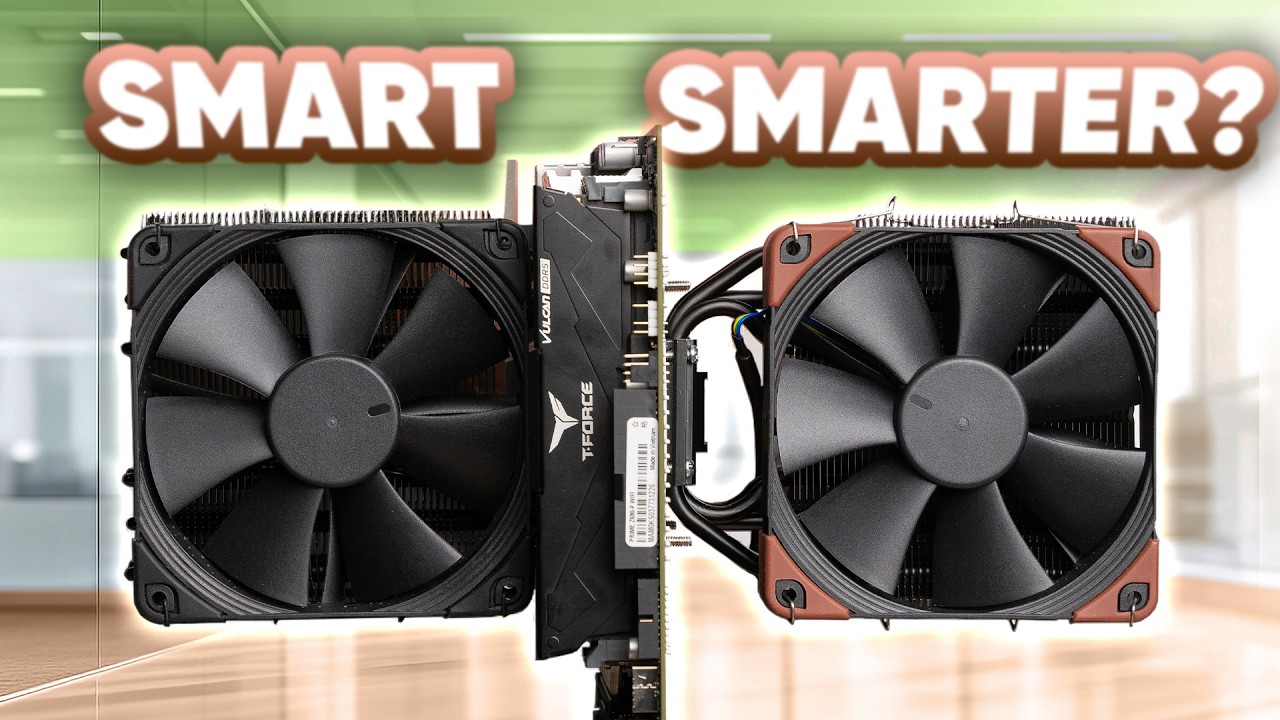
Why aren't we cooling the back of our CPU?
0 up · 0 down · 0 ratings
Promos
Check out acuityscheduling.com to save 20% off your first Acuity Scheduling subscription. Take full control of your web content with Threatlocker's all-new Web Control feature! Check it out using our link: lmg.gg Sure you can buy an AIO cooler, or maybe a Noctua Air Cooler, or maybe you are a Cooler Master guy, I don't judge. Maybe you could use LN2 for maximum overclocking, or maybe you're only thinking in one dimension. We put a cooler on the back of the motherboard to see if it is the solution no one is talking about. Discuss on the forum: linustechtips.com Buy a Thermalright Phantom Spirit 120 EVO CPU Air Cooler: geni.us Buy a Thermalright Grand Vision 360mm AIO Cooler: geni.us Buy a Noctua NH-U12S CPU Air Cooler: geni.us Buy a Noctua NH-D12L chromax.Black CPU Air Cooler: geni.us Buy a Noctua NT-H2 3.5g Thermal Paste: geni.us Buy a Lian Li Galahad II Trinity Performance 240mm AIO Cooler: geni.us ► GET OUR MERCH: lttstore.com ► GET EXCLUSIVE CONTENT ON FLOATPLANE: lmg.gg ► GET A VPN: piavpn.com ► SPONSORS, AFFILIATES, AND PARTNERS: lmg.gg Purchases made through some store links may provide some compensation to Linus Media Group. CHAPTERS --------------------------------------------------- 0:00 This is a good idea 2:24 Some Obstacles 3:11 Making a Backplate 3:58 Mounting the rear cooler 7:50 Final Results
In this Linus Tech Tips video, the team explores an unconventional idea: cooling a CPU from the back of the motherboard. The opening segment frames the question by showing heat on the backside of the motherboard and asking whether removing that heat via a backplate cooler could meaningfully improve overall CPU temperatures. Early tests with a simple fan behind the motherboard yield only a tiny temperature shift, suggesting that backing a cooler against the back is not a straightforward win. The creators then describe the practical challenges: contacting a cooler to the back of the motherboard is impeded by the CPU back plate, traces on the motherboard, and the nonflat nature of back-side components. They conclude that any potential gains depend on heat transfer through the motherboard itself, not just the back side, and they set out to build a custom back plate to evaluate true contact and cooling efficiency. The middle section documents the design process, including removing the back plate, fabricating a new metal back plate, and using a thicker cushioning layer to achieve contact despite nonflat surfaces. The tests compare front versus back mounting in multiple environments, including a controlled environmental chamber and a normal office setting, to reveal how real-world airflow and room temperature affect outcomes. The final results show that while back cooling can produce small improvements in certain conditions, the gains are minimal compared to a conventional front-mounted cooler, and front cooling generally remains the more effective solution. The video closes with a practical takeaway: back cooling is possible but not a universal fix, and the most impactful approach is to optimize front-side cooling or pursue other methods only if the goal is marginal improvement rather than a dramatic performance boost. The host encourages audience interaction, invites feedback on what could be tested next, and plugs sponsored content while underscoring the value of empirical testing in understanding cooling performance.
Topics · science and technology · engineering · computer hardware · thermodynamics · experimental testing · technology review
Questions answered
- Does cooling the CPU from the back of the motherboard provide meaningful temperature improvements?
- The video shows only small improvements in controlled environments and office airflow tests, and front mounting often performs better, indicating back cooling offers limited gains at best.
- What are the main challenges of mounting a back cooler on a modern CPU setup?
- Key challenges include the back plate, nonflat back surfaces, insulating traces, and achieving reliable contact across the cpu heat spreader due to motherboard components.
- Is back cooling worth pursuing over standard front cooling?
- For most scenarios, front cooling remains more effective; back cooling may be interesting as a proof of concept but generally yields minimal practical benefits.