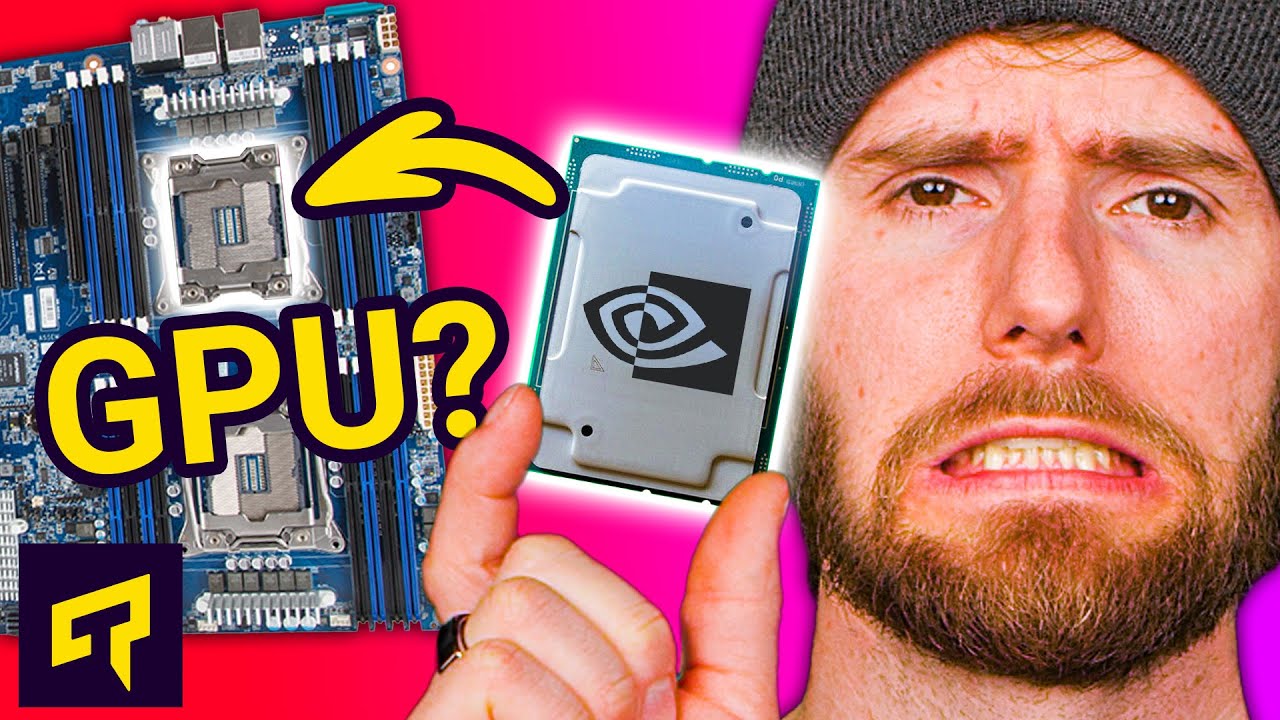
Can You Put a GPU on a MOTHERBOARD?
0 up · 0 down · 0 ratings
Promos
Visit brilliant.org to get started learning STEM for free, and the first 200 people will get 20% off their annual premium subscription. Why can't you just install a GPU in a motherboard socket instead of buying a bulky graphics card? Leave a reply with your requests for future episodes, or tweet them here: twitter.com ► GET MERCH: lttstore.com ► AFFILIATES, SPONSORS & REFERRALS: lmg.gg ► PODCAST GEAR: lmg.gg ► SUPPORT US ON FLOATPLANE: floatplane.com FOLLOW US ELSEWHERE --------------------------------------------------- Twitter: twitter.com Facebook: @LinusTech Instagram: @linustech TikTok: @linustech Twitch: twitch.tv
The video explains why you cannot simply mount a GPU directly on a motherboard, instead of using a discrete graphics card. It centers on three core hurdles: power delivery, memory architecture, and the motherboard socket design. First, GPUs require substantial power, and the VRM circuitry on a dedicated graphics card is specialized to handle that load, which would make a motherboard much larger and more expensive if embedded. Second, memory considerations differ greatly between CPUs and GPUs; GPUs rely on high-bandwidth VRAM (GDDR) to feed textures and assets, whereas system DDR RAM has different latency and bandwidth characteristics, making an integrated solution prone to bottlenecks and errors without a purpose-built memory subsystem. Third, the socket problem compounds over time as multiple GPU manufacturers and rapidly evolving architectures would force frequent motherboard upgrades, locking users into vendor ecosystems and creating a huge variety of incompatible configurations. The video also notes that even if you solved power and memory issues, the overall market demand would be too small to justify pushing GPU sockets into mainstream desktops, so the practical path remains PCIe-based discrete GPUs. In conclusion, the host argues that a motherboard with an integrated GPU socket would be prohibitively expensive, technically complex, and unnecessary for most users, so current designs favor universal PCIe graphics cards instead. The presentation also hints at laptops and specialized devices as the only realistic contexts where GPU-on-motherboard concepts might exist in the future, rather than mainstream desktops.
Topics · technology · hardware · computing · pc-building · gpu · motherboard · laptops · future-tech
Questions answered
- Why can't GPUs be directly mounted on a motherboard like CPUs are on some sockets?
- Because GPUs require heavy power delivery, specialized VRAM (GDDR) with high bandwidth, and a motherboard would need to support many different GPU architectures and memory configurations, making it expensive and impractical.