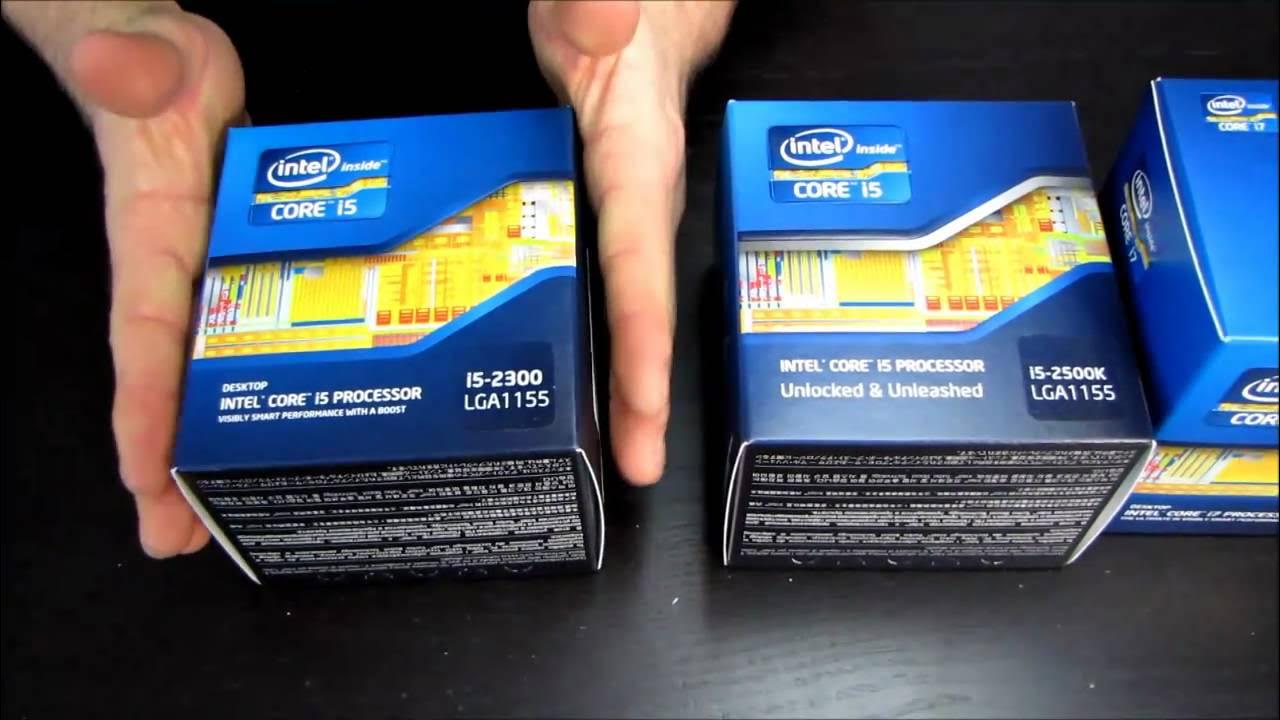
Intel Core i5 2300 LGA1155 CPU Processor Unboxing Linus Tech Tips
0 up · 0 down · 0 ratings
Description
ncix.com The Core i5 2300 is the lowest end of Intel's new 2nd generation Core i5 "Sandy Bridge" processors.
The video provides an in-depth unboxing and comparison of the Intel Core i5 2300, a Sandy Bridge processor on the LGA 1155 platform. Early in the presentation, the host places the i5 2300 within the broader i5 lineup, noting that it is a value-oriented option relative to faster chips like the 2500K and the i7 family. He explains that the i5 2300 uses the LGA 1155 socket and works with p67, h67, and z68 chipsets, highlighting that onboard graphics are present on H67 and that turbo boost is supported on compatible boards. Throughout the segment, the host clarifies that the 2300 is not unlocked for maximum overclocking, and contrasts it with the 2500K which is unlocked, emphasizing the limitations on turbo boosting and overclocking for the non-K chip. He also compares cache sizes, noting that the i5 2300 has six megabytes of cache while the i7 variants have eight, and explains the absence of hyperthreading on the i5 2300. The segment ends with a practical take on how these CPUs stack up in gaming and everyday tasks, and a reminder that turbo boost behaves differently depending on the motherboard chipset and the processor’s K designation. Later in the video, the host moves to a direct side-by-side comparison with the i5 2500K and the i7 2600K. He reiterates clock speeds and features: the 2500K is faster out of the box, supports unlocked overclocking, and includes an upgraded HD graphics 2000 versus 3000 in K-series variants. The i7 2600K is identified as the fastest option in this family at the time, offering higher performance, an 8 MB cache, hyper-threading, and fully unlocked overclocking for maximum overclocking potential. The host summarizes how the 2300’s locked multiplier and 65W-ish TDP shape its performance envelope, and explains why turbo boost is present but not as extensible as on K-series CPUs. He also notes that onboard video on the H67 platform is usable but that overclocking capabilities depend on the chipset and motherboard included in the build. The unboxing portion covers the heatsink assembly, copper slug, pre-applied thermal compound, and the included 80 mm PWM fan, concluding with warranty and installation instructions and a closing nod to the LGA 1155 platform’s connector differences compared with 1156. Overall, the video aims to demystify the midrange i5 2300 by placing it in context with its higher-end siblings, while offering practical guidance on overclocking limits, graphics capabilities, and platform compatibility for potential buyers and PC builders. The unboxing serves as a tactile introduction to the product, followed by a technical interpretation of where the 2300 fits within Intel’s Sandy Bridge lineup and which user scenarios it best serves, such as budget builds or systems where overclocking headroom is not a priority.
Topics · technology · hardware · computing · product-unboxing
Questions answered
- What is the key difference between the i5 2300 and the i5 2500K regarding overclocking?
- The i5 2300 is not unlocked for maximum overclocking, meaning its multiplier cannot be freely adjusted. In contrast, the i5 2500K is unlocked, allowing higher overclocking potential.
- What platforms and chipset features affect the i5 2300's capabilities?
- The i5 2300 uses the LGA 1155 socket and works with p67, h67, and z68 chipsets. On H67 you have onboard graphics, while P67 and Z68 support varying levels of overclocking, with turbo boost behavior depending on the chipset and whether the CPU is a K-series model.
- Does the i5 2300 include hyperthreading?
- No, the i5 2300 does not feature hyperthreading, and it has six megabytes of cache, fewer than some i7 variants that offer eight megabytes.