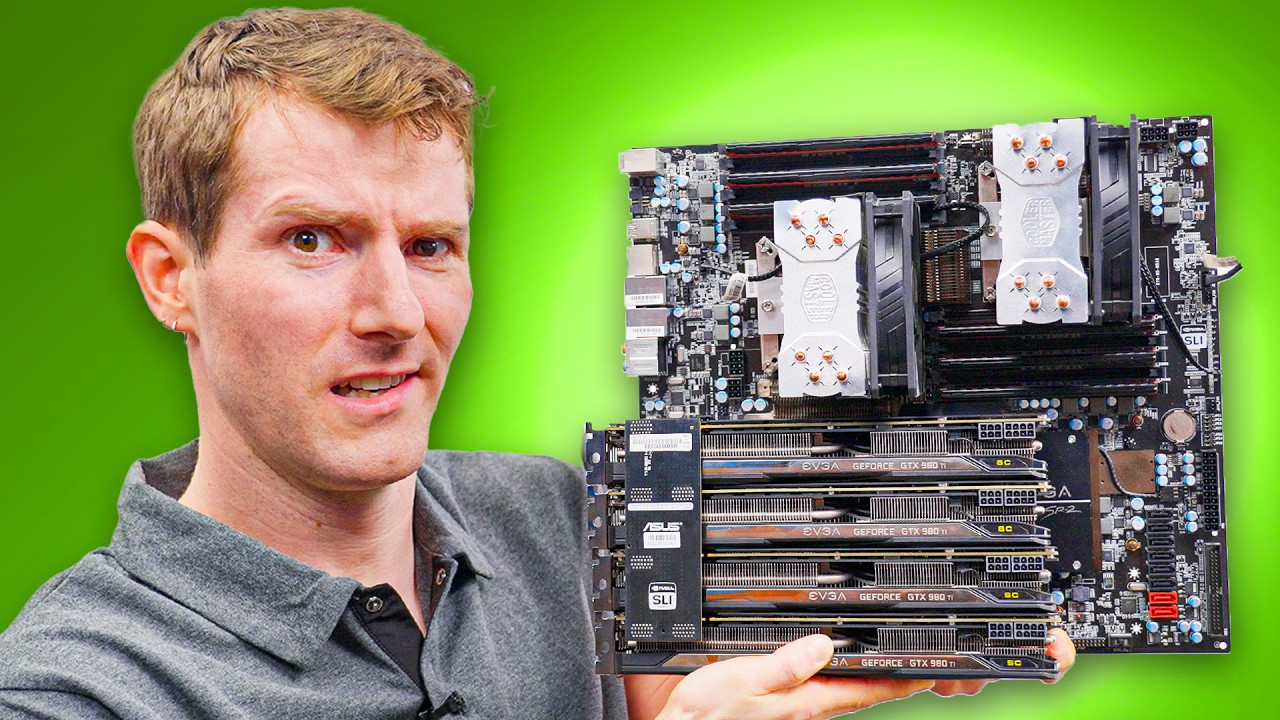
How Bad is This $10,000 PC from 10 Years Ago??
0 up · 0 down · 0 ratings
Promos
Check out the FlexiSpot E7 Plus, and their new comfy recliners, using the link below and use the code LINUSE7P50 for $50 off on your order of $500 or more: E7 Plus standing desk: bit.ly FlexiSpot Recliners: bit.ly Can you really future proof? The Classified SR-2 seems to think so, and we're maxing out its upgrade path to see what it can REALLY do with 24 threads from 2011. Do You OC?: youtube.com Discuss on the forum: linustechtips.com Buy a Samsung SSD 850 EVO 2TB SSD: geni.us Buy an EVGA Supernova 1600 T2 PSU: geni.us Buy Corsair 1600MT/S CL9 1x4GB DDR3 RAM: geni.us Purchases made through some store links may provide some compensation to Linus Media Group. ► GET MERCH: lttstore.com ► GET EXCLUSIVE CONTENT ON FLOATPLANE: lmg.gg ► SPONSORS, AFFILIATES, AND PARTNERS: lmg.gg ► EQUIPMENT WE USE TO FILM LTT: lmg.gg ► OUR WAN PODCAST GEAR: lmg.gg FOLLOW US --------------------------------------------------- Twitter: twitter.com Facebook: @LinusTech Instagram: @linustech TikTok: @linustech Twitch: twitch.tv MUSIC CREDIT --------------------------------------------------- Intro: Laszlo - Supernova Video Link: youtube.com iTunes Download Link: itunes.apple.com Artist Link: soundcloud.com Outro: Approaching Nirvana - Sugar High Video Link: youtube.com Listen on Spotify: spoti.fi Artist Link: youtube.com Intro animation by MBarek Abdelwassaa @mbarek_abdel Monitor And Keyboard by vadimmihalkevich / CC BY 4.0 geni.us Mechanical RGB Keyboard by BigBrotherECE / CC BY 4.0 geni.us Mouse Gamer free Model By Oscar Creativo / CC BY 4.0 geni.us CHAPTERS --------------------------------------------------- 0:00 Intro 1:36 The SR-2 2:25 The Rest of the Build 5:30 The GPU 7:00 Overclock 8:30 Quad SLI 15:40 Time for a Modern Card 19:30 Conclusion 21:47 Outro
This video dives into a relic of PC gaming history, a $10,000 dual Xeon, quad GPU monster built around EVGA’s Classified SR-2 and a pair of Xeon X5690 CPUs. The host explains the premise: this machine represents the pinnacle of enthusiasts pushing the upgrade path years ago, and they set out to test how far it can still go in 2024 with modern games and a high end GeForce GTX 980 Ti setup, all while exploring the practicalities of such a build today. The first major focus is on the SR-2 motherboard itself, its massive EVGA HPTX form factor, and the ambitious memory and PCIe expansion it offered at the time. They discuss the cooling and cabling challenges, power considerations, and the idea that this was never meant to be a daily driver but a showcase of extreme upgrade potential. The video then shifts to assembling the rest of the rig, including a 1600 W EVGA Supernova T2 PSU and a mix of DDR3 memory, where they cobble together triple-channel configurations to squeeze performance from the era. The host sets expectations for how this platform would handle gaming with multiple GTX 980 Ti cards, highlighting the 24 total CPU threads and the potential for overclocking, and proceeds to test, tweak, and benchmark across a spectrum of games that still hold relevance today. Overall, the narrative balances reverence for the hardware with the humor of attempting to wring modern usability from a once top tier system, drawing concrete conclusions about where the SR-2 stands in the context of contemporary GPUs and CPUs. In the early build phase, the video emphasizes the SR-2’s physical footprint and the accompanying hardware ecosystem. They describe the unusual power requirements, including dual 8-pin CPU connectors and three 6-pin PCIe power connectors, underscoring how that level of bulk was once the norm for extreme rigs. The memory story unfolds with Corsair DDR3 sticks cobbled together to achieve triple-channel memory, and they candidly assess compatibility, noting some kits may be inconsistent on such a platform. As they assemble, the host praises the EVGA DG-85 case for its cable management and VR-ready HDMI passthrough, while also pointing out the awkwardness of fitting newer storage devices without modern UEFI boot support. The discussion also covers the storage strategy, sticking with SATA and a 2 TB SSD library to avoid bootloader hacks, illustrating the practical constraints of reviving legacy hardware. The segment closes with a plan to push the platform toward a real overclocking test, acknowledging it will be awkward but ultimately rewarding to see if the 10-year-old kit can still perform, given today’s expectations for gaming fluidity and energy efficiency. The GPU strategy centers on four GTX 980 Ti cards in quad SLI, including a detailed look at the 384-bit memory bus and the challenges of maximizing 3D performance across a high-power setup. They run a series of benchmarks and real-game tests to gauge 1080p and 1440p performance, noting frames per second, frame pacing, and the practical overhead of inter-GPU communication. The team highlights the diminishing returns of quad SLI with age, pointing out micro stutter and inconsistent scaling, especially beyond two cards, where the APs and drivers struggle to coordinate four GPUs. They test a range of titles, from Crysis to Jedi Fallen Order, and capture the reality that even with modern patches and driver tweaks, the configuration is not a reliable daily driver. The dialogue remains balanced and educational, showing both the nostalgia of multi-GPU glory days and the hard truth about current day practicality, culminating in a verdict that the system remains a remarkable curiosity rather than a viable modern gaming rig. The camera work and on-screen notes reinforce the learning while the hosts celebrate the engineering vigor behind reviving this sort of hardware. The overclocking and tuning segment delivers a hands-on exploration of how far the CPUs could be pushed and what that means for gaming performance. An initial dummy overclock boosts both Xeon CPUs to above 4.0 GHz, then a more aggressive push hits 4.2 GHz before stability issues force a conservative 4.2 GHz finish. The host explains the power draw and thermal realities, showing that even at optimized CPU speeds, the GPU bottleneck remains a limiting factor in the total system performance. With the CPUs tuned, they reassess the GPU load across multiple modern tests, finding that the four-card arrangement rarely yields the ideal scaling and that the system remains CPU-bound in many scenarios. The final assessment weighs the experience against the energy costs, noting that while the SR-2 is an engineering marvel, its usability today is highly contextual and best enjoyed as a retro tech showcase rather than a practical gaming machine. In closing, the video reflects on the joy of experimentation, the enduring appeal of overclocking culture, and a practical takeaway: upgrading an older system is often more sensible than chasing a mega GPU cascade that may not translate into meaningful gains. The conclusion ties together the historical significance with practical insights for builders today. The hosts summarize the performance reality: the SR-2 with quad 980 Tis can still deliver playable frames in certain titles at modest settings, but the CPU and platform bottlenecks keep it from matching modern mid-range builds. They advise that for most enthusiasts, replacing the CPU and motherboard first is a more efficient path to meaningful gaming improvements than trying to resurrect a 10-year-old platform. They also acknowledge the charm and educational value of the project, celebrating the stubborn curiosity that drives DIY computer culture while acknowledging that the days of multi-GPU configurations on consumer games are largely behind us. The video ends on a note of enthusiasm for revisiting difficult but rewarding builds and invites viewers to participate in a forum discussion about similar retro upgrade projects, signaling the ongoing community energy around this kind of hardware archaeology.
Topics · technology history · hardware benchmarking · overclocking · consumer electronics · gaming PCs · computer architecture
Questions answered
- What was the EVGA Classified SR-2 platform, and why is it notable today?
- The EVGA Classified SR-2 was a dual Xeon workstation motherboard that supported up to 24 threads across two CPUs, six-channel memory, and multiple PCIe slots, making it a legendary example of extreme enthusiast builds from over a decade ago.
- How did the host approach testing the four GTX 980 Ti GPUs in quad SLI?
- They configured quad SLI with a dual Xeon platform, monitored power usage around 750 watts, and ran modern games to assess frame rates, scaling, and the practicality of SLI in today’s context, noting significant overhead and diminishing returns beyond two GPUs.
- What were the main bottlenecks observed during the tests?
- The CPU and platform limitations were the primary bottlenecks, with DDR3 memory and the QPI link introducing latency and stutter that limited scaling and modern game performance, even as the GPUs offered substantial raw power.
- Would you recommend reviving a system like this for modern gaming?
- For most players, reviving such a platform is not recommended due to poor scalability and driver issues; upgrading the CPU and motherboard is typically a better path to meaningful performance gains, though the build remains an excellent educational retro project.