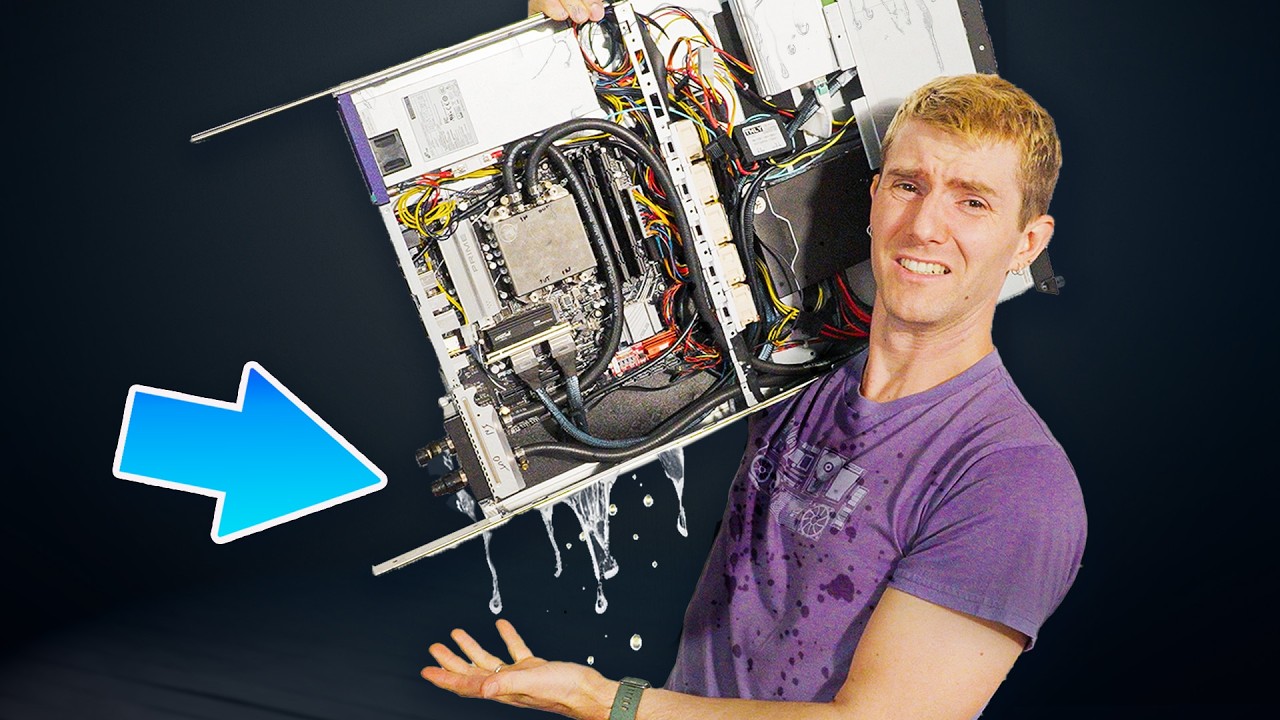
The Big Leak WAS my fault… maybe - Flooded PC Repair Part 2
0 up · 0 down · 0 ratings
Description
Promos
Thanks again Pulseway for helping with today's video. Get started free today, or save 40% on all plans at lmg.gg One of my custom cooled gaming machines decided to leak. So what caused this water damage? Was it my fault? And how can I stop this from happening again? Discuss on the forum: linustechtips.com ► GET OUR MERCH: lttstore.com ► GET EXCLUSIVE CONTENT ON FLOATPLANE: lmg.gg ► GET A VPN: piavpn.com ► SPONSORS, AFFILIATES, AND PARTNERS: lmg.gg
Check out a TOROIDAL Isolation Transformer (120 VAC to 120 VAC): lmg.gg Purchases made through some store links may provide some compensation to Linus Media Group. Shop Linus Tech Tips Merchandise: 1. 3D Down Jacket Large lttstore.com 2. Backpack lttstore.com 3. LTT Northern Lights Desk Pad 1500mm x 900mm lttstore.com 4. Screwdriver All Black / Silver Shaft lttstore.com 5. Screwdriver Black and Orange / Silver Shaft lttstore.com 6. Stealth Desk Pad 1500mm x 900mm lttstore.com 7. Sticklocks lttstore.com 8. Stubby Screwdriver Black and Orange / Silver lttstore.com 9. Tech Sack lttstore.com 10. Track Jacket Large lttstore.com CHAPTERS --------------------------------------------------- 0:00 Intro 1:18 The theories 3:12 We have a solution 5:00 Jake gets grounded 7:50 Sensors 8:50 Draining the loop 11:00 A little help from Pi 14:24 Checking our work 16:15 Setting up the leak sensor 17:10 Why there won't be a "next time" 19:14 Test run 20:25 What about the pumps? 22:36 Fingers crossed 24:19 Outro
The video continues Linus Tech Tips’ water cooling saga with a flooded custom gaming rig in a home rack. The opening section revisits the moment a leak occurred and analyzes initial hypotheses, including a corroded fitting and potential galvanic effects between metals. The host and team explore several theories, ultimately identifying corrosion as the likely culprit and discussing how different materials interacted under load. They introduce a galvanic-isolation approach using a transformer to prevent voltage differences that drive corrosion, explaining how the transformer decouples the circuit and reduces the risk of future leaks. The narrative then shifts to practical fixes, including relocating and securing pumps to a UPS, testing grounding strategies, and outlining a grounding bus bar workflow to ensure chassis and racks are properly bonded. The team tests sensors and monitoring hardware to detect leaks, flow, and tank levels, with hands-on setup of leak, flow, and float sensors. They prototype an automation flow using Pulseway to react to sensor data, including shutting off pumps and isolating the system, and plan to extend monitoring with a Raspberry Pi and a Sequent Microsystems board. As the episode progresses, they install hardware, test scripts, and discuss how data flows from sensors to dashboards, with a focus on ensuring the cooling loop remains protected and controllable, even remotely. The video closes with a mix of troubleshooting and humor, including a demonstration of remote control options, a reflection on the value of monitoring, and a tease for further refinements in the next installment.
Topics · technology · hardware · DIY · home automation · education · science_and_tech
Questions answered
- What caused the leak and how was it addressed?
- The leak was traced to corrosion on fittings likely driven by galvanic effects in the cooling loop. The team implemented an isolation transformer to prevent voltage differences, added a grounded mounting solution, installed leak and flow sensors, and set up a Pulseway-based monitoring workflow to shut off pumps if a leak is detected.
- How is monitoring implemented and what does Pulseway do?
- A Raspberry Pi with sensors is connected to Pulseway via an API to report real-time flow, leak, and tank status. Custom fields in Pulseway store sensor data, and an automated workflow can shut down pumps or trigger alerts if data indicates a problem.
- What safety measures were added to prevent future incidents?
- They added galvanic isolation with a transformer, improved grounding, a dedicated grounding bus bar, multiple sensors (leak, flow, float), and remote monitoring with automatic pump shutoffs to limit water damage.
- What components were used for sensing and automation?
- Leak sensor with two wired leads, a flow sensor, a float switch, a Raspberry Pi with a Sequent Microsystems hat, custom wiring including pull-up/down resistors, relays for pump control, and Pulseway for alerting and automation.
- What guidance is given for future builds?
- The video emphasizes robust monitoring, proper grounding, and tested automation workflows, suggesting future work will focus on refining sensor thresholds, securing wiring, improving panel safety, and expanding automated shutdowns across more devices.