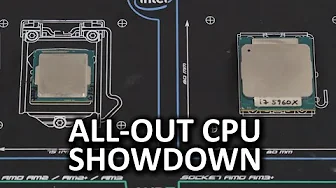
Heavyweight vs Lightweight CPU Showdown - Intel i7 5960X and Pentium G3258
0 up · 0 down · 0 ratings
Channels and socials
Comparing Intel's i7 5960X to their Pentium G3258 might seem like a "David vs Goliath"-esque battle, but the results might not be so one-sided... Dollar Shave Club link: dollarshaveclub.com Sponsor link: linustechtips.com Pricing & discussion: linustechtips.com Support us: linustechtips.com Join our community forum: bit.ly twitter.com @LinusTech Intro Screen Music Credit: Adhesive Wombat -
Check out his channel here: youtube.com Pre-roll Music Credit: Title: Hellberg - I'm Not Over (Radio Edit) [feat. Tash] Video Link: youtube.com Beatport Download Link: beatport.com Label Channel: youtube.com Outro Screen Music Credit: Approaching Nirvana - Sugar High youtube.com
The video sets up a classic underdog vs flagship comparison by pairing Intel's eight-core i7 5960X with the budget-oriented Pentium G3258 anniversary edition. It clearly frames the showdown as a David vs Goliath style contest, promising to run the G3258 with as much optimization as possible to see how close it can come to the high-end 5960X. The host describes the core specifications of each processor, noting the i7 5960X's 3.0 GHz base clock, boost up to 3.5 GHz, 16 threads via hyperthreading, quad-channel DDR4 memory support, and a very high price. In contrast, the G3258 is presented as a dual-core Haswell-based chip with no hyperthreading, a fixed 3.2 GHz clock, and a notably lower price point, but with potential for aggressive overclocking to around 4.5 GHz or more with modest voltage. The testing setup includes 16 GB of DDR3 or DDR4 depending on compatibility, an Nvidia GTX 970 graphics card, and a Corsair H60 liquid cooler, with all games run at 1080p to reflect common gamer usage. The presenter emphasizes that while the G3258 can deliver surprisingly decent frame rates when overclocked, it struggles in multi-threaded workloads such as rendering and compression benchmarks, underscoring the advantages of more cores for non-gaming heavy tasks. The conclusion suggests that cost, power efficiency, and the extent of performance headroom influence the final winner, acknowledging that the best choice depends on the user’s priorities, whether raw multitasking capability or gaming performance at a budget. The video closes with engagement prompts and a light plug for sponsor and affiliate links, while inviting viewers to share who they think won the showdown.Overall, the video presents a balanced view that values price-to-performance and highlights the practical trade-offs between high-end CPUs and budget overclocking potential.
Topics · technology · hardware · cpu benchmarking · processor comparison
Questions answered
- What were the main strengths of the i7 5960X in this showdown?
- The i7 5960X’s main strengths were its eight cores, 16 threads through hyper-threading, high sustained performance, and better multitasking and rendering capabilities, which kept it ahead in multi-threaded workloads and at peak efficiency in gaming when paired with a capable GPU.
- How did the Pentium G3258 perform and why is it notable?
- The Pentium G3258 performed surprisingly well for its price, especially when overclocked to around 4.5 GHz, delivering strong single-threaded performance that narrowed the gap with the 5960X in some games, while clearly lagging in multi-threaded tasks and heavy workloads due to its dual-core design and lack of hyper-threading.