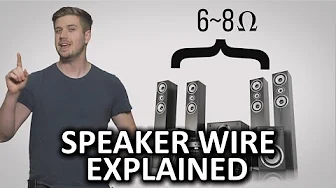
What Speaker Wire To Buy As Fast As Possible
0 up · 0 down · 0 ratings
Description
If you're looking to upgrade your home audio system, you might be surprised by just how important your speaker wire choices are... Dollar Shave Club link: dollarshaveclub.com Follow: twitter.com Join the community: linustechtips.com License for image used in this video: creativecommons.org
The video introduces the fundamentals of choosing speaker wire by focusing on impedance, a measure of how much current a speaker or wire resists. It explains that most home theater speakers run between six and eight ohms, and that improper wiring can add impedance that degrades performance, especially for low-impedance speakers. The host demystifies common marketing hype around cables and emphasizes practical factors: wire length and thickness (gauge) are the main determinants of effective current delivery, much like water through a pipe. He compares short, thick wires to long, skinny ones, noting that shorter runs with thicker wire lower impedance and improve current delivery, which matters for higher-end or four-ohm speakers. The guide provides concrete gauge recommendations aligned with room size and speaker impedance, suggesting 16 gauge for typical rear channels within about 50 feet, 22 gauge for front center and subwoofers within around 30 feet, and 14 or 20 gauge for surround versus front channels when using 4 ohm speakers. The discussion also covers insulation quality and connector types, advising that while solid connections matter, spending excessively on premium cables yields no audible improvements and that the focus should stay on sensible wire gauge and clean terminations to avoid noise or loose connections. In closing, the host frames audio wire selection as a straightforward, no-nonsense topic and invites viewers to judge the results by whether their system sounds right, not by hype, while peppering the video with light humor and a few product plug mentions. The overall takeaway is practical guidance for wire gauge and length, paired with a skeptical view of overpriced cables, aimed at helping typical home theater setups achieve better sound without unnecessary costs.
Topics · audio · home_theater · electronics · consumer_tech
Questions answered
- What is impedance and why does it matter for speaker wire selection?
- Impedance is the resistance a speaker or wire offers to electrical current. It matters because too much added resistance from improper wiring can reduce performance, especially with low-impedance speakers, and influence how much power reaches the speaker.
- What gauge wire is recommended for typical home theater setups?
- For typical 6 to 8 ohm speakers, 16 gauge wire is recommended for rear channels up to about 50 feet, 22 gauge for front center and subwoofer up to around 30 feet, and 14 gauge for surrounds or 20 gauge for front channels if using 4 ohm speakers.
- Do premium cables improve sound quality?
- No, spending hundreds on premium cables generally does not improve sound quality; the video advises avoiding snake oil and focusing on appropriate gauge, length, and solid connections.
- Should shielding or insulation protect against interference in speaker wires?
- Insulation protects against oxidation and shorting, while shielding specifically mitigates interference. In practice for typical speaker wires, shielding is not a major factor in sound quality, but proper secure terminations and avoiding overly long runs are more impactful.