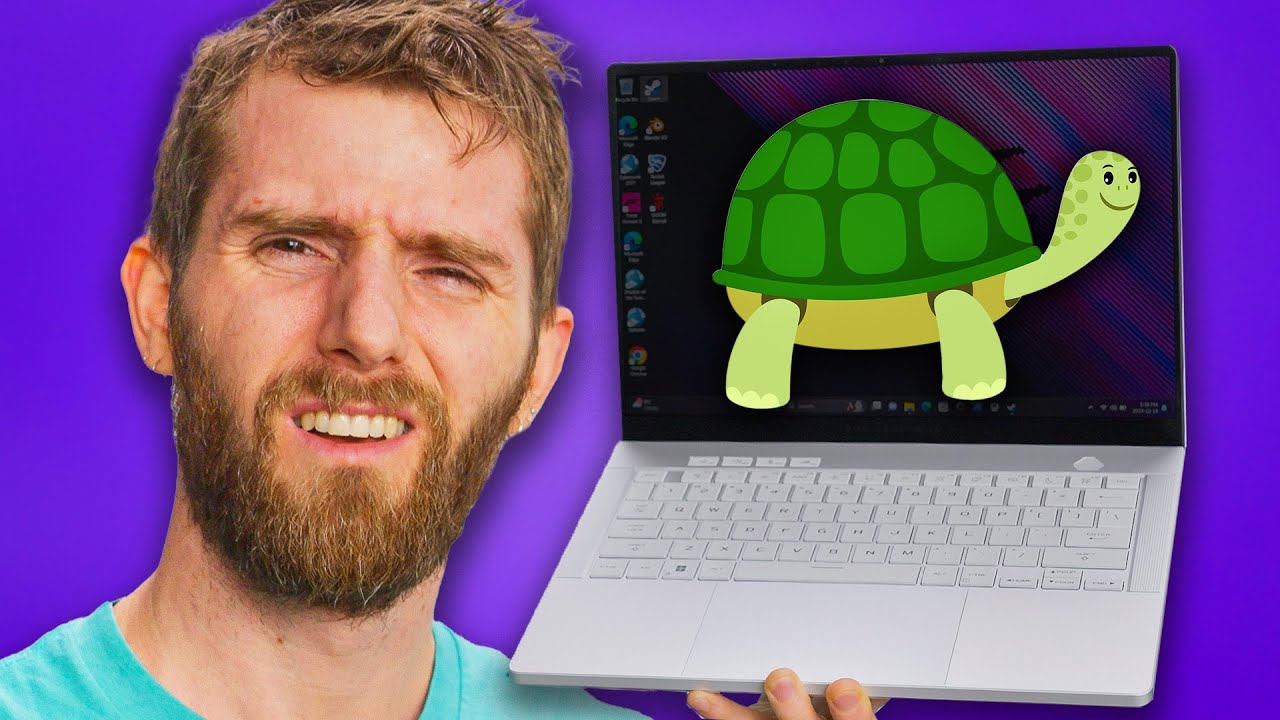
I'm Sorry, Slower is… Better?? - Asus Zephyrus G14 and G16 First Look
0 up · 0 down · 0 ratings
Description
Thanks ASUS for sponsoring today’s video!
Promos
Check out the new ROG Zephyrus G14 and G16 below: rog.asus.com rog.asus.com Discuss on the forum: linustechtips.com We're all gearing up for CES 2024 coverage this year, but ASUS came by to give us a first look at what's coming up for ROG. Let's take a peek at what's new and if slower = better ► GET MERCH: lttstore.com ► GET EXCLUSIVE CONTENT ON FLOATPLANE: lmg.gg ► SPONSORS, AFFILIATES, AND PARTNERS: lmg.gg ► EQUIPMENT WE USE TO FILM LTT: lmg.gg ► OUR WAN PODCAST GEAR: lmg.gg FOLLOW US --------------------------------------------------- Twitter: twitter.com Facebook: @LinusTech Instagram: @linustech TikTok: @linustech Twitch: twitch.tv MUSIC CREDIT --------------------------------------------------- Intro: Laszlo - Supernova Video Link: youtube.com iTunes Download Link: itunes.apple.com Artist Link: soundcloud.com Outro: Approaching Nirvana - Sugar High Video Link: youtube.com Listen on Spotify: spoti.fi Artist Link: youtube.com Intro animation by MBarek Abdelwassaa @mbarek_abdel Monitor And Keyboard by vadimmihalkevich / CC BY 4.0 geni.us Mechanical RGB Keyboard by BigBrotherECE / CC BY 4.0 geni.us Mouse Gamer free Model By Oscar Creativo / CC BY 4.0 geni.us CHAPTERS --------------------------------------------------- 0:00 Slower = better? 2:33 ROG G16 3:08 Display 7:01 Performance 8:46 What's inside? 11:24 I/O 13:29 Audio
Linus Tech Tips takes a first look at the Asus Zephyrus G14 and G16, exploring how slower power envelopes and targeted configurations can deliver meaningful gains in portability without sacrificing too much performance. The video kicks off with an acknowledgement of sponsorship from Asus and frames the G14 as the slimmer, lighter option while the G16 targets higher performance, including a potentially faster GPU choice and more robust cooling options. Linus breaks down why Asus chose to cap GPU power at 100 watts in some configurations and how that decision helps shave thickness and weight, making the lineups more approachable for buyers who don’t need top-tier GPUs. He emphasizes that both laptops feature OLED displays, with the G14 offering a 3K OLED at 120 Hz and the G16 a QHD+ OLED at 240 Hz, both with variable refresh rate tech, which is unusually challenging to implement on self-emissive panels. The discussion then dives into the technical hurdles of VRR on OLED, including brightness fluctuations when frame rates swing, and how Asus mitigates this with a fixed sub-pixel emission rate, effectively stabilizing brightness at high and low frame rates. Throughout, Linus compares materials, such as the CNC milled aluminum chassis, and design choices like infrared facial recognition replacing the older fingerprint reader, while highlighting the impressive trackpad, keyboard, and overall build quality. The segment on I/O options, power delivery, and speaker system rounds out the hands-on look, with a careful note that some of the more ambitious claims require more testing, but the early impressions are very positive, especially for the G14’s overall value and the G16’s premium optioning. The video closes with practical takeaways for buyers and a tease of CES 2024 coverage, underscoring that Asus is intentionally appealing to both casual gamers and professionals who need mobile power with smarter power management and design choices.
Topics · technology · laptops · gaming hardware · consumer electronics
Questions answered
- What are the key differences between the Asus Zephyrus G14 and G16 in this first look?
- The G14 focuses on portability with a thinner profile and lighter weight and uses up to an RTX 4070 with OLED display options, while the G16 targets higher performance with a more capable GPU lineup and a larger, higher refresh OLED or IPS panel, offering more robust cooling and power options.
- Why does Asus lock the emission rate of OLED sub-pixels at high frequencies, and how does that impact brightness?
- To maintain consistent brightness when frame rates fluctuate, Asus fixed the emission rate at 960 Hz for the G16 and 480 Hz for the G14, which stabilizes perceived brightness but requires high-frequency scanning and is computationally intensive.
- Do these laptops still offer OLED benefits with VRR, and what are the tradeoffs?
- Yes, both offer OLED with VRR, reducing tearing and improving smoothness, but achieving VRR on OLED is challenging due to brightness and power considerations; Asus’ approach attempts to balance brightness stability with power efficiency, though it comes with caveats about potential flicker and battery impact.
- What are the main configuration options and the power delivery constraints discussed?
- The G14 tops out at around 90 watts to the GPU with a Ryzen 9 8945HS, and the G16 can be configured up to an RTX 4090 at up to 125 watts to the GPU in manual mode; Asus uses a slim power jack to deliver up to 330 watts with high efficiency, aiming to keep the chassis slim without sacrificing performance.