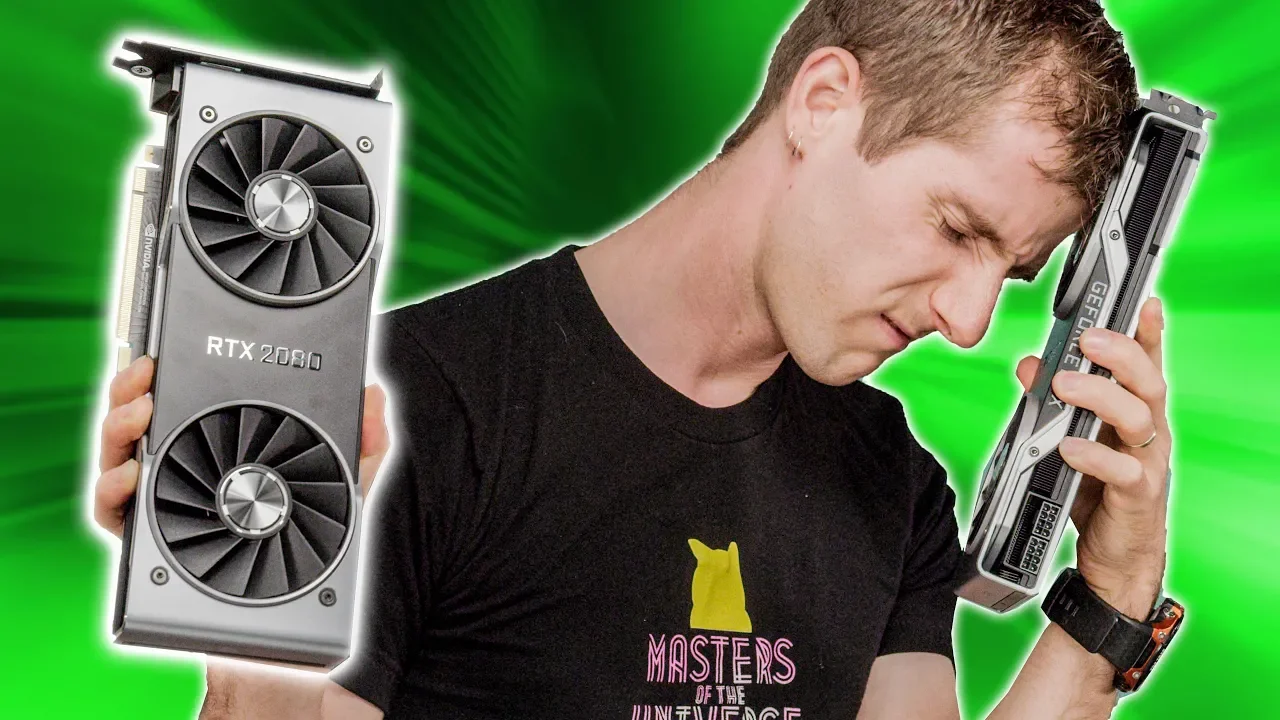
This Seems Rushed... - GeForce RTX Review
0 up · 0 down · 0 ratings
Promos
Check out the Thermaltake Level 20 series cases on Amazon at geni.us Sign up for Private Internet Access VPN at privateinternetaccess.com Buy RTX 2080 Ti on Amazon: geni.us Buy RTX 2080 on Amazon: geni.us Buy GTX 1080 Ti on Amazon: geni.us Buy GTX 1080 on Amazon: geni.us Linus Tech Tips merchandise at designbyhumans.com Linus Tech Tips posters at crowdmade.com Our Test Benches on Amazon: amazon.com Our production gear: geni.us Twitter - twitter.com Facebook - @LinusTech Instagram - @linustech Twitch - twitch.tv Intro Screen Music Credit: Title: Laszlo - Supernova Video Link: youtube.com iTunes Download Link: itunes.apple.com Artist Link: soundcloud.com Outro Screen Music Credit: Approaching Nirvana - Sugar High youtube.com Sound effects provided by freesfx.co.uk
This video presents Linus Tech Tips’ hands-on take on the GeForce RTX 20 series, focusing on the 2080 and 2080 Ti. The host begins by acknowledging the aggressive pre-order momentum and frames the launch as underwhelmed by solid performance data since real-time ray tracing games were not widely available at the time. He explains the core distinction between rasterization and ray tracing, highlighting the RTX architecture’s RT cores that enable hybrid rendering with traditional rasterization for practical frame rates. The review then pivots to live gaming results, noting that the 2080 Ti delivers high 4K performance and that the 2080 sits near last generation Ti levels, while flagging the substantial power, cooling, and price increases. He also discusses productivity benchmarks with mixed results, praising the potential of DLSS while acknowledging software readiness and driver maturity as key caveats. The video ramps up with comments on the launch strategy, calling it rushed and insufficiently prepared, and the host presses for more real-world testing before drawing firm conclusions about RTX impact. In closing, the host teases potential future explorations, including overclocking, VR features, and a deeper dive into DLSS and ray tracing in actual titles once available, while also promoting related hardware and the merchandise store. Overall, the video balances strong initial gaming performance with caution about the preliminary nature of RTX features and the timing of the launch, urging a wait-for-ready-state perspective for consumers and professionals alike.
Topics · technology · hardware · graphics · gaming · reviews
Questions answered
- What is the fundamental difference between rasterization and ray tracing as explained in the video?
- Rasterization renders a scene by projecting 3D content onto a 2D screen using traditional shading, textures, and lighting, while ray tracing simulates light interacting with the world by casting rays from the camera to generate more realistic reflections, shadows, and lighting, with higher computational cost.
- What hardware feature enables real-time ray tracing in the RTX cards according to the video?
- RT cores are dedicated hardware on the RTX GPUs that render simplified ray traced scenes in parallel with the standard CUDA cores, enabling hybrid rendering with traditional rasterization.
- Why does the host consider the RTX launch rushed, based on the transcript?
- Because reviews were conducted with limited time, there were few actual RTX-enabled games available to test, driver and hardware availability was compressed into a short window, and the public demonstrations relied on preselected, curated benchmarks rather than broad real-world scenarios.