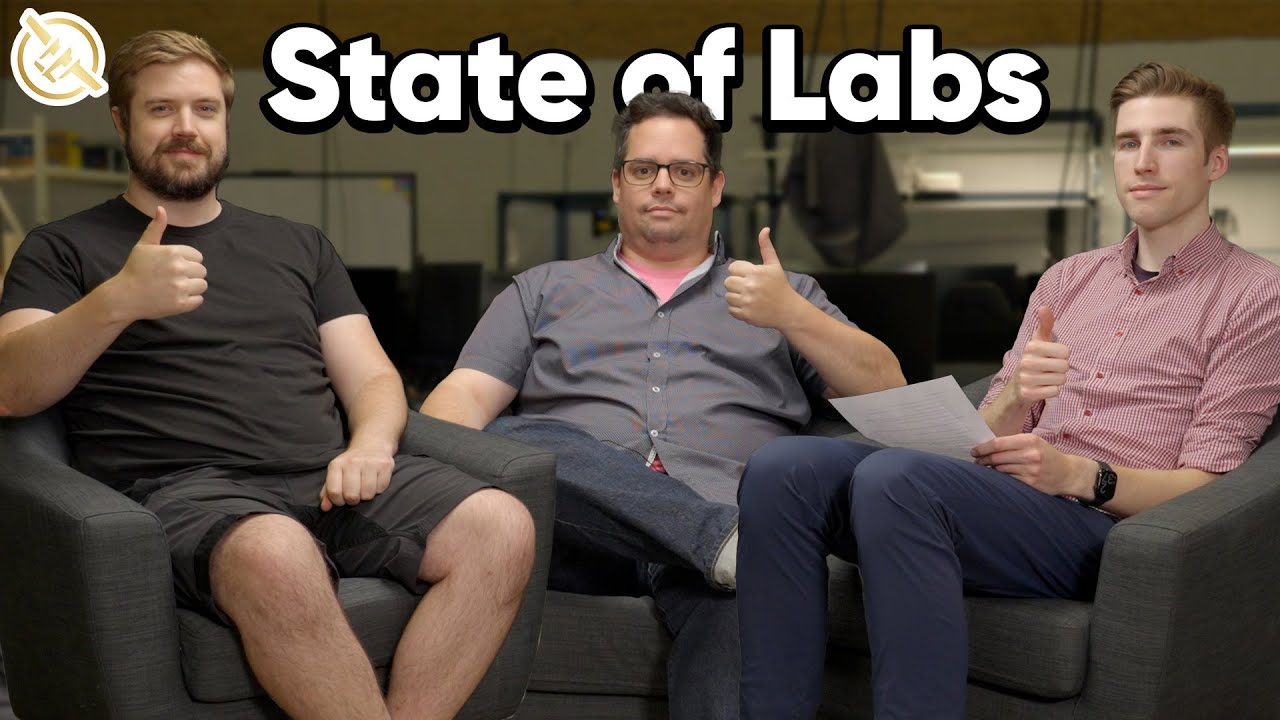
The State of Labs 2025
0 up · 0 down · 0 ratings
Description
Thank you for your support!
Promos
Check out Floatplane for more benefits at a lower price at lmg.gg ► GET MERCH: lttstore.com ► LTX: lmg.gg ► SPONSORS, AFFILIATES, AND PARTNERS: lmg.gg ► OUR WAN PODCAST GEAR: lmg.gg FOLLOW US --------------------------------------------------- Twitter: twitter.com Facebook: @LinusTech Instagram: @linustech TikTok: @linustech Twitch: twitch.tv
The State of Labs 2025 presents an overview of how laboratory ecosystems are evolving as we approach the mid-2020s. The video frames the current landscape by highlighting shifts in research infrastructure, tooling, and collaboration models that enable scientists to work more efficiently and safely. Viewers are guided through a synthesis of trends in automation, data management, and the integration of emerging technologies into everyday lab practice. The presenters draw connections between hardware advancements, software platforms, and the culture of experimentation that drives faster iteration cycles. They also examine how funding, policy, and institutional priorities shape what labs can pursue and what they cannot. The discussion emphasizes the importance of reproducibility and open science as a counterbalance to increasing complexity in modern experiments. Throughout, there are concrete references to case studies, pilot programs, and real-world outcomes that illustrate how labs are adapting to shortage of skilled personnel and rising expectations for speed and reliability. The concluding segments synthesize lessons learned and propose practical steps researchers and administrators can take to future-proof their lab environments. The first major theme centers on automation and robotics as force multipliers for lab teams. The speakers describe how automated platforms reduce repetitive tasks, improve precision, and free researchers to focus on hypothesis-driven work. They compare different deployment strategies, from fully autonomous workflows to hybrid approaches that preserve human oversight for critical decision points. The narrative emphasizes design thinking in lab automation, stressing modularity, interoperability, and scalable software control. Examples are provided to illustrate where automation has shortened development cycles and enhanced throughput without compromising data quality. A key takeaway is that successful automation is as much about process design as it is about the technology itself. End-user training and cross-disciplinary collaboration are highlighted as essential for realizing automated benefits in practice. A second thread focuses on data, software, and the digital backbone of modern labs. The video details how data pipelines, laboratory information management systems, and analytics platforms are becoming central to experimental programs. The presenters discuss the balance between collecting rich datasets and maintaining data provenance, traceability, and security. They contrast centralized versus decentralized data architectures, noting how different organizational cultures influence data sharing and collaboration. The importance of standards, metadata, and reproducible workflows is stressed as a foundation for long-term value. In addition, the role of machine learning and AI-assisted decision support is explored, with caveats about bias, interpretability, and rigorous validation. A third focus area is safety, ethics, and governance within research environments. The speakers outline evolving best practices for risk assessment, physical safeguards, and responsible use of powerful tools. They address the need for clear policies around data privacy, biosurveillance, and dual-use technologies. The discussion includes governance models that encourage responsible experimentation while enabling scientific innovation. Stakeholder engagement, including researchers, administrators, and funders, is presented as crucial for aligning incentives with safety and societal benefit. The segment closes with practical recommendations for building a culture of responsibility without stifling curiosity and discovery. A fourth segment covers funding models, procurement strategies, and institutional priorities. The presenters compare traditional grant-based funding with more flexible, outcome-oriented approaches that accelerate project timelines. They discuss the implications of budget cycles, capital investments in infrastructure, and maintenance costs for cutting-edge equipment. The dialogue highlights how partnerships with industry, consortia, and public-private initiatives can unlock resources and shared facilities. The discussion also touches on workforce development, highlighting training pipelines and apprenticeships that help labs attract and retain skilled talent. The final thoughts emphasize aligning funding with measurable impact, strong governance, and sustainable operations. A fifth area investigates collaboration and open science as drivers of impact. The video emphasizes the value of shared platforms, open data policies, and transparent methodological reporting. It includes examples of multi-institution collaborations that amplify reach and accelerate discovery. The presenters discuss the tension between openness and intellectual property, offering strategies to balance competing priorities. They advocate for community-driven standards and peer-reviewed validation as mechanisms to increase trust in results. The segment ends with a forward-looking view on how collaborative models could redefine authorship, credit, and recognition in scientific work. A sixth theme centers on instrumentation and lab infrastructure evolution. The discussion covers advances in sensing, microfabrication, and miniature analytical tools that expand what can be measured at the bench. The presenters compare hardware approaches, noting trade-offs between sensitivity, cost, and ease of use. They highlight improvements in enablement tools such as user-friendly interfaces, plug-and-play modules, and remote monitoring capabilities. The narrative links these innovations to broader productivity gains and better experimental design. The overall message is that smarter hardware choices, coupled with robust software ecosystems, multiply experimental capabilities without proportional cost increases. A seventh thread addresses education, training, and workforce readiness for modern labs. The speakers reflect on curricula updates, hands-on learning experiences, and continuous professional development for researchers at all career stages. They stress the importance of practical exposure to automated systems, data governance, and interdisciplinary collaboration. The segment offers guidance on designing learning pathways that prepare new entrants for the realities of contemporary lab work while accommodating evolving technology stacks. The conclusion points to a culture of lifelong learning as essential to maintaining relevance in a fast-changing research environment. The eighth and final thread considers the outlook for the next five years, drawing on the trends discussed earlier. Predictions focus on the convergence of automation, data, safety, and collaborative models as a defining feature of modern laboratories. The speakers present scenarios for how labs may operate in resource-constrained contexts and how shared infrastructure can democratize access to advanced tools. They offer actionable recommendations for institutions aiming to future-proof their capabilities, including governance reforms, investment priorities, and community engagement. The closing remarks reiterate that labs of the near future will be defined by their ability to combine rigorous science with scalable, responsible, and inclusive practice.
Topics · science_and_technology · laboratory_management · research_infrastructure · automation · data_science · ethics_and_policy · education_and_training · collaboration_and_open_science