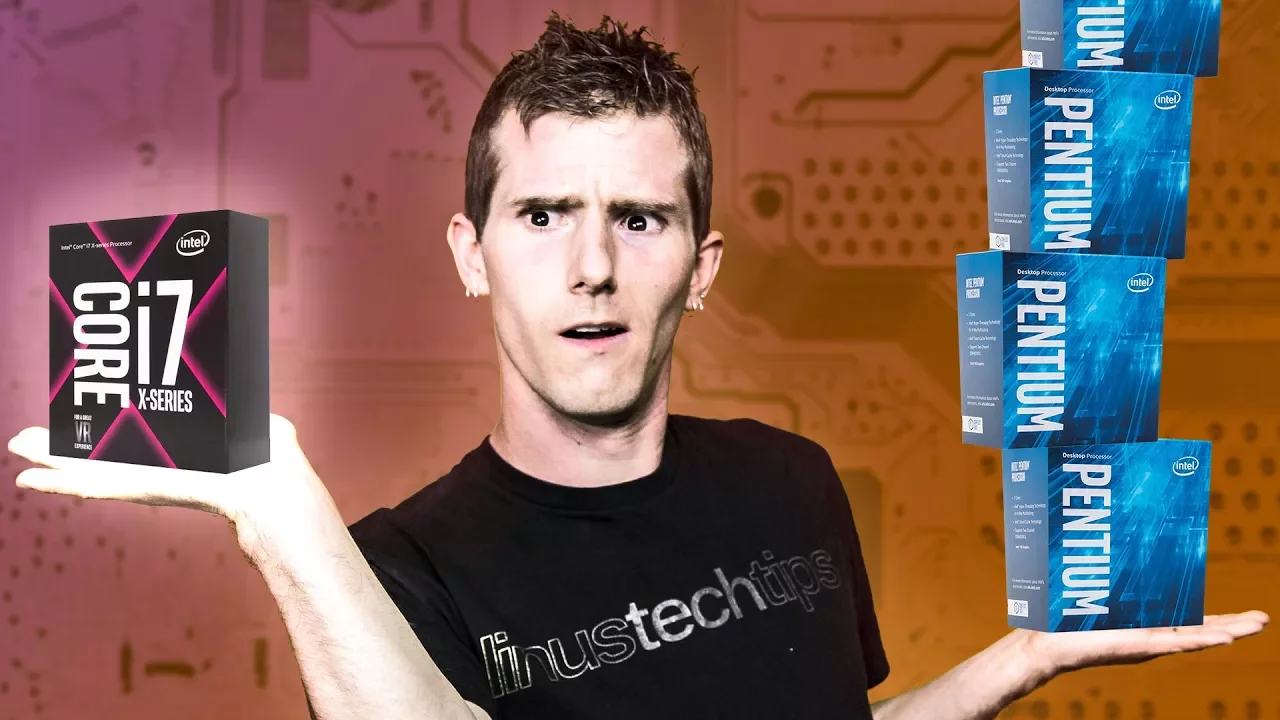
Is a $600 CPU 10x MORE POWERFUL than a $60 one?
0 up · 0 down · 0 ratings
Promos
Intel's Core i7 7820X is nearly TEN TIMES more expensive than the Pentium G4560... But does it offer ten times the PERFORMANCE? Synergy sponsor link: Share your mouse and keyboard between multiple computers with Synergy! Save 50% here: symless.com Buy the Core i7 7820X On Amazon: geni.us On Newegg: geni.us Or buy the Pentium G4560 On Amazon: geni.us On Newegg: geni.us Discuss on the forum: linustechtips.com Our Affiliates, Referral Programs, and Sponsors: linustechtips.com Linus Tech Tips merchandise at designbyhumans.com Linus Tech Tips posters at crowdmade.com Our production gear: geni.us Twitter - twitter.com Facebook - @LinusTech Instagram - @linustech Twitch - twitch.tv Intro Screen Music Credit: Title: Laszlo - Supernova Video Link: youtube.com iTunes Download Link: itunes.apple.com Artist Link: soundcloud.com Outro Screen Music Credit: Approaching Nirvana - Sugar High youtube.com Sound effects provided by freesfx.co.uk
The video investigates whether a six hundred dollar flagship CPU actually delivers ten times the performance of a sixty dollar budget chip, using the Core i9 7820X and the Pentium G4560 as the extreme ends of the price spectrum. It starts by clarifying expectations, noting that the higher end part has more cores, higher turbo capabilities, and a more complex platform, yet questions whether this translates to proportionally better performance in real workloads. The host explains the experimental plan: identical hardware for fair baseline tests, plus a second test run with the high-end chip reduced to two cores to simulate lower-end behavior. They also introduce AVX-512 and cache rebalancing as potential factors that could widen or narrow performance gaps depending on workload. The discussion then moves into the core findings, showing that in gaming, the premium chip does not yield ten times the performance, while certain productivity tasks benefit more from the advanced cache and AVX-512, especially in workloads like Y-cruncher and Blender. The host emphasizes that price-to-performance is complex and workload dependent, and that Skylake-X’s new cache generally helps but can hurt in some scenarios, with the conclusion that value is highly workload dependent and that a 2x improvement may be a more reasonable expectation for many business-oriented tasks. Finally, the video broadens the lens to practical considerations such as cooling requirements and total system cost, noting that a higher-end CPU often demands a more capable motherboard and cooling solution, which further affects the overall value proposition. The presenter closes with a takeaway that price does not map linearly to performance, and to consider specific workloads and total cost of ownership when evaluating such a purchase, while also highlighting the benefits of multi-machine setups for productivity and workflow optimization.
Topics · hardware · technology · cpu · performance · science-and-tech · benchmarks
Questions answered
- Do high-end CPUs like the Core i9 7820X provide ten times the performance of budget CPUs in real workloads?
- No, the video concludes that ten times the performance is not generally realized across workloads; gains are workload dependent and can be modest in gaming while more noticeable in certain productivity tasks.
- What factors besides raw cores and clock speed influence value when comparing these CPUs?
- Factors include cache design, AVX-512 support, memory and PCIe capabilities, cooling and platform costs, and the impact of these on real-world productivity versus gaming workloads.