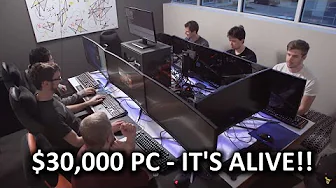
7 Gamers 1 CPU is back! But does it ACTUALLY work!?
0 up · 0 down · 0 ratings
Channels and socials
A few weeks ago we unveiled the "7 gamers 1 CPU" computer, and while we ran some benchmarks, many viewers weren't satisfied. Today, we fix that. TunnelBear message: TunnelBear is the easy-to-use VPN app for mobile and desktop. Visit tunnelbear.com to try it free and save 10% when you sign up for unlimited TunnelBear data. Rackspace message: Check them out and take part in their Deep Dive sessions talking about dedicated infrastructure! bit.ly Pricing & discussion: linustechtips.com Support us: linustechtips.com Join our community forum: bit.ly twitter.com @LinusTech Intro Screen Music Credit: Title: Laszlo - Supernova Video Link: youtube.com iTunes Download Link: itunes.apple.com Artist Link: soundcloud.com Outro Screen Music Credit: Approaching Nirvana - Sugar High youtube.com Sound effects provided by freesfx.co.uk
The video revisits the Linus Tech Tips experiment where seven gamers share a single high-end CPU rig, now reassembled after its CES appearance. The crew gathers around to run a coordinated Crysis 3 benchmark, with the goal of proving the system’s real-world gaming viability beyond initial impressions. Early results show the seven stations averaging around 80 to 90 frames per second at 1440p, with a rough napkin calculation suggesting total system performance in the 600 to 700 FPS neighborhood when considering multiple players. The team then digs into a hands-on benchmarking process, guiding viewers through the Crysis 3 Min/Max/Avg readouts and tying those numbers to practical observations about CPU core utilization, GPU clock behavior, and overall stability. When the test loop completes, the video shifts to power consumption and thermal data, revealing a wall draw between 1400 and 1600 watts and GPU temperatures in the mid 40s Celsius, indicating the cooling solution is holding up under load. A core portion of the video is dedicated to live, collaborative benchmarking. Linus instructs the team on starting the benchmark, with emphasis on not dropping into holes or diverging from the test plan. The group swaps tips, checks file paths, and confirms GPU and PCIe stability after reseating hardware, then re-runs the game for fresh data. The result is a practical demonstration of seven gaming workloads running concurrently on a single CPU rig, with visuals and commentary highlighting how the system distributes load across cores and manages turbo clocks under stress. The segment blends humor with technical detail, showing both the camaraderie of a multi-person LAN-style session and the objective performance readouts that viewers care about. In the closing moments, the team addresses common criticisms about the project, confirms ongoing sponsorships, and invites viewers to explore related content and sponsor resources while reaffirming the project’s experimental spirit. Overall, the video presents a thorough, entertaining, and technically grounded revisit of the seven gamers one CPU concept. It documents concrete metrics like FPS ranges, GPU temperatures, CPU clock speeds, and PCIe stability, and it ties those metrics to meaningful conclusions about real-world playability and hardware behavior under a multi-user workload. The tone remains approachable for enthusiasts while delivering enough data to satisfy those seeking reproducible benchmarks. Viewers are reminded of the collaborative, at-work environment that makes the experiment feasible and engaging, including reactions to the test results and the ongoing dialogue about upgrades, cooling, and power management.
Topics · technology · hardware · gaming · benchmarking · multiplayer · science-and-technology · live-events
Questions answered
- What were the observed FPS ranges when seven gamers shared a single CPU rig playing Crysis 3 at 1440p?
- The video reports FPS numbers in the neighborhood of 80 to 90 frames per second for each player when observing the in-game readouts during the seven-player session, with the broader context noting overall multi-user throughput around several hundred FPS when considering aggregate performance.
- Did the system maintain stable GPU temperatures and power delivery during the benchmarks?
- Yes, the cooling system held up, with GPU temperatures in the mid 40s Celsius and power consumption observed between roughly 1400 and 1600 watts at the wall during the test runs.
- What was the main goal of this follow-up video compared to the initial reveal?
- The goal was to address criticisms by providing concrete benchmarks and demonstrable gameplay results to show that seven gamers can indeed operate on a single CPU rig and to validate the setup under real gaming conditions.