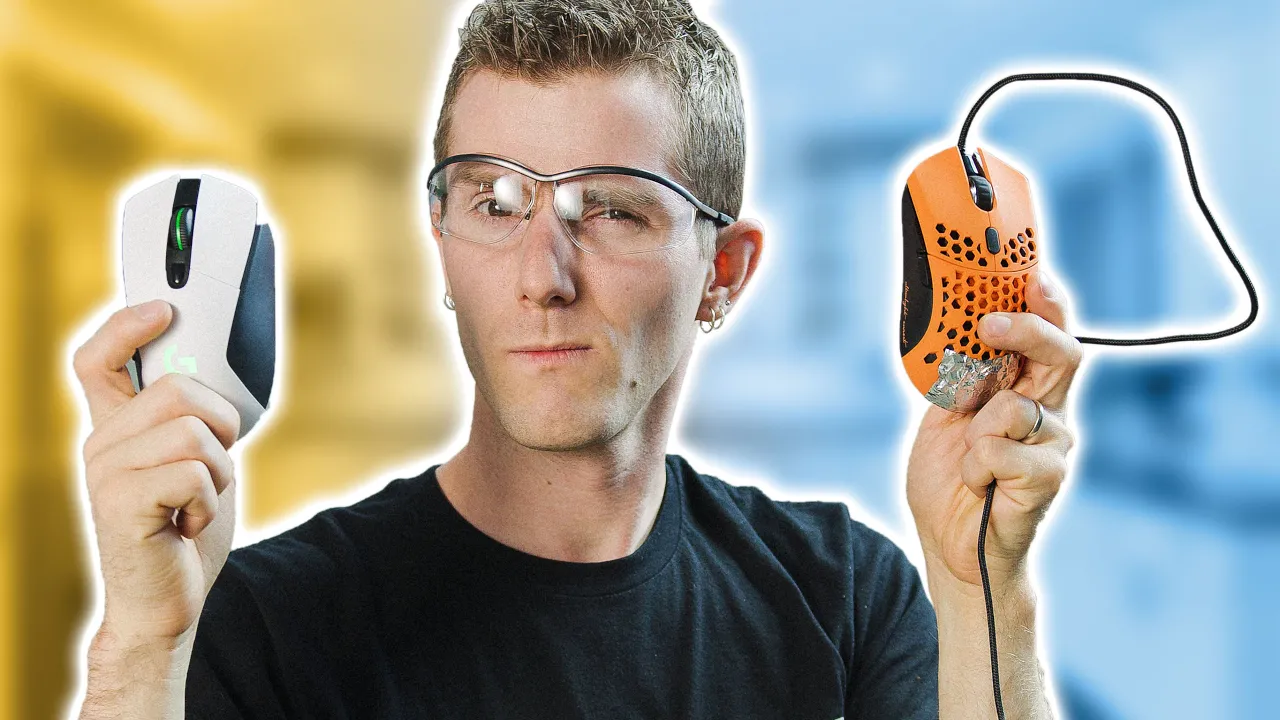
Are Wireless Gaming Mice ACTUALLY Faster??
0 up · 0 down · 0 ratings
Promos
Check out Storyblocks Video at videoblocks.com We tested five wired and wireless mice with the Phantom Flex 4K camera at 1000 FPS to see if wireless mice were faster than wired! Buy: Logitech G703 On Amazon: geni.us On NewEgg: geni.us Buy: Logitech G MX518 On Amazon: geni.us On NewEgg: geni.us Buy: CORSAIR Dark Core SE On Amazon: geni.us On NewEgg: geni.us Buy: Logitech MX Anywhere 2S On Amazon: geni.us On NewEgg: geni.us Discuss on the forum: linustechtips.com Our Affiliates, Referral Programs, and Sponsors: linustechtips.com Get Private Internet Access today at geni.us Displate metal posters: lmg.gg Linus Tech Tips merchandise at lttstore.com Linus Tech Tips posters at crowdmade.com Our Test Benches on Amazon: amazon.com Our production gear: geni.us Twitter - twitter.com Facebook - @LinusTech Instagram - @linustech Twitch - twitch.tv Intro Screen Music Credit: Title: Laszlo - Supernova Video Link: youtube.com iTunes Download Link: itunes.apple.com Artist Link: soundcloud.com Outro Screen Music Credit: Approaching Nirvana - Sugar High youtube.com
The video investigates a long-standing claim in the gaming peripheral market: are wireless gaming mice truly as fast and as consistent as their wired counterparts? The host explains the rationale behind testing latency without relying on brand hype, and describes the experimental setup, including a Phantom Flex 4K high-speed camera to capture millisecond-level timing. The testing rig uses a competitive CS:GO scenario on a high-end Corsair rig and a 1080p 240 Hz monitor to measure the total mouse-to-screen latency. Early results show that a wired MX518 registers very low latency, while the first wireless candidate, the Logitech G703, performs within the same margin of error, challenging the belief that wireless inherently sacrifices speed. Throughout, the video emphasizes consistency across runs and acknowledges the practical limits of their measurement approach, given that some signal path components beyond the mouse itself influence perceived latency. The discussion then broadens to compare additional high-performance mice from Corsair and Logitech, including the Dark Core RGB SE and MX Anywhere 2, evaluating whether the belief that higher polling rates (1000 Hz) offer tangible benefits holds up under controlled testing. The hosts draw practical conclusions about real-world gaming performance, noting that differences at sub-millisecond scales are not visually perceptible on typical gaming monitors, and that the overall value of wireless mice remains substantial due to freedom of movement and equivalent latency in practice. Finally, the segment ties the findings back to consumer guidance, reinforcing that for most players there is no meaningful disadvantage to wireless mice, while acknowledging some trade-offs in tracking consistency and sensor sophistication among budget models. The video ends with a direct takeaway: high-end wireless mice can match wired performance, but the perceived gains from ultra-low latency claims are often more marketing than measurable in everyday play.
Topics · science_and_technology · gaming_hardware · input_devices · latency · high_speed_camera
Questions answered
- Do wireless gaming mice have the same latency as wired mice in this test?
- Yes, within the margin of error reported in the experiment, wireless mice performed on par with wired mice for the tested models.
- Is a thousand Hz polling rate shown to provide a perceptible benefit in this video?
- No, the test suggests that there is no meaningful perceptible advantage from 1000 Hz over 500 Hz on the tested hardware and monitor setup.
- Which mouse showed the lowest measured latency overall?
- The wired MX518 demonstrated very low latency, and some wireless mice were comparable within the experimental margin of error.