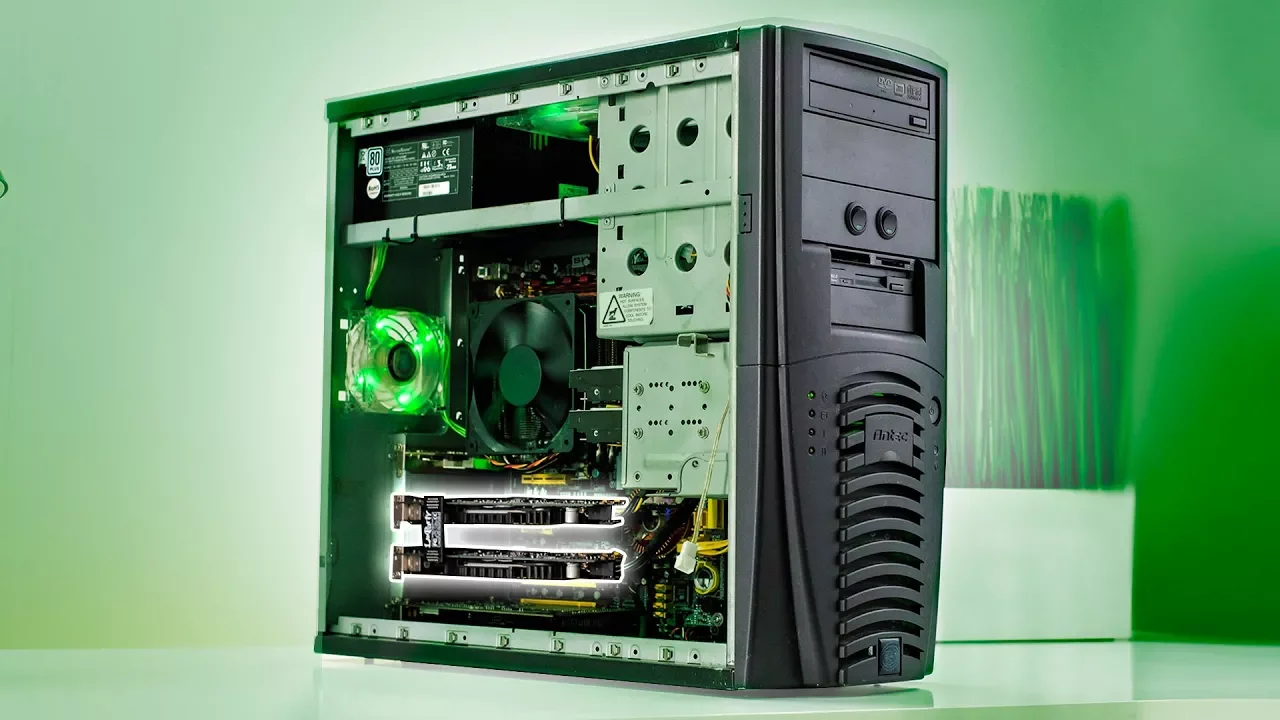
nVidia’s FIRST SLI Gaming Setup! - RECONSTRUCTED
0 up · 0 down · 0 ratings
Promos
What made the very first SLI system awesome? Visit squarespace.com and use offer code LTT for 10% off Buy ZOTAC's MEK1 on Amazon: geni.us Buy ZOTAC's MEK1 on Newegg: geni.us Buy ZOTAC's MEK1 at their store: geni.us Buy NVIDIA video cards on Amazon: geni.us Discuss on the forum: linustechtips.com Our Affiliates, Referral Programs, and Sponsors: linustechtips.com Linus Tech Tips merchandise at designbyhumans.com Linus Tech Tips posters at crowdmade.com Our production gear: geni.us Get LTX 2018 tickets at ltxexpo.com Twitter - twitter.com Facebook - @LinusTech Instagram - @linustech Twitch - twitch.tv Intro Screen Music Credit: Title: Laszlo - Supernova Video Link: youtube.com iTunes Download Link: itunes.apple.com Artist Link: soundcloud.com Outro Screen Music Credit: Approaching Nirvana - Sugar High youtube.com Sound effects provided by freesfx.co.uk
nVidia’s FIRST SLI Gaming Setup! reconstructed explores the origins of Nvidia's Scalable Link Interface, tracing how the technology evolved from its 3dfx roots to the first generation of multi‑card setups. The video begins by outlining the historical context, noting 3dfx’s bankruptcy and Nvidia’s decision to reintroduce sli as a way to combine two cards for improved performance. It explains the two rendering strategies, AFR and SFR, and how the high bandwidth 400 megahertz 1 gigabyte per second link enabled the two GPUs to cooperate on frame output. The host also discusses the driver challenges of early sli, including the need for many game profiles and driver updates to achieve meaningful scaling, sometimes only surfacing after months of refinement. Throughout, it connects the hardware decisions to practical outcomes, such as required power, cooling, and the consequent impact on real-world gaming performance. The segment then shifts to hardware specifics, describing the xeon platform, sli ready motherboards, and a high quality power supply as prerequisites for a stable dual‑card setup, followed by notes on matching GPUs and the significance of balanced cooling. Finally, the video evaluates performance with reported scaling figures, highlighting a range of synthetic and real‑world results, and closes with reflections on the era’s limitations, the dependency on sli profiles, and the enduring appeal of revisiting foundational tech moments in gaming history.
Topics · technology · hardware · gaming · computing history
Questions answered
- What did the first generation Nvidia SLI rely on for rendering, AFR or SFR?
- The first generation Nvidia SLI used two rendering approaches: Alternate Frame Rendering (AFR) where each card renders a full frame in turn, and Split Frame Rendering (SFR) where the frame is horizontally split between the two cards based on geometry load.
- What were the main hardware prerequisites for a dual‑GPU SLI setup in this reconstruction?
- Key prerequisites included an SLI ready motherboard with Nvidia’s enforce4 chipset, a powerful CPU to keep both GPUs fed, a strong 24‑pin ATX power supply with a solid 12V rail distribution, two PCI Express power connectors for the GPUs, and well‑ventilated case cooling.