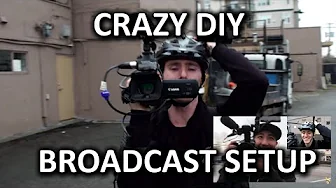
DIY Live Reporting Backpack
0 up · 0 down · 0 ratings
Promos
This video was sponsored by XSplit. Check them out at xsplit.com and use offer code LINUS to save 10% off your first purchase of XSplit Personal or XSplit Premium! Is it possible to report on live news events without a giant truck and a whole team? Let's find out... Giveaway link: linustechtips.com Pricing & discussion: linustechtips.com Support us: linustechtips.com Join our community forum: bit.ly twitter.com @LinusTech Intro Screen Music Credit: Title: Laszlo - Supernova Video Link: youtube.com iTunes Download Link: itunes.apple.com Artist Link: soundcloud.com Outro Screen Music Credit: Approaching Nirvana - Sugar High youtube.com Sound effects provided by freesfx.co.uk
The video opens by framing a shift in how news can be broadcast, arguing that decades of relying on large trucks, editing bays, and satellite links are being disrupted by personal technology. It traces the evolution from camera phones and affordable broadband to live streaming platforms and social internet culture, culminating in the concept of a DIY live reporting backpack. The host then walks through the gear involved, starting with a capable but portable ASUS laptop, a sponsor provided XSplit Broadcaster, and a battery pack to extend mobile power. He selects a Canon XA20 as the main camera, an Elgato HD60 capture device to feed HDMI video into the software, and a lavalier plus shotgun microphone to balance audio quality with mobility. A MiFi hotspot, a remote control for on-the-go scene switching, and a helmet-mounted selfie setup complete the rig, all aimed at delivering live coverage from nearly any location. The test broadcast to Twitch demonstrates the practical limits and tradeoffs of this compact live reporting approach, including battery life, stability, and the balance between portability and professional audio/video quality. The video concludes by reflecting on the democratization of news production: while the setup can be powerful for enthusiasts and journalists outside traditional outlets, it also raises questions about training, privacy, and reliability, balancing opportunities with responsibilities. Finally, sponsorship messaging for XSplit ties the concept back to professional tools that can scale this DIY approach for aspiring broadcasters, while inviting viewers to share their thoughts in the comments. The host invites feedback on whether this approach is a positive step toward broader access to live reporting or if professional teams should remain the standard for news coverage.
Topics · technology · video_production · live_broadcasting · diy · journalism
Questions answered
- What components are essential for a DIY live reporting backpack?
- Essential components include a capable portable laptop, a video capture device with HDMI input, an external battery or power solution, a mobile internet option such as a MiFi hotspot, an audio setup with lavalier and shotgun mics, and a lightweight mounting system or helmet for hands-free operation. A software platform for switching inputs and streaming, such as XSplit, is used to broadcast live.
- Why is audio considered as important as video in live event coverage?
- Audio quality is crucial because it conveys clear information and context about the event, helps viewers understand what is happening, and reduces the need to rely on visual cues alone, which can be misleading in dynamic environments.