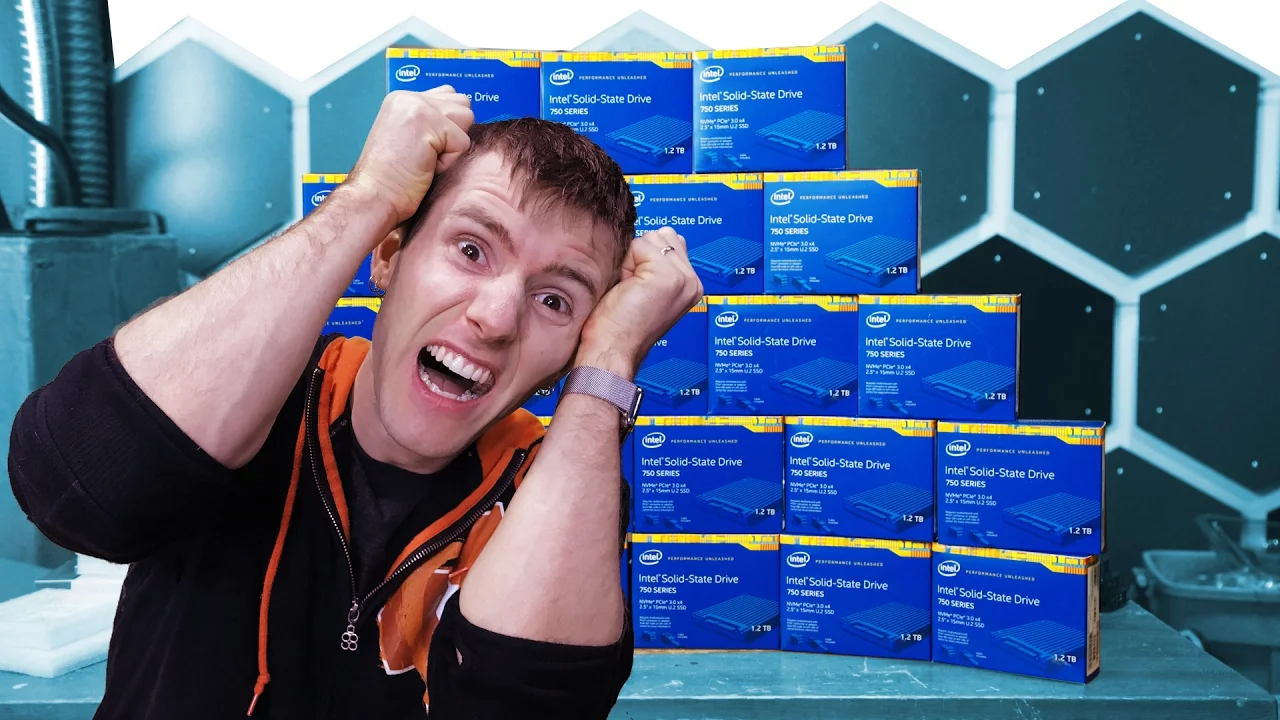
The Fastest Storage EVER – HOLY $H!T Ep 14
0 up · 0 down · 0 ratings
Description
This video was sponsored by Blue Apron! First 100 people will get three free meals on their first Blue Apron order using this link! cook.ba So you think you can't RAID NVMe drives? LINUS TECH TIPS KNOWS NO BOUNDS MOTHAF***AZ! Watch Nerdsports: youtu.be Buy Intel NVMe drive on Amazon: geni.us Discuss on the forum: linustechtips.com Our Affiliates, Referral Programs, and Sponsors: linustechtips.com
Channels and socials
Check out our Linus Tech Tips posters at crowdmade.com twitter.com @LinusTech Intro Screen Music Credit: Title: Laszlo - Supernova Video Link: youtube.com iTunes Download Link: itunes.apple.com Artist Link: soundcloud.com Outro Screen Music Credit: Approaching Nirvana - Sugar High youtube.com Sound effects provided by freesfx.co.uk
In the opening segment, the host introduces the ambitious build around 24 PCIe NVMe SSDs destined for a new storage server. We get a rapid-fire montage of unboxing a Super Micro SSG 2028 AR NR48N barebones chassis, then detailing a high-end configuration with quad 10 Gb network, 64 GB of RAM, and dual 2699 V422 CPUs. The host humorously acknowledges the daunting inventory task and moves into assembling the machine, showing the front drive bays that ultimately support 48 NVMe drives via clever enclosure design. He walks through the expansion options, power supply redundancy, and the physical layout, explaining how the three PCIe expansion paths feed the drive banks and how the system will ultimately host a massive RAID array. The setup emphasizes extreme scalability and the promise of turning a 2U box into a storage powerhouse, with the camera cutting between assembly, cable management, and the first boot to convey the scale of the project. As the build progresses, the focus shifts to the software and testing plan, starting with drive installation and disc management. The host demonstrates initiating a RAID configuration, discussing the tradeoffs between performance and redundancy, and opting for a RAID zero during the experiment to push maximum throughput. The test bench is prepared, network connections are wired, and the system is tuned for a direct throughput challenge. The narrator explains that the theoretical bandwidth from a 16x PCIe Gen 3 link could reach around 16,000 MB/s, then moves to the real-world measurements, highlighting how the numbers begin to approach the device's theoretical potential. The on-screen progress builds anticipation for the moment when the drives finally prove their speed, guiding viewers through the setup until the first performance figures appear. In the performance reveal, the host reports dramatic results from the sequential read and write tests, noting sustained and peak speeds that exceed 10 GB/s with peaks near 12.7 GB/s on the Z drive. The narrative cadence moves from astonishment to a practical interpretation: even with redundancy added later, the system demonstrates the potential to saturate multiple 10 Gb network connections. The video pivots to the user experience and the implications of such throughput for large-scale storage tasks, concluding with a reminder about the project’s sponsorship and a lighthearted sign-off. The segment emphasizes that this is a proof-of-concept demonstration meant to explore the outer limits of consumer-and-enterprise storage hardware, leaving viewers excited about what high-end NVMe arrays can achieve in real-world scenarios.
Topics · hardware · technology · storage · servers · raid · nvme · performance