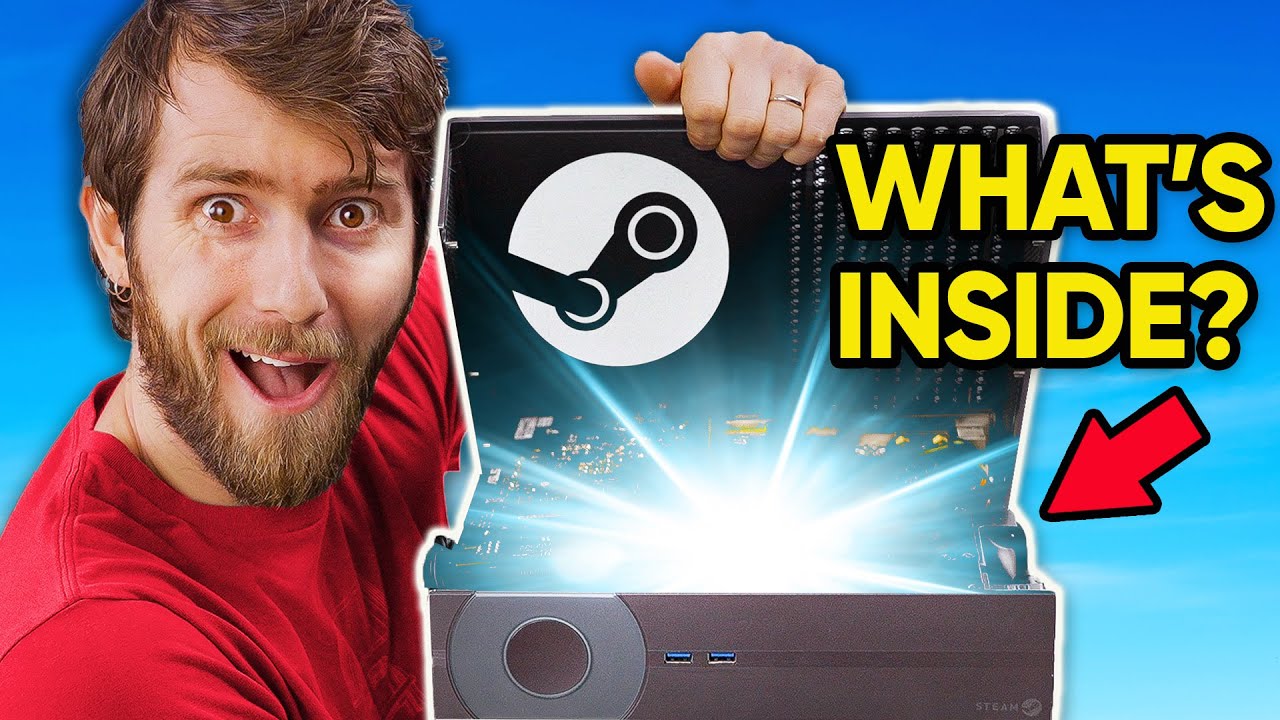
What’s Inside Valve’s Prototype STEAM Console?
0 up · 0 down · 0 ratings
Promos
Check out Goliath today using the link below and save 20% today: goliathtechnologies.com Buy a Seasonic TX 1000 PSU: geni.us Valve’s Steam Machine was their first game console, and we’ve got a prototype! But it’s broken… Can we fix it? And if we can, should we, or should we have left it in the past? Discuss on the forum: linustechtips.com Donate to Free Geek Twin Cities: freegeektwincities.org Purchases made through some store links may provide some compensation to Linus Media Group. ► GET MERCH: lttstore.com ► LTX 2023 TICKETS AVAILABLE NOW: lmg.gg ► GET EXCLUSIVE CONTENT ON FLOATPLANE: lmg.gg ► SPONSORS, AFFILIATES, AND PARTNERS: lmg.gg ► OUR WAN PODCAST GEAR: lmg.gg FOLLOW US --------------------------------------------------- Twitter: twitter.com Facebook: @LinusTech Instagram: @linustech TikTok: @linustech Twitch: twitch.tv MUSIC CREDIT --------------------------------------------------- Intro: Laszlo - Supernova Video Link: youtube.com iTunes Download Link: itunes.apple.com Artist Link: soundcloud.com Outro: Approaching Nirvana - Sugar High Video Link: youtube.com Listen on Spotify: spoti.fi Artist Link: youtube.com Intro animation by MBarek Abdelwassaa @mbarek_abdel Monitor And Keyboard by vadimmihalkevich / CC BY 4.0 geni.us Mechanical RGB Keyboard by BigBrotherECE / CC BY 4.0 geni.us Mouse Gamer free Model By Oscar Creativo / CC BY 4.0 geni.us CHAPTERS --------------------------------------------------- 0:00 Intro 1:26 But why did Steam Machines exist? 2:15 Basically PC consoles - They even made a controller! 2:53 Linus broke the script 4:02 It was already broken. Let's tear it down and fix it! 5:36 It's all standard hardware, but a very nonstandard chassis 6:58 The GPU is NOT stock. 7:49 This was so ahead of its time 9:40 Linus breaks the script again 10:53 Hardware was only half the problem... 11:43 HoloISO to the rescue! 12:42 IT LIVES! But it's not a good experience 13:53 Tragedy. 14:23 Controllers, old hardware, and shaders, oh my 15:29 What would a modern version without these problems look like? 16:58 Hang on... How did Valve plan to deal with hardware variations? 17:44 Conclusion - All hands on Deck
Valve’s prototype Steam Machine is introduced as a compact PC designed for living room use, distinct from ordinary gaming PCs by its hardware intent and custom touches. The video frames a project that Valve pursued in the early days of SteamOS, aiming to create a living room friendly platform with a semi-standardized PC, a dedicated controller, and a Linux-based operating system. It explains that Valve produced around 300 units, all with bespoke chassis work, and reveals the unit seen is a broken example rescued from a collector. The discussion then shifts to the hardware inside, highlighting nonstandard elements like a modified GPU setup, a custom cooling shroud, and an aggressive internal cable management scheme that shows how much effort went into optimizing airflow in a tiny form factor. The narrative continues with host Linus and team diagnosing the faults, swapping a GTX 780 for a more capable Titan card, and contending with nonstandard power connectors and aging PCIe wiring that caused intermittent operation. They also explore the software barriers by attempting to boot SteamOS, finding that Valve’s early efforts were hampered by driver issues, fast-changing Linux toolchains, and a multi-OS compatibility challenge. The turning point comes with a plan B: trying Holo OS, a community Port aimed at running SteamOS in Deck-like form on PC hardware, which demonstrates that the project could still function with the right software layer but remains constrained by hardware compatibility and performance gaps. The wrap-up contemplates what a modern Steam Machine could look like, suggesting the Deck’s model,compact, affordable, and ecosystem-aligned,might have matured differently with Linux support, better hardware standards, and refined software integration. The video closes with reflections on what Valve’s Steam Machine history teaches about living-room PC gaming, the role of standardized hardware for predictable experiences, and whether a resurrected Steam Machine could re-enter the market with today’s hardware and software landscape.
Topics · technology · gaming hardware · teardown · linux
Questions answered
- What was Valve trying to achieve with the Steam Machine and SteamOS in the context of the living room PC revolution?
- Valve aimed to create a living room friendly PC platform that could run SteamOS, promoting a Linux-based ecosystem, a large install base, and a standardized hardware approach to enable developers to target a broad audience.
- Why did Valve pursue a proprietary chassis and a high-end hardware configuration for this prototype?
- The team sought to maximize performance and smooth Linux experience for testers, and to demonstrate premium features that could justify potentially higher pricing in a market where Windows-based consoles dominated.
- What workaround helped during the software boot issues when SteamOS could not boot past the setup wizard?
- They used Holo OS, a community project to port SteamOS-like functionality to PC hardware, to bypass the boot and compositor issues and restore a working experience.
- Could a modern Steam Machine become viable today, based on the video’s analysis?
- Yes, if Valve leverages mature Linux support, compatible game libraries, affordable hardware, and an ecosystem that bridges PC flexibility with living room usability, addressing price and hardware variation concerns.