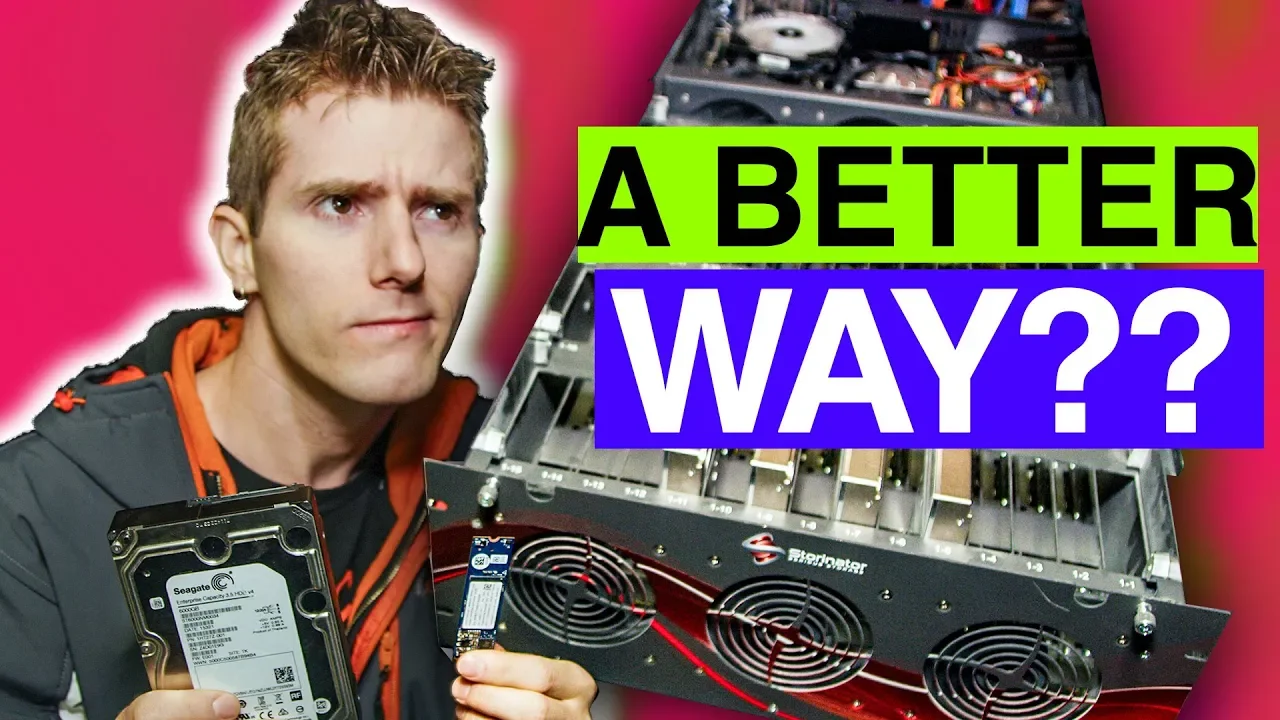
These Servers are TOO EXPENSIVE - Hybrid Storage Explored
0 up · 0 down · 0 ratings
Promos
Visit squarespace.com and use offer code LTT for 10% off Get iFixit's Marlin Screwdriver set today for only $24.99 USD at ifixit.com Buy HDDs on Amazon: geni.us Discuss on the forum: linustechtips.com Our Affiliates, Referral Programs, and Sponsors: linustechtips.com Get Private Internet Access today at geni.us Linus Tech Tips merchandise at lttstore.com Linus Tech Tips posters at crowdmade.com Our Test Benches on Amazon: amazon.com Our production gear: geni.us Twitter - twitter.com Facebook - @LinusTech Instagram - @linustech Twitch - twitch.tv Intro Screen Music Credit: Title: Laszlo - Supernova Video Link: youtube.com iTunes Download Link: itunes.apple.com Artist Link: soundcloud.com Outro Screen Music Credit: Approaching Nirvana - Sugar High youtube.com
This video introduces the problem of choosing storage for a high-demand editing environment, weighing the benefits and drawbacks of solid state drives (SSDs) versus traditional hard disk drives (HDDs). The host highlights that while SSDs deliver exceptional performance, their high cost and limited capacity can be prohibitive for large-scale storage needs, especially in scenarios that require concurrent editing of 8K video. To address this, the episode revisits tiered storage concepts and asks whether a middle ground can provide both performance and capacity without breaking the bank. The discussion then pivots to Microsoft's storage spaces tiering feature as a potential on-ramp, contrasting it with FreeBSD based solutions like FreeNAS, and exploring practical limitations around RAM and cache sizing. The host experiments with a hybrid setup using a mix of NVMe Optane caching and mechanical drives, attempting to configure a tiered pool on a network share to see if editors can work without bottlenecks. As the testing unfolds, the video documents the real-world challenges of implementing tiered storage. The initial attempt to configure storage spaces via GUI hits a configuration hurdle related to column count, prompting a pivot to PowerShell for manual tuning. Despite making progress, the common theme emerges: tiered storage solutions are not a simple plug-and-play fix, especially under heavy 8K editing workloads. The team observes transfer rates and editor experiences, noting that caching helps but does not eliminate all bottlenecks, and there is a recurring tension between cost, capacity, and performance. Ultimately, the host reassesses expectations and concludes that expanding high-performance storage will require substantial investment, while also showcasing a sponsored plug for Squarespace. In closing, the episode frames the larger takeaway: tiered storage can offer meaningful gains, but it is not a universal shortcut. Performance improvements hinge on workload characteristics, the size of the fast tier, and how well the system can automate data promotion and caching. The discussion hints at future refinements, such as configurable data tiering rules, and ends with a practical reminder that for serious capacity and speed, budgeting for more capable hardware remains a reality. Viewers are left with a nuanced view of how to balance speed, space, and cost in demanding media workflows, along with a practical sense of the iterative process required to get there.
Topics · technology · storage · networking · workflow