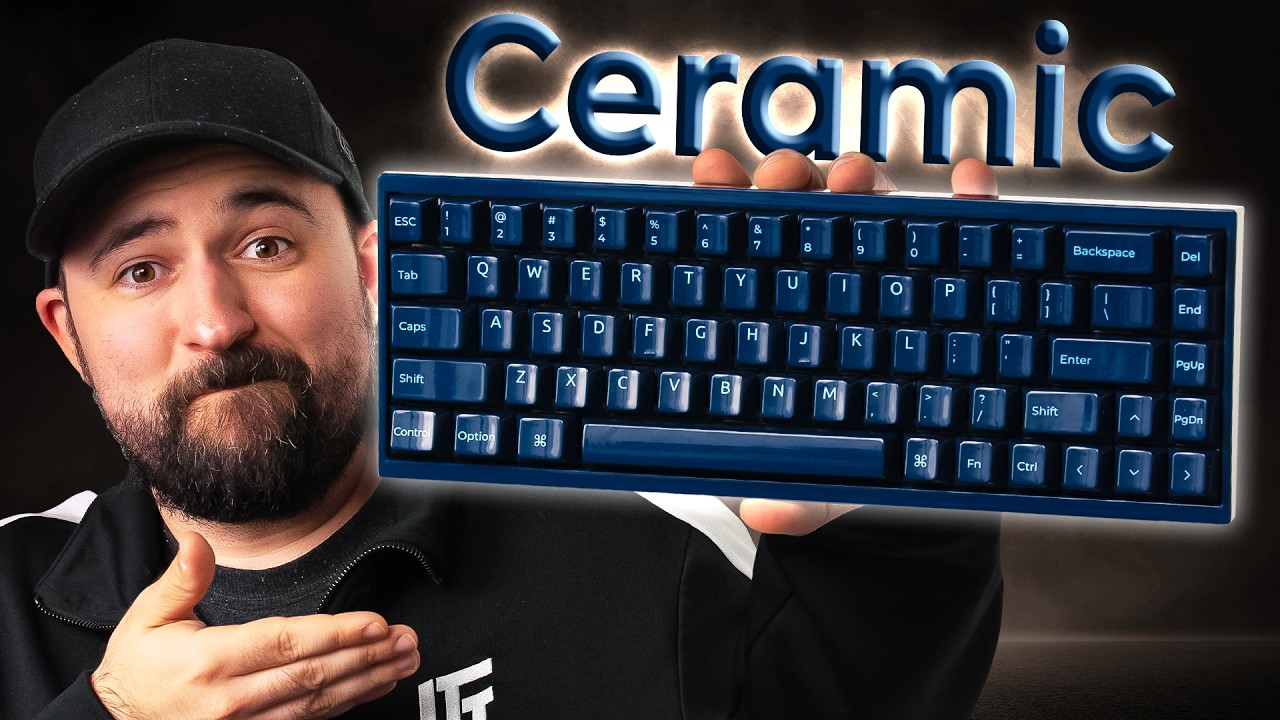
A Fully CERAMIC Keyboard....It feels weird. - Keychron Q 16 HE
0 up · 0 down · 0 ratings
Description
Thanks to MSI for sponsoring this video!
Check out their Crosshair 18 HX AI laptop at lmg.gg and get $200 off until 10/19! Plouffe bought ceramic keycaps for his keyboard, but found they felt a little weird. The solution? A FULLY Ceramic keyboard. Right? With a shiny, almost toy-like look, will Plouffe be impressed, or should you stick with your standard plastic/metal keeb?
Promos
Check out the Keychron Q16 HE 8K Magnetic Switch Keyboard: lmg.gg Want us to unbox something? Make a suggestion at lmg.gg ► GET MERCH: lttstore.com ► GET A VPN: piavpn.com ► GET EXCLUSIVE CONTENT ON FLOATPLANE: lmg.gg ► SPONSORS, AFFILIATES, AND PARTNERS: lmg.gg Purchases made through some store links may provide some compensation to Linus Media Group. Affiliate links powered in part by affilimate.com Linus Sebastian is an investor in Framework Computer, Inc CHAPTERS --------------------------------------------------- 0:00 Plouffe is a believer 0:20 Unboxing 2:07 Design impressions 4:37 Sponsor - MSI 5:11 Looking under the caps and keycap build quality 7:37 Keyboard sound and RGB 8:41 Typing impressions and Plouffe trying not to buy one 10:20 Pricing, LABS latency test results, and final thoughts 11:49 Outro
The video opens by setting the stage for ceramic keycaps and keyboards, recounting the excitement around ceramic materials and the promise of a truly unique keyboard experience. The host describes the Keychron Q16 HE 8K magnetic switch keyboard as the world’s first fully ceramic keyboard, noting that there is no aluminum construction at all, not even a metal plate, which immediately signals a bold design choice. The unboxing reveals the included accessories, such as a cloth cleaning pouch, a USB-C to USB-C cable with a USB-C to A adapter, a keycap puller, a switch puller, and replacement feet, all packaged to support a ceramic build. The host weighs the device, remarks on its visual appearance with a deep blue hue and a shiny ceramic shell, and calls out the fingerprint susceptibility of ceramic surfaces, warning viewers to expect smudges on keycaps and the case. The overall impression blends skepticism and fascination as the host explains why ceramic can feel both premium and odd, and previews the price point which is under $300, making the concept more approachable than one might expect for a ceramic keyboard. As the review progresses, the host digs into the design and build quality, highlighting the 65% layout with standard navigation keys and the ability to access function-row actions via a function key. He comments on the unibody-like appearance of the keyboard, the presence of four to six screws for disassembly, and the plate-mounted switch mounting with rubber dampening to reduce noise. The discussion turns to the material specifics, including how plastic inserts are used to fit ceramic keycaps onto the stem to avoid the looseness problems that plagued earlier ceramic builds, and how this update improves keycap stability. There is also a focus on the Hall Effect magnetic switches, including the distinctive north-facing RGB, and the observation that the switches are hot-swappable, allowing for customization without permanent modification. Throughout, the host weighs the tradeoffs of ceramic versus traditional plastics, noting that while the ceramic surface looks premium and resists certain wear, it can be more challenging to manage fingerprints and potential chipping if bumped. The reviewer then transitions to practical testing, including a sound and typing impression that aims to capture the tactile and acoustic character of the keyboard. The spacebar is highlighted for its deep, low thock and minimal rattle, aided by internal foam inserts to address hollow-spacebar acoustics. A live typing test demonstrates the board’s latency and 8K polling rate, with cited latency measurements around 1.47 milliseconds at practical load, underscoring the board’s performance suitability for fast-paced typing and gaming. The host shares personal enthusiasm for the overall look, feel, and sound, but acknowledges that some viewers may still perceive the ceramic surface as plasticky despite the premium finish. Finally, the host weighs the value proposition, arguing that the complete package,keyboard, keycaps, and switches,comes in at a competitive price, and contemplates future variants such as a larger 104-key version while considering the potential for further ceramic-keycap or stem improvements. The video closes with the host reflecting on whether ceramic keyboards are here to stay and whether the Q16 HE represents a meaningful step forward for enthusiasts and modders alike.
Topics · technology · hardware · computer-peripherals · product-review
Questions answered
- What is unique about the Keychron Q16 HE 8K compared to other keyboards?
- It is described as the world’s first fully ceramic keyboard with a 65% layout and magnetic Hall Effect switches, designed to be hot-swappable with replaceable keycaps and a non-traditional ceramic shell.
- How does the video characterize the price and value of the Q16 HE?
- The presenter argues the kit, including keyboard, keycaps, and switches, is under 300 dollars on Kickstarter or around 230 dollars at regular price, framing it as a strong value for a ceramic build.
- What are some practical considerations mentioned for using a ceramic keyboard?
- Ceramic surfaces are fingerprint magnets and can be prone to smudges; the keycaps may feel colder and slick, and there are considerations about durability and the need for careful handling to avoid chipping or cracking.