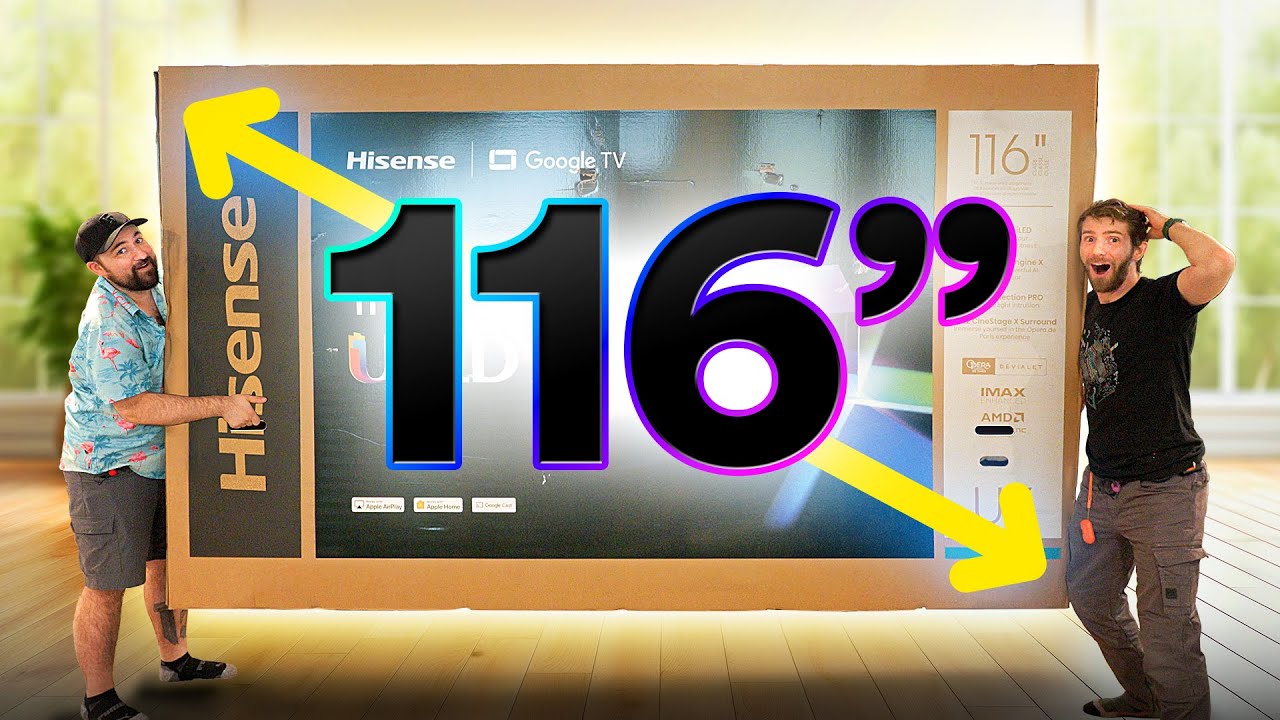
I'm FIRST to Unbox The World's Biggest TV - Hisense 116UX
0 up · 0 down · 0 ratings
Description
Prevent cyberattacks and eliminate misconfigurations today with ThreatLocker's Defense Against Configurations (DAC) Dashboard using our link! threatlocker.com Hisense sent over their NEW world's largest TV, the Hisense 116UX. It's got RGB MiniLED, a 165Hz refresh rate, and a very bold claim of reaching 95% of the BT.2020 color space. Discuss on the forum: linustechtips.com
Promos
Check out the Hisense 116" Class UX Series 4K RGB-MiniLED TV: geni.us ► GET OUR MERCH: lttstore.com ► GET EXCLUSIVE CONTENT ON FLOATPLANE: lmg.gg ► GET A VPN: piavpn.com ► SPONSORS, AFFILIATES, AND PARTNERS: lmg.gg Purchases made through some store links may provide some compensation to Linus Media Group. Affiliate links powered in part by affilimate.com Linus Sebastian is an investor in Framework Computer, Inc CHAPTERS --------------------------------------------------- 0:00 Intro 1:12 Unboxing 6:56 Powered On 8:35 Watching Content 11:50 Speaker Test 13:00 Gaming 17:17 Conclusion 19:11 Outro
Channels and socials
Check out Vincent at HDTVTest: youtube.com
This video presents the unboxing and initial hands on experience with the Hisense 116UX, a 116 inch class LED TV that claims a color performance of up to 95 percent of BT.2020 and a 165 Hz native refresh rate. The hosts begin by acknowledging the challenge of maneuvering and unboxing such a gigantic screen, noting the heavy shipping weight and the impressive, but bulky, packaging. They highlight the key hardware features including RGB miniLED backlighting, a large number of local dimming zones, and the inclusion of a DisplayPort input, which is unusual for consumer TVs. Throughout the opening segment, they discuss practical setup considerations, such as the fate of the sound system and the importance of a solid wall mount, while joking about the price tag and the perceived value. The tone blends humor with an earnest interest in evaluating whether the TV can live up to the hype in a dedicated theater room setting, and whether it justifies its premium positioning relative to other giant displays. In the middle portion, attention shifts to the TV’s I/O and build quality. They examine the rear and side inputs, the on-device Ethernet with Wi-Fi 6E, and the unusual but welcomed inclusion of a DP port, which supports high bandwidth for gaming and content creation workflows. The crew discusses calibration and visual intricacies such as bloom, anti-glare coatings, and the impact of RGB miniLED backlighting on color saturation and brightness. They also compare the overall design and handling to a prior 115 inch TCL, noting improvements in the physical lift system and handle design. The discussion naturally extends to power consumption estimates and cooling, acknowledging the scale of 800 watts in practice and the need for robust room conditioning. The segment ends with a plan to move the TV into a home theater environment and to conduct further testing in a controlled setting. The review continues with image quality impressions across color, brightness, and motion. They perform color and black level observations, noting strong color saturation in HDR-like scenes and a generally favorable bloom management when viewed dead-on. They test movie scenes, animations, and a few gaming sequences to evaluate motion handling, input lag, and overall responsiveness, acknowledging that the panel type (VA with RGB miniLED) has trade-offs compared to OLEDs and other technologies. The speakers built into the TV receive a quick test, though the hosts emphasize that a dedicated audio system would likely yield superior results. They also discuss the 3500 zone count as a high-end spec that helps minimize visible blooming in many scenarios, while recognizing room-for-improvement in fast-paced gaming environments. The video closes with a confirmation of interest in keeping the set for home theater use, a note about forthcoming lab measurements of color and brightness, and encouragement to follow a potential follow-up video for more exhaustive testing and mounting considerations. Overall, the unboxing and initial impressions portray the Hisense 116UX as a flagship giant with bold claims and sophisticated tech, balanced by practical caveats around weight, power, and true-world performance. The hosts are transparent about calibration, testing constraints, and the realities of moving and integrating a 116-inch screen into a living or theater space. The video leaves viewers with a sense of anticipation for deeper reviews, additional tests, and a potential follow-up that will include precise gamut, color accuracy data, and a final verdict on whether the price is justified by real-world viewing experiences.
Topics · technology · unboxing · home_theater · video_games · display_technology · consumer_electronics · product_reviews · cinema
Questions answered
- What is the HDMI and input configuration of the Hisense 116UX?
- The TV offers full 4K 165 Hz support on its HDMI inputs and includes a DisplayPort input via USB-C, enabling high bandwidth for gaming and computer connections.
- Does the 116UX deliver on the claimed color performance?
- The presenters discuss RGB miniLED backlighting aimed at achieving up to 95 percent of BT 2020, but they indicate that exact color gamut validation results would come from a follow-up measurement video.
- Is the onboard audio adequate for cinema use?
- The hosts advise using an external audio setup, as the built-in speakers are not sufficient for high-quality cinema sound.
- Is this TV suitable for gaming?
- The TV supports a native 165 Hz mode and auto low latency, but the presenters note that for fast-paced first-person shooters a higher-refresh-rate gaming monitor might still be preferable.