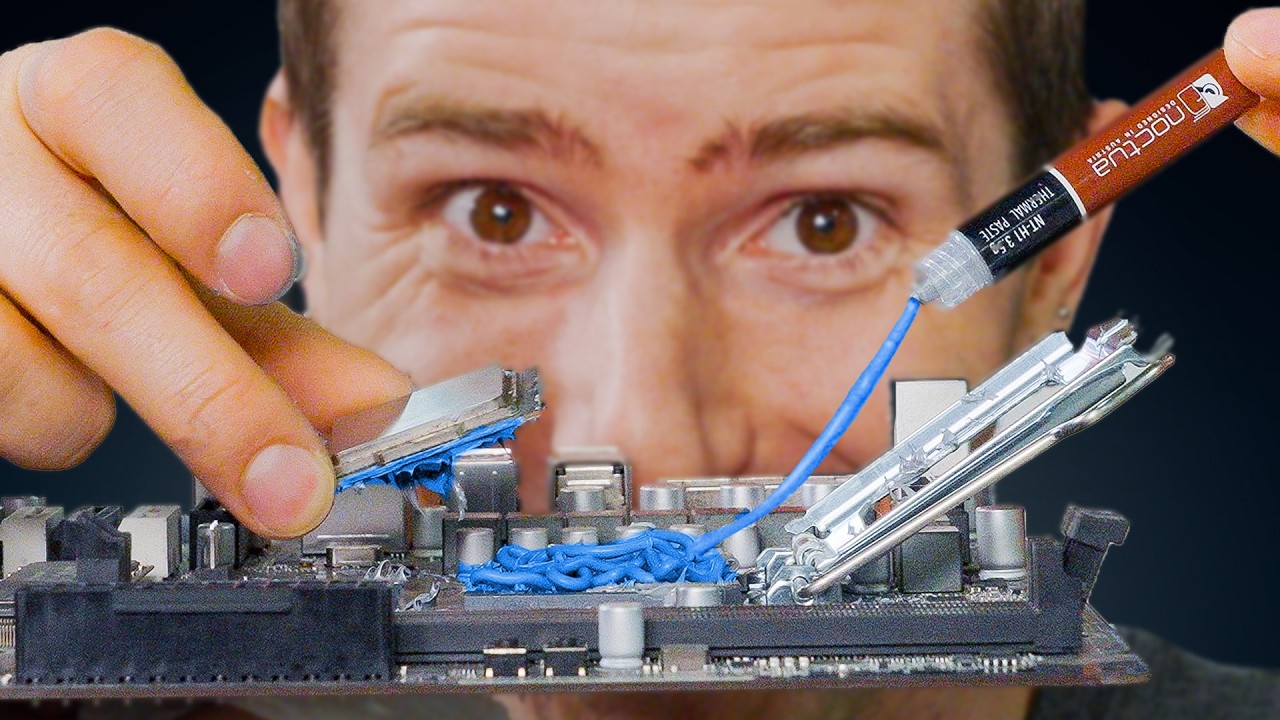
I Tried Your Darkest PC Fantasies
0 up · 0 down · 0 ratings
Promos
Sign up and upgrade to Grammarly Pro to level up your productivity: grammarly.com Grab your LTT Ridge Wallet at ridge.com Seriously, don't try any of this stuff at home. Don't delete system 32, don't put thermal paste in the CPU socket. Don't spray water on your computer. Don't blast your computer with x-rays for 5 hours. Just don't do it. Let us do it. Discuss on the forum: linustechtips.com ► GET OUR MERCH: lttstore.com ► GET EXCLUSIVE CONTENT ON FLOATPLANE: lmg.gg ► GET A VPN: piavpn.com ► SPONSORS, AFFILIATES, AND PARTNERS: lmg.gg Purchases made through some store links may provide some compensation to Linus Media Group. CHAPTERS --------------------------------------------------- 0:00 Don't try this at home 1:03 Don't put Thermal Paste here 2:40 Don't Use a Display at -30 C 5:41 Don't Put your PC in Here 6:07 Don't yank your drives 8:20 Don't Delete System32 10:24 Don't Waste Solder 10:45 Don't blow your fans? 12:10 Don't Water your computer 13:17 PC post X-ray blast 15:11 Outro
I Tried Your Darkest PC Fantasies starts with a strong safety disclaimer that sets the tone for a high energy exploration of extreme and dangerous PC experiments. The hosts acknowledge the risks of harming hardware but instead choose to simulate and test outrageous ideas in a controlled setting. Early segments focus on thermal paste mishaps, including attempts to place paste in inappropriate areas of the CPU socket and the potential mounting pressure from oversized heat sinks. They discuss the logic behind using non-conductive pastes and the theoretical outcomes, while repeatedly stressing do not try this at home. The pacing then shifts to environmental challenges for displays, with claims about liquid crystal temperatures and the impact of freezing on pixel response times, all measured with a practical, lab-like approach rather than a casual teardown. In each case the team explains the expected physics, the observable symptoms, and the safe alternative of letting the computer run in a controlled setup rather than risking a real system failure. The segment concludes with a call to audience and sponsor integration, keeping the energy high while promising continued exploration of “dark fantasies” within safe boundaries given by the presenters.
Topics · hardware · technology · stunts · experiment · safety
Questions answered
- What is the main safety message the video emphasizes before attempting any experiments?
- The video explicitly warns not to try these experiments at home and stresses conducting dangerous tests only in a controlled environment.
- What extreme test is described as potentially breaking the monitor’s liquid crystal display?
- Cooling the monitor’s liquid crystals to very low temperatures to observe how pixel response times degrade and cause a blurry image.
- Why do the hosts discuss removing RAM or deleting System 32 in the video context?
- These actions are used as dramatic demonstrations to show how certain risky operations could affect system behavior, but they are framed as experiments that should not be attempted by viewers.
- What is the purpose of the x-ray/CT scanner test in the video?
- To simulate radiation exposure and observe if electronics survive unusual radiation stress, illustrating resilience and safety thresholds in a controlled environment.