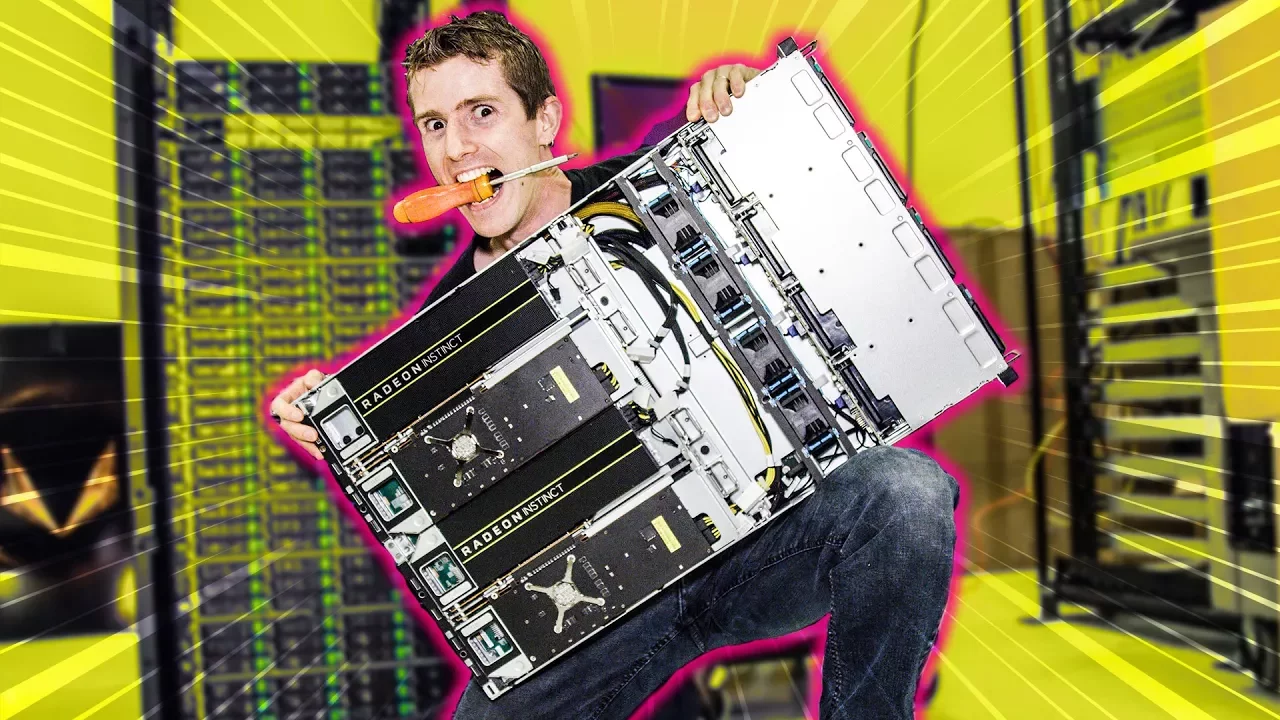
AMD LET ME BUILD THEIR NEW 80 VEGA SUPERCOMPUTER…
0 up · 0 down · 0 ratings
Promos
AMD's new 80 VEGA supercomputer is nice, but it isn't complete until it has the "Linus touch." Let's just hope I don't drop it... ;) Share your mouse and keyboard between multiple computers with Synergy! Save 50% here: symless.com Buy AMD Vega Amazon: geni.us Newegg: geni.us Discuss on the forum: linustechtips.com Our Affiliates, Referral Programs, and Sponsors: linustechtips.com Linus Tech Tips merchandise at designbyhumans.com Linus Tech Tips posters at crowdmade.com Our production gear: geni.us Twitter - twitter.com Facebook - @LinusTech Instagram - @linustech Twitch - twitch.tv Intro Screen Music Credit: Title: Laszlo - Supernova Video Link: youtube.com iTunes Download Link: itunes.apple.com Artist Link: soundcloud.com Outro Screen Music Credit: Approaching Nirvana - Sugar High youtube.com Sound effects provided by freesfx.co.uk
In this behind the scenes look at AMD’s latest 80 Vega-based supercomputer, the video documents the scale and engineering behind a single rack designed to deliver around one petaflop of full-precision performance. The host walks through the core components including the P47 server blade, the AMD EPYC processors at the heart of the system, and the 80 Radeon Instinct Vega GPUs that power the bulk of the compute capability. We see details on memory capacity and bandwidth, with each EPYC chip supporting up to 128 PCIe lanes and multi-terabyte RAM configurations, enabling multi-GPU configurations with ample headroom for high-speed networking like InfiniBand. The narrative also highlights ROCm, AMD’s open, non-proprietary software stack intended to allow users to scale with multiple racks and customize performance for workloads such as finance, climate science, and AI. Throughout, there is emphasis on efficiency, with power consumption around 35 kilowatts for the system and claims of superior performance per watt and per dollar compared to competing solutions, albeit as estimates still in development. The host emphasizes both the human effort involved in assembly and the broader strategic aim of delivering scalable, open hardware and software integration for modern HPC workloads. The segment closes with practical notes on the lab environment, the collaboration with partners like Inventec and Mellanox, and a nod to Synergy for sharing peripherals across machines, underscoring that this is as much a demonstration about the process as about the final hardware. The video frames the AMD ROCm-enabled P47 as a flexible, open platform where performance scales by adding more racks, provided the software and hardware continue to operate in concert. It contrasts the power-dense, air-cooled design with the necessity of advanced cooling like rear-door solutions, illustrating the balance between raw compute capacity and manageability in a data centre setting. The host also foregrounds market implications, arguing that the combination of VEGA GPUs with EPYC CPUs could yield better performance per dollar and per watt for target workloads, while acknowledging the ongoing need to refine cost models and real-world efficiency figures. Overall, the production presents a snapshot of a cutting-edge endeavour to push HPC forward with openly integrated AMD technologies, and it frames the upcoming SIGGRAPH unveiling as a milestone for showcasing the system's capabilities and readiness for further scaling.
Topics · computing · hardware · high-performance-computing · data-centre
Questions answered
- What makes the AMD P47 rack in this supercomputer notable?
- The P47 is a compact server blade that can host up to 640 CPU cores (1280 threads) and up to 80 Radeon Instinct Vega GPUs in a single rack, supported by 4 to 80 terabytes of memory and up to 128 PCIe lanes per EPYC processor for high bandwidth GPU access.
- What is ROCm and why is it important for this system?
- ROCm is AMD’s open, non-proprietary software architecture that links all AMD components at high speeds, enabling customization and scalable performance across a multi-rack system without proprietary bottlenecks.
- How much power does the system consume and what cooling approach is used?
- The system consumes around 35,000 watts and uses rear-door cooling to manage the heat density in air-cooled configurations.