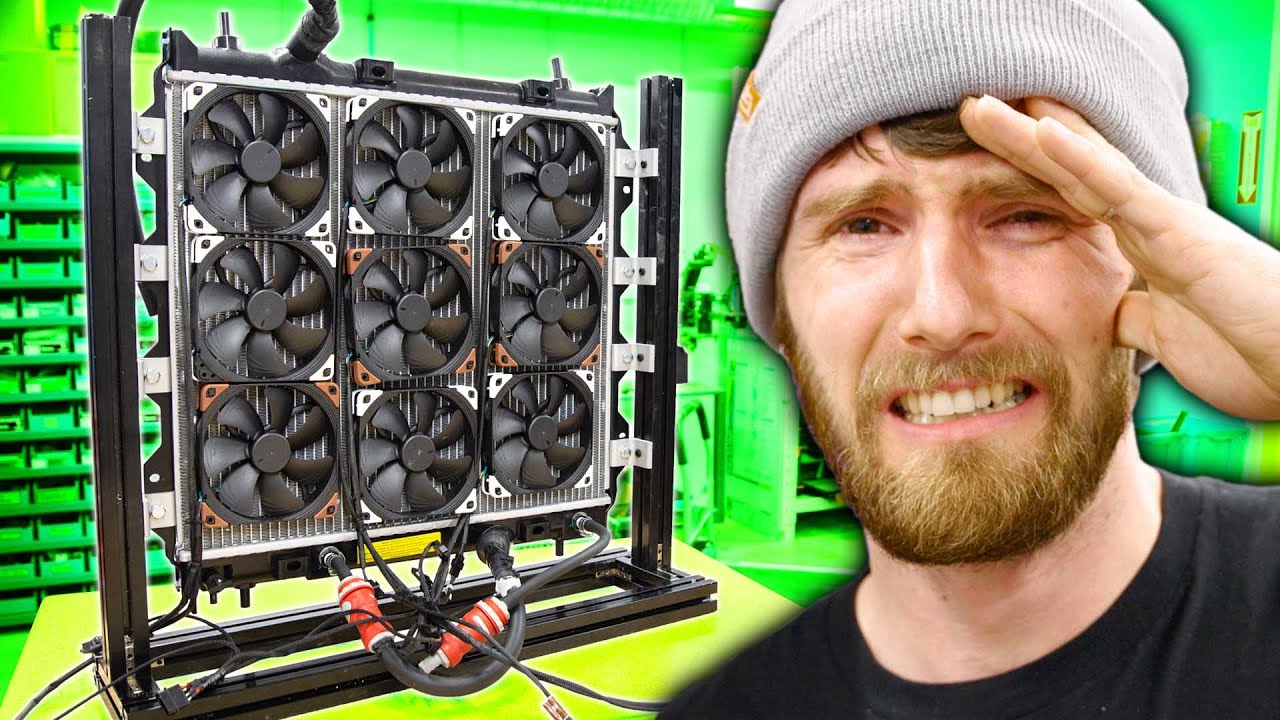
Our Craziest Cooling Project Yet - Car radiator liquid cooler
0 up · 0 down · 0 ratings
Description
Go to privacy.com to get $5 off your first purchase!
Promos
Check out Crucial at: crucial.gg On today's episode of Linus Tech Tips the gang gets more wet than usual! Buy an AIO CPU Cooler (PAID LINK): geni.us Buy some Noctua Fans (PAID LINK): geni.us Purchases made through some store links may provide some compensation to Linus Media Group. Discuss on the forum: linustechtips.com ► GET MERCH: lttstore.com ► AFFILIATES, SPONSORS & REFERRALS: lmg.gg ► PODCAST GEAR: lmg.gg ► SUPPORT US ON FLOATPLANE: floatplane.com FOLLOW US ELSEWHERE --------------------------------------------------- Twitter: twitter.com Facebook: @LinusTech Instagram: @linustech TikTok: @linustech Twitch: twitch.tv MUSIC CREDIT --------------------------------------------------- Intro: Laszlo - Supernova Video Link: youtube.com iTunes Download Link: itunes.apple.com Artist Link: soundcloud.com Outro: Approaching Nirvana - Sugar High Video Link: youtube.com Listen on Spotify: spoti.fi Artist Link: youtube.com Intro animation by MBarek Abdelwassaa @mbarek_abdel Monitor And Keyboard by vadimmihalkevich / CC BY 4.0 geni.us Mechanical RGB Keyboard by BigBrotherECE / CC BY 4.0 geni.us Mouse Gamer free Model By Oscar Creativo / CC BY 4.0 geni.us
This video showcases Linus Tech Tips attempting a highly unconventional cooling project by repurposing a car radiator as a liquid cooling radiator for a high end PC. The crew begins with the premise that water cooling is powerful for moving heat, but explains that the radiator is still a bottleneck in any loop, so they seek to push the concept further than a typical dual 120 millimeter setup. They identifiy the car radiator as having dual loops and plan a makeshift, budget approach to route water through the radiator, into the CPU and GPU blocks, and back through a pump, with the goal of dramatically reducing CPU and GPU temperatures during a stress test. The build process emphasizes rapid prototyping and improvisation, using available hardware, zip ties, and 80/20 aluminum framing to mount the radiator on top of the PC case. Along the way they grapple with leaks, head pressure, and flow issues, often improvising fixes on the fly such as a D5 pump, a shutoff valve, absorbent rags, and improvised tubing reducers. The testing sequence reveals a surprising improvement in thermal performance compared to the original dual-radiator setup, with CPU temperatures peaking lower and GPU temperatures significantly cooler once a continuous flow is established. The video ends with a candid evaluation of the project’s practicality, acknowledging that the setup is far from a polished product but celebrating the experimental spirit and the dramatic temperature gains achieved under less-than-ideal conditions. The sponsor integrations and links are interspersed, but the core takeaway remains a playful demonstration of how far DIY cooling can be pushed when constraints are loosened for the sake of experimentation and learning, even if the result is messy and not production ready.
Topics · diy · hardware · technology · science_and_technology · pc_gaming · cooling_systems
Questions answered
- What is the core idea behind using a car radiator for PC cooling?
- The idea is to move heat more effectively by using a larger radiator from a car to dissipate heat from the CPU and GPU through a water cooling loop, potentially achieving lower temperatures than a standard PC radiator setup.
- What were the main challenges encountered during the build?
- Key challenges included identifying the radiator's internal dual loops, mounting the radiator securely, managing leaks, bleeding the loop, ensuring adequate flow, and keeping the computer powered during a test while improvising with makeshift fittings.
- Did the project improve thermal performance?
- Yes, during testing the CPU temperatures were lower than before and the GPU temps dropped significantly once a stable flow was achieved, although this was under non-ideal, experimental conditions.
- Was the setup production ready after the test?
- No, the setup remained a messy, improvised prototype with leaks and ad hoc fittings, suitable for demonstration and learning but not recommended for production use.