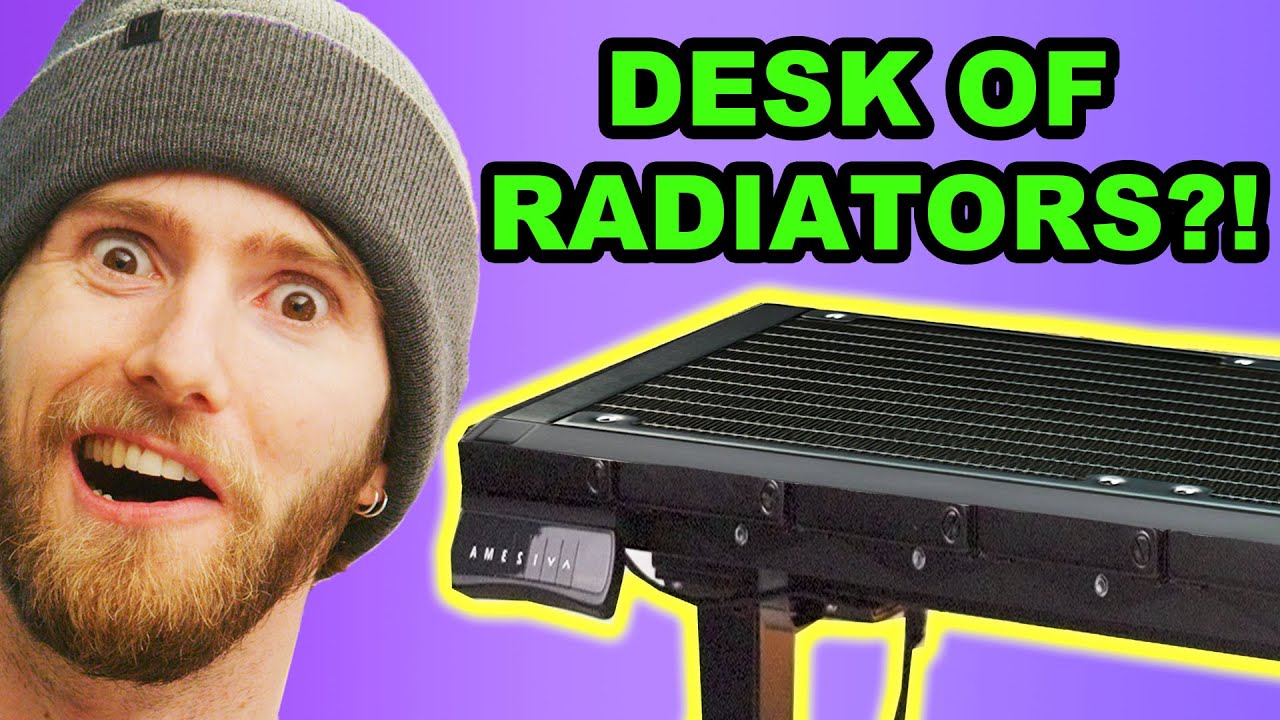
The Desk Made of Radiators can cool ANYTHING
0 up · 0 down · 0 ratings
Description
Normally your desk just holds up a computer... But what if it cooled it too? Discuss on the forum: linustechtips.com
Promos
Check out Protocase: lmg.gg Buy an Alphacool 560mm Radiator: geni.us Buy an Alphacool Eisball RGB Reservoir: geni.us Buy an Intel Core i9-12900KS: geni.us Buy an RTX 3090: geni.us Purchases made through some store links may provide some compensation to Linus Media Group. ► GET MERCH: lttstore.com ► AFFILIATES, SPONSORS & REFERRALS: lmg.gg ► PODCAST GEAR: lmg.gg ► SUPPORT US ON FLOATPLANE: floatplane.com FOLLOW US --------------------------------------------------- Twitter: twitter.com Facebook: @LinusTech Instagram: @linustech TikTok: @linustech Twitch: twitch.tv MUSIC CREDIT --------------------------------------------------- Intro: Laszlo - Supernova Video Link: youtube.com iTunes Download Link: itunes.apple.com Artist Link: soundcloud.com Outro: Approaching Nirvana - Sugar High Video Link: youtube.com Listen on Spotify: spoti.fi Artist Link: youtube.com Intro animation by MBarek Abdelwassaa @mbarek_abdel Monitor And Keyboard by vadimmihalkevich / CC BY 4.0 geni.us Mechanical RGB Keyboard by BigBrotherECE / CC BY 4.0 geni.us Mouse Gamer free Model By Oscar Creativo / CC BY 4.0 geni.us CHAPTERS --------------------------------------------------- 0:00 - Intro 0:27 - The Plan 3:10 - Assembly Begins 5:40 - Plumbing the Loop 8:03 - Desk Modification 9:53 - Filling the Loop 11:37 - Attaching the Rads to the Desk 13:00 - POST? 13:49 - Linus Reaction 18:27 - Jake Reaction 20:20 - Flexispot! 20:48 - Outro
The video presents a bold engineering project: a desk constructed from radiators that not only holds a computer but actively cools it. The hosts begin by outlining eight 560 millimeter radiators and the goal of achieving passive cooling for high end components like an RTX 3090 and an i9-12900KS. They use SolidWorks for initial modeling and commend AlphaCool for providing reliable 3D models to ensure proper fit. The design evolves with simple mounting brackets and laser cut components from Protocase, which are then powder coated for a clean, industrial look. The team also experiments with reservoir mounting, ultimately selecting an ice ball reservoir and attaching it to the desk surface with sound dampening tape to reduce vibrations. The process showcases iterative decisions about how to integrate the radiator array with desk functionality, balancing aesthetics, space, and cooling performance. Overall, the plan emphasizes modularity and practical engineering choices to turn a concept into a working, visually striking workstation. As they move into assembly, the video explains the practical constraints of building such a desk, including choosing a PC configuration that fits the compact desk space. They experiment with PC form factors and power supplies, ultimately using an i9-12900KS with a 1000W SFX-L unit to deliver ample headroom. A key moment is the decision to avoid a glass top to keep the radiator system visually honest and to emphasize the desk as a radiator assembly rather than a table that merely hosts radiators. The installation includes mounting hardware, cable management, and careful alignment of tubing to ensure clean routing. They also address sound considerations by planning to mount certain components with tape and choosing low vibration mounts to keep noise down. Throughout, the builders reflect on CAD planning paying dividends in reduced guesswork during the physical build. The result is a desk that looks purposeful, functions as a true cooling loop, and doubles as a conversation piece about high performance computing design. The video’s middle section focuses on plumbing the cooling loop and routing tubing, where the eight radiators impose significant hydraulic resistance. They opt for soft tubing to simplify routing and avoid the complexity of hard tubing, noting that the choice saves time and reduces the risk of leaks during testing. The team runs a leak test, fills the loop gradually, and calibrates the flow to verify that the pump can push water through the dense radiator array. They also tackle a PC boot challenge, discovering a power supply failure that halts progress briefly but is quickly swapped to restore operation. The temperatures are then monitored with the CPU at around 23 degrees and the GPU around 21 degrees during initial testing, signaling impressive cooling performance for a desk built from radiators. The commentary highlights the potential to run high wattage components with near silent operation once the system stabilizes. In the final build phase, the video demonstrates attaching the radiator chassis to a FlexiSpot desk and balancing structural integrity with ease of assembly. They confront practical issues such as drilling through strong steel and ensuring the desk remains stable while extended, all while juggling the aesthetic of the radiator array. The FlexiSpot sponsor segment adds real world context about standing desks and showcases how off the shelf furniture can be adapted for extreme custom builds, including a note about a limited time sale. Once the desk is assembled, they turn on the cooling system, reveal noisy fans during performance tests, and illustrate how the design can render a practically silent system when fans operate at controlled speeds. The hosts celebrate the project as exceeding their initial expectations, praising the clean cable management, the visual appeal of exposed radiators, and the cooling potential that a fully water cooled desk unlocks for future builds. The closing mood is celebratory, with appreciation for the collaborators and sponsors and an invitation for viewers to share their own radiator desk ideas. The overall takeaway is that a desk made from radiators is a viable, eye catching approach to extreme PC cooling when paired with solid CAD planning, careful mounting, and a modular assembly process. The hosts emphasize that the project was about more than novelty; it demonstrates a high level of engineering practicality, the importance of sound isolation, and the possibility of future refinements. While the concept is pricey and not universally practical, it stands as a proof of concept for enthusiasts who want maximum cooling capacity with a visually striking workstation. The video ends with a positive verdict on the desk’s stability, cooling performance, and the teamwork behind making a seemingly ridiculous idea work in the real world, inviting viewers to imagine similarly ambitious, conversation-sparking builds.
Topics · science and technology · engineering · hardware · DIY · product design · cooling technology · makerspace
Questions answered
- What components were chosen for the radiator desk cooling loop?
- Eight 560 mm radiators were used, with an i9-12900KS CPU and an RTX 3090 considered but ultimately a compact SFX-L power supply and suitable graphics solution were chosen to fit the desk setup.
- Why was soft tubing preferred over hard tubing?
- Soft tubing was preferred to simplify routing, reduce labor, and avoid the extra work and potential leaks associated with hard tubing in a dense radiator loop.
- How was noise managed in the desk cooling system?
- Sound dampening was achieved by mounting some components with double sided tape to reduce vibrations and by using fans that only spin up when CPU temperatures reach high thresholds.