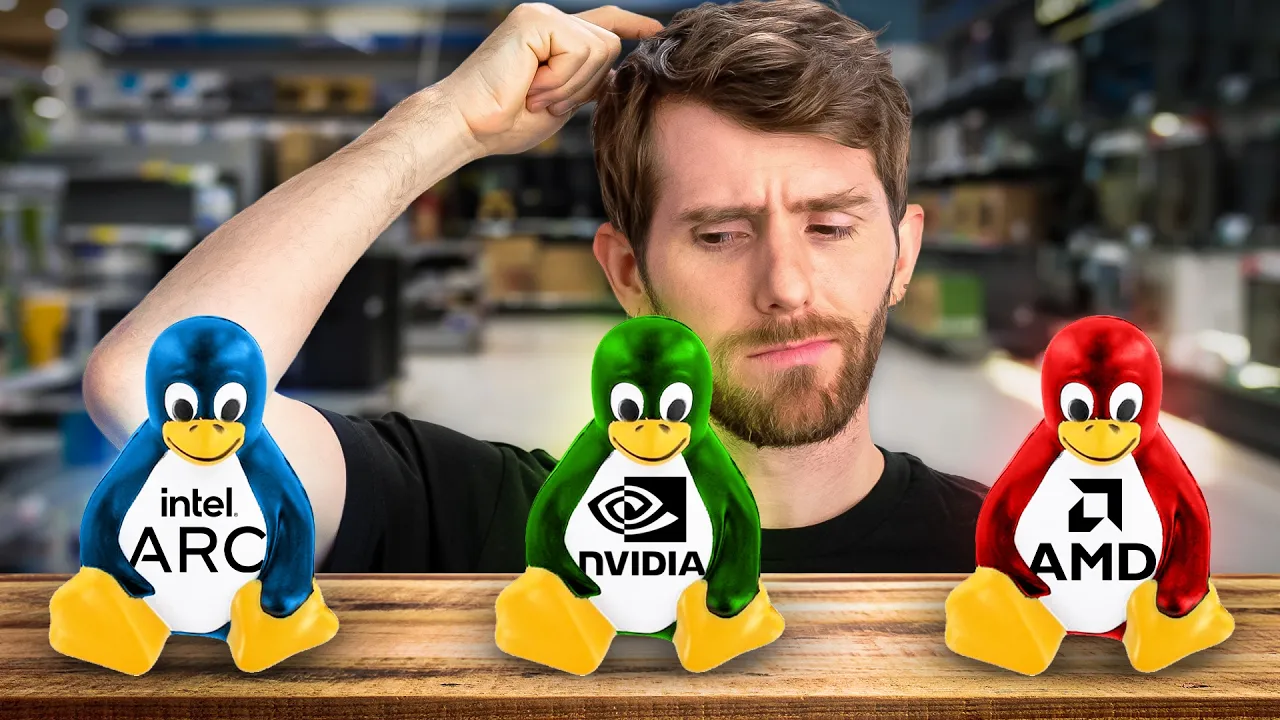
What GPU is the BEST for Linux Gaming?
0 up · 0 down · 0 ratings
Description
Check out PlayTracker for FREE using our link! playtracker.net Do you want to move off Windows 11 but are scared because you don't know if your GPU is good enough for it? WELL WE ARE HERE! We tested Nvidia, AMD, and Intel GPUs with Linux to see if we can accomplish day to day tasks and even some gaming! Discuss on the forum: linustechtips.com
Check out the GPUs from the video! AMD RX 7700XT 12GB: geni.us AMD RX 9070 16GB: geni.us Intel Arc B580 12GB: geni.us NVIDIA RTX 5060Ti 16GB: geni.us NVIDIA RTX 4060Ti 16GB: geni.us
Promos
Check out our Channel Partners: Secretlab - Grab a TITAN Evo ergonomic gaming chair: lmg.gg PIA - Get the VPN of our choice: piavpn.com dbrand - Buy a "Circuit" series skin for your device: dbrand.com ► GET OUR MERCH: lttstore.com ► GET EXCLUSIVE CONTENT ON FLOATPLANE: lmg.gg ► SPONSORS, AFFILIATES, AND PARTNERS: lmg.gg Purchases made through some store links may provide some compensation to Linus Media Group. Affiliate links powered in part by affilimate.com Linus Sebastian is an investor in Framework Computer, Inc and HexOS by Eshtek. CHAPTERS --------------------------------------------------- 0:00 Intro 1:39 Which Cards did we Test 2:25 Driver Issues 3:30 The Install Experience 3:50 The Day to Day 5:15 Which one Games Better 6:10 Intel B580 6:35 Nvidia Results 7:30 AMD Results 8:10 What about other Distros 9:00 Conclusion 10:40 Outro
The video evaluates which GPU is best for Linux gaming by testing Nvidia, AMD, and Intel options across setup, drivers, day-to-day usability, and gaming performance. The host emphasizes that success depends not only on raw FPS but also on how smoothly the system can be installed and used in daily life, including which Linux distro and kernel version work best with each card. Early on, the team recounts the installation challenges many GPUs face under Linux, noting driver availability and distro compatibility as key barriers. They then describe their methodology, selecting five GPUs to cover recent and slightly older hardware, and acknowledge that driver support evolved over time, such as improvements after moving to newer Ubuntu releases. The analysis highlights that, while Linux gaming performance at 1080p and 1440p generally trails Windows, the relative losses vary by manufacturer, with AMD often carrying the strongest gaming performance advantage in their tests, and Intel showing larger declines on average. The conclusion stresses that for most users, Linux on any GPU is viable, and the verdict is less about brand supremacy and more about choosing a distribution, kernel, and drivers that suit the hardware. The video ends by pointing to growth in Linux gaming resources and promotes Play Tracker as a cross-platform gaming analytics tool, framing the Linux transition as a gradual, increasingly accessible path rather than a single definitive upgrade. Overall, the video balances empirical in-game benchmarking with day-to-day usability considerations and ends with practical guidance for viewers considering a move from Windows to Linux for gaming.
Topics · technology · linux · gaming · open_source · hardware · operating_systems · software_drivers
Questions answered
- Which GPU brands were tested for Linux gaming in this video?
- NVIDIA, AMD, and Intel GPUs were tested.
- What was highlighted as a major barrier to Linux gaming at the start of the tests?
- Driver support and distro compatibility were the initial major barriers.
- What was the overall conclusion about Linux gaming across GPUs?
- Linux gaming is viable on any GPU, with AMD often providing the strongest gaming performance in the tested scenarios, and the choice largely depending on distro and driver setup rather than brand alone.