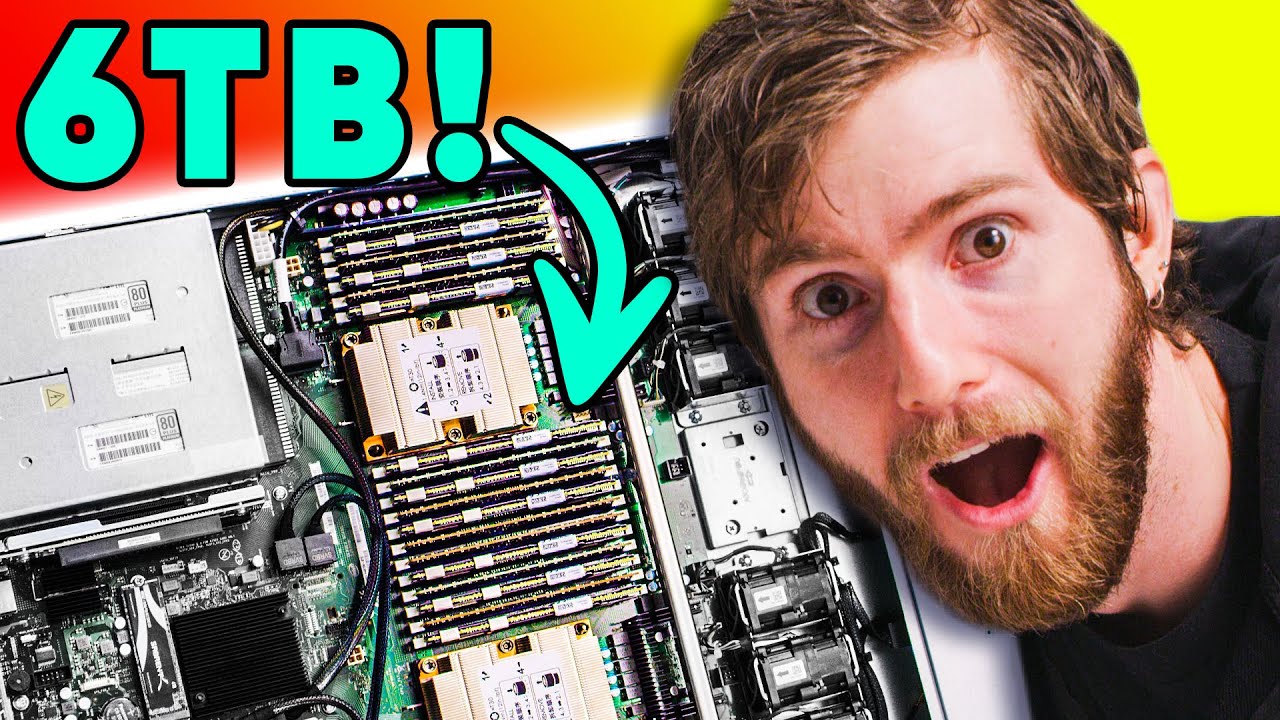
I've never seen anything like this... - 6TB of RAM in one PC!
0 up · 0 down · 0 ratings
Description
Thanks to Pulseway for sponsoring this video! Remotely monitor and manage your PC with Pulseway, for free today at lmg.gg There's 6TB of ram in this server,
Promos
check out what we do with it! Buy Samsung M386ABG40M5B 256GB Memory Module On Newegg (PAID LINK): geni.us Purchases made through some store links may provide some compensation to Linus Media Group. Discuss on the forum: linustechtips.com ►GET MERCH: lttstore.com ►SUPPORT US ON FLOATPLANE: floatplane.com ►LTX EXPO: ltxexpo.com AFFILIATES & REFERRALS --------------------------------------------------- ►Affiliates, Sponsors & Referrals: lmg.gg ►Private Internet Access VPN: lmg.gg ►Our Official Charging Partner Anker: lmg.gg ►MK Keyboards: lmg.gg ►Nerd or Die Stream Overlays: lmg.gg ►NEEDforSEAT Gaming Chairs: lmg.gg ►Displate Metal Prints: lmg.gg ►Official Game Store: nexus.gg ►Epic Games Store (LINUSMEDIAGROUP): lmg.gg ►Amazon Prime: lmg.gg ►Audible Free Trial: lmg.gg ►Streamlabs Prime: geni.us ►Our Gear on Amazon: geni.us FOLLOW US ELSEWHERE --------------------------------------------------- Twitter: twitter.com Facebook: @LinusTech Instagram: @linustech Twitch: twitch.tv FOLLOW OUR OTHER CHANNELS --------------------------------------------------- Techquickie: lmg.gg TechLinked: lmg.gg ShortCircuit: lmg.gg LMG Clips: lmg.gg Channel Super Fun: lmg.gg Carpool Critics: lmg.gg MUSIC CREDIT --------------------------------------------------- Title: Laszlo - Supernova Video Link: youtube.com iTunes Download Link: itunes.apple.com Artist Link: soundcloud.com Outro Screen Music Credit: Approaching Nirvana - Sugar High youtube.com Monitor And Keyboard by vadimmihalkevich / CC BY 4.0 geni.us Mechanical RGB Keyboard by BigBrotherECE / CC BY 4.0 geni.us Mouse Gamer free Model By Oscar Creativo / CC BY 4.0 geni.us
The video opens with a reveal of a server inside a compact 1U chassis, boasting an astonishing memory footprint that blends traditional DRAM with Intel Optane data center memory modules. The host identifies a 512 gigabyte DIMM and quickly walks through how the system could reach up to six terabytes of memory by combining standard DRAM modules with Optane-based persistent memory. He explains that the setup enables workloads with unprecedented complexity by reducing reliance on bulk storage swapping. A key concept introduced is the distinction between memory mode, where Optane acts as very high capacity memory, and app direct mode, where Optane presents persistent storage-like capabilities directly to the CPU. Throughout the segment, the host emphasizes the scale of this platform, the potential performance implications, and the architectural choices that make such a configuration feasible, setting the stage for deeper exploration later in the video. As the unboxing continues, the host examines the server’s I/O and expansion options, noting the unusual backplane and the presence of PCIe 24x slots adapted to 16x, plus a mezzanine and multiple network ports designed for remote management. He inspects the storage configuration, discovering two high-end Intel DCPMM NVMe SSDs that turn out to be higher capacity yet lower performance 4610 variants, which are SATA-based rather than NVMe in this unit. The curiosity about the hardware extends to the CPU(s), with speculation about Cascade Lake or Apache Pass DIMMs and the possibility of dual CPUs, highlighting the era of the hardware and the anticipated performance envelope. The host teases how the system can be configured in different modes, and previews the multi-tier storage strategy that combines SRAM cache, DRAM, Optane, NVMe SSDs, and SATA SSDs to optimize data access patterns for compute workloads. The segment ends with a plan to boot the machine and document BIOS-level considerations before putting the system through more formal testing. In the 10 to 15 minute window, the BIOS and memory configuration take center stage as the host confirms a total of 384 gigabytes of DRAM and six terabytes of Intel Optane persistent memory, with the system recognizing the Optane modules in a special memory-like role. He references Lenovo and Intel guidance on DRAM-to-persistent memory ratios for different workloads, such as Redis IMDB, legacy databases, and cache-sensitive applications, illustrating how tuning can dramatically affect performance. The host reflects on the cognitive leap required to grasp this hybrid memory architecture, comparing it to earlier RAM-capacity curiosities and marveling at the idea of distinct chip types sharing a single DIMM slot. A boot discussion follows, noting that the device is configured to boot over network rather than from a local drive, underscoring its role as a compute node rather than a traditional desktop PC. The narrative then shifts toward how the system integrates into real workloads and what benchmarks might reveal about its capabilities, while acknowledging the challenge of meaningful performance metrics for such a novel platform. The final section explores practical implications, including Windows 10 support for memory-heavy tasks and the concept of four to five storage tiers inside the machine: SRAM as CPU cache, DRAM, Optane, NVMe, and SATA SSDs, all orchestrated to keep data closest to the CPU for peak throughput. The host demonstrates real-world considerations like power, acoustics, and thermal behavior, noting that the chassis is surprisingly quiet for a high-density server. He elaborates on how Optane in this configuration can function as an extended system memory or as a hyper-fast storage tier, depending on the chosen mode, and discusses endurance and pricing realities that frame the total cost of ownership. The video closes with a teaser for a follow-up that will put the system through benchmarks and practical tests, and a sponsor plug for Pulseway, which enables remote monitoring and management of servers and workstations across Windows, Mac, and Linux platforms. The host invites viewers to explore Pulseway for free and teases related content from upcoming server projects, reinforcing the channel’s broader focus on cutting-edge hardware and enterprise-scale IT.
Topics · technology · computing · servers · data_center · storage · memory · optane_memory · hardware_reviews
Questions answered
- What makes the 6 TB RAM server unique in terms of memory technology?
- It blends 384 GB of DRAM with six terabytes of Intel Optane persistent memory, enabling modes like app direct and memory mode that either treat Optane as fast storage or as an expanded memory pool.
- What are the two main memory configuration modes discussed for Optane in this setup?
- App direct mode uses Optane as persistent storage accessible like memory, while memory mode makes Optane act as a very large memory pool with DRAM caching behavior.
- Why is the system configured to boot over network instead of from a local drive?
- The device is designed as a compute node with multi-tier storage; network boot aligns with its data-center oriented workflow and backplane architecture.
- What workloads or applications could benefit most from this architecture?
- workloads that require extremely large-memory footprints or fast in-memory databases, such as Redis or memory-resident analytics, and scenarios needing very fast storage access for data-intensive tasks.