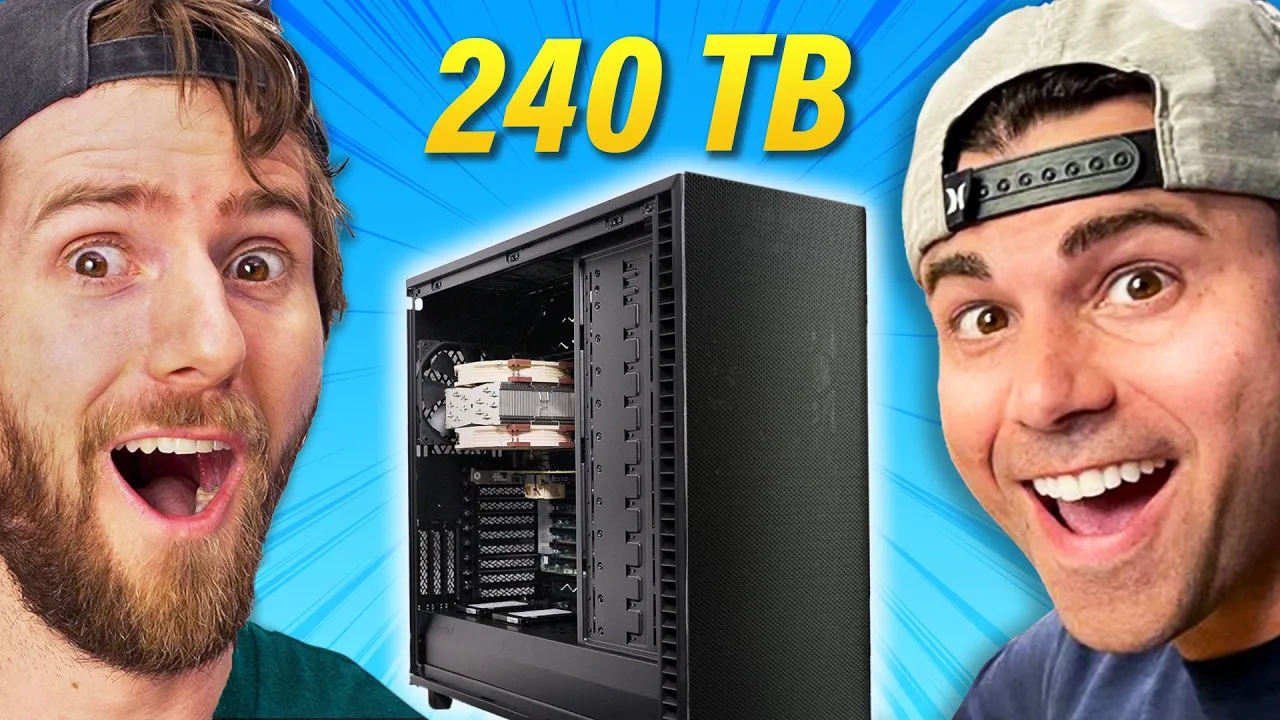
Mark Rober! I Built You a Computer! - Double NAS Build
0 up · 0 down · 0 ratings
Promos
Purchase Cablemods 12 Volt HPWR Basic cables at: store.cablemod.com amazon.com Mark Rober's team needed to fix their growing storage problem and they knew exactly who to call. Today we build two 240TB NAS' for Mark, and demo them remotely syncing across the globe! Discuss on the forum: linustechtips.com Buy a Ubiquiti UniFi EnterpriseXG 24 10 Gig Network Switch: store.ui.com Buy a Seagate Exos 20TB HDD: geni.us Buy an AMD EPYC 7302P CPU: geni.us Buy an AMD EPYC 7302P CPU on eBay: ebay.us Buy an ASrock Rack ROMED8-2T/BCM Motherboard: geni.us Buy a Supermicro Motherboard on eBay: ebay.us Buy Micron 3200MT/s CL22 DDR4 32GB RAM: geni.us Buy a Sabrent 1TB NVMe M.2 SSD: geni.us Buy a Noctua NH-U14S TR4-SP3 CPU Cooler: geni.us Buy a Fractal Design Define 7 XL E-ATX Computer Case: geni.us Buy a Seasonic PRIME Platinum 1300W PSU: geni.us Buy a Micron 5400 PRO SSD: geni.us Purchases made through some store links may provide some compensation to Linus Media Group. ► GET MERCH: lttstore.com ► LTX 2023 TICKETS AVAILABLE NOW: lmg.gg ► GET EXCLUSIVE CONTENT ON FLOATPLANE: lmg.gg ► SPONSORS, AFFILIATES, AND PARTNERS: lmg.gg ► EQUIPMENT WE USE TO FILM LTT: lmg.gg ► OUR WAN PODCAST GEAR: lmg.gg FOLLOW US --------------------------------------------------- Twitter: twitter.com Facebook: @LinusTech Instagram: @linustech TikTok: @linustech Twitch: twitch.tv MUSIC CREDIT --------------------------------------------------- Intro: Laszlo - Supernova Video Link: youtube.com iTunes Download Link: itunes.apple.com Artist Link: soundcloud.com Outro: Approaching Nirvana - Sugar High Video Link: youtube.com Listen on Spotify: spoti.fi Artist Link: youtube.com Intro animation by MBarek Abdelwassaa @mbarek_abdel Monitor And Keyboard by vadimmihalkevich / CC BY 4.0 geni.us Mechanical RGB Keyboard by BigBrotherECE / CC BY 4.0 geni.us Mouse Gamer free Model By Oscar Creativo / CC BY 4.0 geni.us CHAPTERS --------------------------------------------------- 0:00 Intro
The video opens with Linus introducing Mark Rober and immediately framing the project as solving a real storage problem at scale. He describes Mark’s team dealing with towers of external drives, no robust backups, and a workflow that relies on Dropbox for raw footage access. The plan is to build two identical high-capacity NAS boxes, with a focus on practical, cost-conscious design and easy remote synchronization between sites. The host promises a solution that requires minimal networking tweaks, no port forwarding, and secure remote mirroring so Mark can access his data from anywhere. The setup centers on a TrueNAS Scale system using an AMD Epic 7302P platform to maximize PCIe lanes, ECC RAM, and overall reliability for long-term video editing workloads. The segment emphasizes balancing performance with sensible budgeting, preferring a dependable enterprise stack that remains upgradeable and future-proof. The intro closes by outlining the broader narrative: two NAS instances, remote syncing, and a demonstration of offsite backup that will impress Mark and illustrate true peace of mind. The next portion dives into hardware selection, explaining why the Epic 7302P was chosen over a Ryzen-based alternative. The team notes that an Epic chip provides ample cores, PCIe bandwidth, and robust ECC memory support, making it a strong fit for a drive-heavy workload. They reveal price observations from the used and refurbished market, showing that even a Naples to Milan era CPU can be affordable if bought on the used market. The discussion then shifts to the motherboard choice, highlighting ASRock Rack Rome D8-2T for its extensive IO, dual 10G networking, and a large number of PCIe lanes, which is critical for future expansion. RAM decisions follow, with four 32 GB registered ECC modules chosen to balance cost against the ARC cache needs of TrueNAS Scale. The reasoning includes a practical trade-off: the system uses TrueNAS Scale with ZFS, which benefits from a healthy ARC size to cache frequently accessed data. A substantial portion is devoted to cooling and power considerations, with a Noctua U14S TR4-SP3 CPU cooler and a Seasonic Prime Platinum 1300W PSU chosen to provide reliability and enough headroom for a dense drive array. They discuss the rationale for not using a high-end AIO cooler, citing long-term reliability and noise concerns given Mark’s home and office environments. The air-flow plan emphasizes front intake and a layout that keeps drive vibrations and acoustic noise to a minimum by employing silicone grommets on drive trays to dampen vibrations. The chassis choice is a Fractal Define 7 XL, adapted to hold 12 drives via a storage-focused front plate, and the host walks through the drive mounting process including anti-vibration considerations and ensuring all screws are snug for long-term stability. The video then covers storage topology, including an HBA to expand SATA ports and four mini SAS HD connections from the motherboard, allowing eight of the twelve drives to be connected without adapters. The team explains their boot drive strategy, selecting Micron 5400 Pro SATA SSDs for their durability and performance as boot devices, while noting that TrueNAS primarily writes to data drives, making boot speed less critical. A RAID configuration discussion follows, with TrueNAS automatically proposing a RAID-Z2 arrangement across six drives with two parity drives, yielding about 150 TB usable space while preserving data protection. They further plan to add a one terabyte NVMe for level two ARC caching, which can boost read performance by caching mid-frequency data without overly taxing RAM. The setup process includes final configuration steps such as enabling email alerts for drive failures, creating datasets and user accounts, and configuring remote access tooling like Tailscale for offsite synchronization. The team reveals that only one NAS was built on camera; the second unit has been prepared previously, allowing a live remote demonstration from Vancouver to Mark’s location in Los Angeles. The plan is to demonstrate automated offsite backups across thousands of miles, showcasing the reliability and speed of scheduled transfers once the initial copy completes. The closing act has Mark virtually confirming the NAS experience as a game changer, with the two NASes delivering a secure, scalable, and sleep-easy solution. The video ends by reiterating the peace of mind that comes with proper offsite backups and a reminder about sponsorships and additional content, while teasing future optimization and potential future expansions. In sum, the video blends deep hardware tinkering with pragmatic system design, illustrating how a carefully chosen Epic-based NAS stack can deliver robust, scalable, and maintainable storage for a high-profile creator. The narrative underscores the balance between cost efficiency and reliability, showing that strategic reuse of existing hardware on the used market can unlock enterprise-grade performance. The result is a concrete, auditable solution that promises offsite security, easy remote access, and a practical upgrade path for Mark Rober’s production needs. The on-camera process is supplemented by off-camera planning, remote collaboration, and a test demonstration that confirms the system’s ability to sync securely over long distances, providing the intended peace of mind for Mark and his team.
Topics · technology · hardware · diy_build · nas_storage · data_center · video_production
Questions answered
- What was the primary storage problem Mark Rober faced?
- He had towers of external hard drives with no robust backup, and a workflow reliant on Dropbox for raw footage access.
- Why was the AMD Epic 7302P platform chosen?
- Because it provides abundant PCIe lanes, registered ECC memory, and strong performance for drive-heavy workloads at a reasonable cost on the used market.
- How many NAS units were actually built on camera?
- Only one NAS was built on camera; a second unit had already been prepared off-camera for the remote demo.
- What is level two ARC and why is it used?
- Level two ARC is a second-tier read cache using a 1 TB NVMe SSD to further accelerate frequently accessed data without overusing RAM.
- How does the project ensure data protection?
- By configuring a RAID-Z2 pool across six drives with two parity drives, plus an offsite backup and snapshotting to recover from ransomware or other disasters.
- What remote-access solution is used for syncing?
- Tailscale is used to enable secure remote access for the offsite synchronization between locations.
- What is the purpose of the HBA in the build?
- The HBA increases the number of SATA ports by using mini SAS HD to four SATA connectors, enabling more drives in the system.