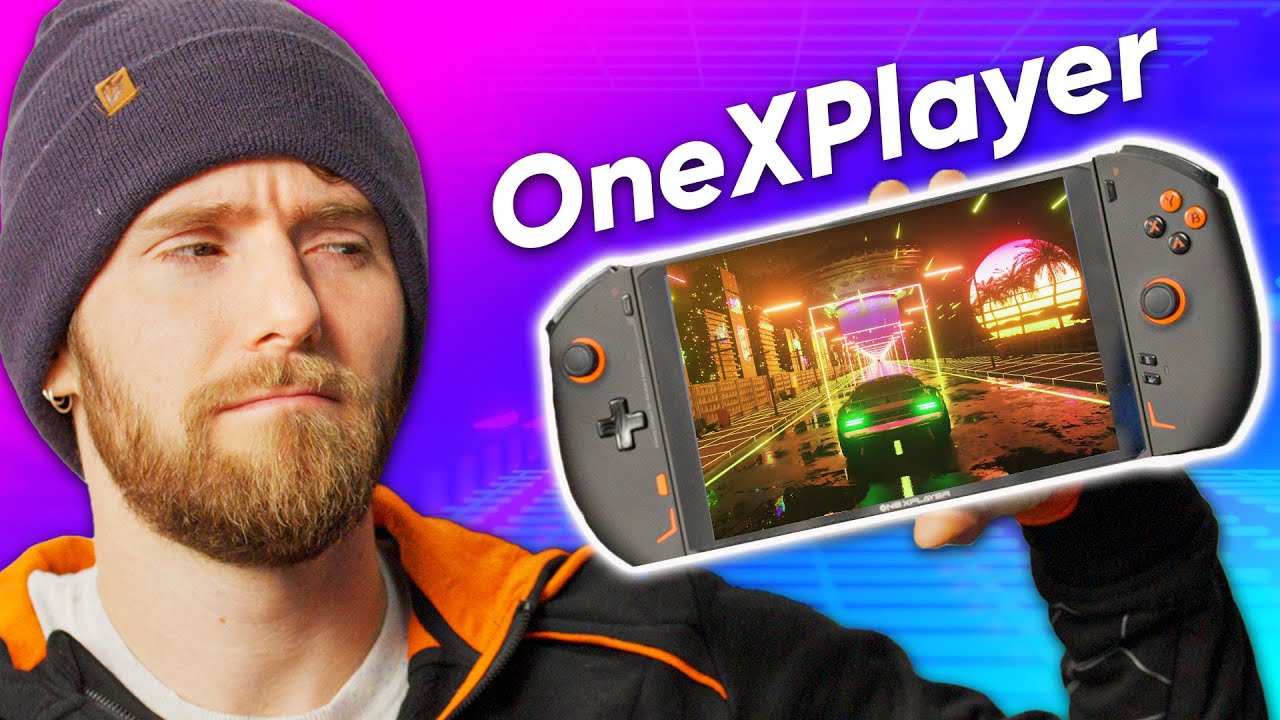
I think I found some problems… - OneXPlayer OXP2
0 up · 0 down · 0 ratings
Description
Thanks to Secret Lab for sponsoring today's video! Check them out at lmg.gg Tired of your Nintendo Switch? Want something more powerful than the Steam Deck? Maybe the OneXPlayer OXP2 is the device for you! Linus is here to check it out to see if this is the perfect mix of existing consoles or if the OXP2 can't deliver on any of its lofty goals.
Promos
Check out the OneXPlayer 2: lmg.gg Purchases made through some store links may provide some compensation to Linus Media Group. Want us to unbox something? Make a suggestion at lmg.gg ► SUBSCRIBE ON FLOATPLANE: floatplane.com ► GET MERCH: lttstore.com ► AFFILIATES, SPONSORS & REFERRALS: lmg.gg ► PODCAST GEAR: lmg.gg ► SUPPORT US ON FLOATPLANE: floatplane.com FOLLOW US ELSEWHERE --------------------------------------------------- Twitter: twitter.com Instagram: @shortcircuityt TikTok: @linustech Facebook: @ShortCircuitYT CHAPTERS --------------------------------------------------- 0:00 This thing is big and very unique 0:22 The controllers 1:00 Main unit specs, size, and ports 3:30 Display, the kickstand, and game streaming, 5:26 Sponsor - Secret Lab 5:52 Cyberpunk 2077 - Speaker, joystick, and Turbo mode impressions 9:21 Spider-Man Remaster - Frame rates 10:22 Miscellaneous features and pricing 11:31 Outro
The video opens with an immediate sense of scale and novelty, presenting the OneXPlayer OXP2 as a device that dwarfs typical handhelds while offering a modular design, highlighted by detachable controllers. The host breaks down the hardware in detail, noting the configuration options including Ryzen 6800U and a Radeon 6800M GPU, which positions the device as a high performance alternative to existing handhelds like the Steam Deck. He emphasizes the build characteristics such as the thick chassis, 65Wh battery, and the 2560x1600 display, explaining how the high pixel density helps mitigate non native resolution scaling and preserve visual clarity even when games run at lower internal resolutions. The review also covers practical features like USB-C ports, microSD expansion, and a turbo button reminiscent of older high performance devices, while forecasting real world implications for battery life, heat, and portability. Depth is added by discussing the kickstand, wireless controller compatibility, and streaming capabilities, which broaden the OXP2’s appeal beyond native PC gaming to cloud or local streaming, depending on user preferences. By the midway point, the host pivots to live gameplay impressions, using Cyberpunk 2077 and Spider-Man Remastered as test cases to gauge input latency, frame rates, and the impact of turbo mode on performance. He points out that while 720p at high frame rates is attainable, the experience is ultimately bounded by the device’s 60 Hz panel and calibration, leaving room for improvement in a final production version. The segment concludes with a candid note on speaker quality, heat, and price, underscoring that the OXP2 stacks up well against Steam Deck in certain scenarios but comes with tradeoffs in audio, weight, and value for money, depending on what the user prioritizes in a handheld PC. The second section delves into more granular testing results, focusing on the Hall effect joysticks and the importance of minimizing dead zones for precision gaming. The host experiments with 1280x800 and 1920x1200 targets, reveals that default dead zones can hamper accuracy, and demonstrates how enabling turbo mode can boost average and 1% low frame rates, making otherwise challenging moments playable. He stresses that the perceived benefit of Hall effect sensors hinges on achieving tight, minimal dead zones, and he notes that the prototype has some wobble in the controller rails that may be improved in final production. Throughout, the commentary balances enthusiasm for the OXP2’s performance with a nuanced acknowledgment of its current limitations, including the need for better factory calibration of color, display tuning, and speaker quality. The host also discusses the device’s streaming potential, showing how the kickstand enables flexible setups and portable gaming while leveraging wired or wireless controllers, and he compares the experience to streaming options like Steam Link for battery-friendly play on the go. The segment wraps with practical takeaways on pricing, noting a baseline around 989 USD and a top tier near 1400 USD, which frames the device as a premium option that appeals to enthusiasts who want raw power in mobile form and are comfortable with some imperfections during a prototype phase. The closing remarks summarize the OXP2 as a strong, battery-rich handheld PC that can deliver 60 Hz mass market performance with caveats around audio, cooling, and dead zone tuning, while acknowledging the broader market context in which it competes with established devices like the Steam Deck and other handhelds. Overall, the video provides a thorough hardware overview, real-world performance testing, and practical workflow insights for potential buyers, emphasizing both the potential and the current limitations of the OneXPlayer OXP2, with a balanced verdict on who would benefit most from this device and under what conditions it shines or falls short.
Topics · technology · hardware reviews · portable gaming · gaming devices · consumer electronics · computer hardware
Questions answered
- What are the key hardware highlights of the OneXPlayer OXP2?
- The OXP2 uses an AMD Ryzen 6800U CPU and Radeon 6800M GPU, with a 65Wh battery, 2560x1600 display, USB-C and USB 4 ports, microSD expansion, and a turbo mode feature.
- How does the display impact gaming on non native resolutions?
- The high pixel density helps mitigate the visual impact of non native resolutions, reducing the noticeable interpolation even when set to lower internal resolutions.
- What is the main issue discussed regarding controls?
- The main issue is the dead zones on the Hall effect joysticks; if the dead zones are too large, precision suffers and the benefits of Hall effect sensors are diminished.