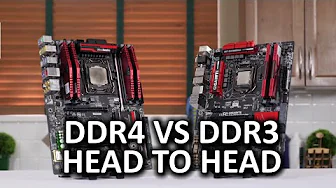
DDR4 vs DDR3 - Apples to Apples Comparison
0 up · 0 down · 0 ratings
Promos
DDR4 is a pretty hot discussion topic right now, and we became curious... can you expect to see a tangible performance benefit from running DDR4 compared to DDR3, keeping all other variables as close to the same as possible? Sponsor link: linustechtips.com Pricing & discussion: linustechtips.com Support us: linustechtips.com Join our community forum: bit.ly twitter.com @LinusTech Intro Screen Music Credit: Adhesive Wombat -
Channels and socials
Check out his channel here: youtube.com Outro Screen Music Credit: Approaching Nirvana - Sugar High youtube.com
The video opens by framing an apples-to-apples comparison between DDR4 and DDR3 memory, addressing the core question of whether upgrading to DDR4 yields tangible performance benefits when other system variables are held constant. The host explains that while DDR4 is faster and more power efficient, its higher cost at the time of filming drives the need for a fair assessment. To achieve fairness, two Haswell-based CPUs are chosen, the Core i7-4790K and the Core i7-5820K, with cores disabled and both CPUs clocked to 4.4 GHz to neutralize raw clock advantages. The memory configurations are clearly defined: DDR3 at up to 2133 MHz in a 16 GB dual-channel kit, and DDR4 at up to 2400 MHz in a 16 GB quad-channel kit, provided by ADATA. The test platforms use matching motherboards with similar feature sets to minimize other variables, including SATA Express, M.2, and onboard audio, with attention paid to ensure stable, fair benchmarking across both memory technologies. The host also notes the practical reality that consumer boards and CPUs do not support both DDR3 and DDR4 simultaneously, reinforcing the apples-to-apples constraint. Throughout the setup, the video acknowledges the costs, platform support, and future-proofing considerations that come with choosing DDR4 versus DDR3, setting the stage for a series of controlled benchmarks. The segment concludes with an overview of the benchmarking plan, including synthetic benchmarks, real-world tasks like multi-threaded rendering and compression, and gaming scenarios to evaluate how memory bandwidth and latency translate into noticeable performance differences across typical workloads.
Topics · hardware · computing · memory technology · performance benchmarking · gaming hardware